Sunday, June 1, 2008

Theories of Breeding

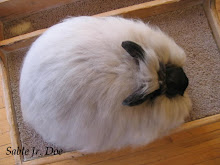
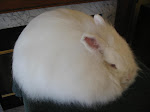
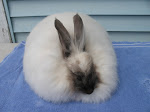
Tonight I am running another old article from my previous blog. Hopefully no one is profoundly disgusted by the fact that I am doing this (LOL!), but I have some great info. sitting here in my files and I would like to get it into the archives here ASAP so that it is accessible from this blog as well. I am extremely busy at work right now with end-of-year meetings, reports, and testing, etc. but once the 16th rolls around it will all be over and I will be back to gabbing and raising bunnies full time:). I took lots of pictures of babies this weekend and have pretty much decided who I am going to keep out of the oldest litters, but I will post those pictures in the next entry so as not to bore you out of your skull with another monotonous slew of baby photos (it seems like I have been gawking at these cutiepies too much lately:-). I am going to post 2 pictures of Oomi however, because she was absolutely beautiful before I clipped her yesterday. Just to brag for a minute, this rabbit has great wool but an even better body underneath it---one of the best bodies I have ever bred here in fact, LOL:). I bred her to Pierre yesterday for a first litter, and I am hoping that she can pass that type on to her babies.

More next time!


Theories of Breeding:

I have been doing alot of reading lately about various breeding systems, and not surprisingly there seems to be more than one idea on how to improve the quality of a rabbit line over time:).

Okay, LINEBREEDING is a system of breeding where rabbits are repeatedly bred back to other family members (uncle to niece, daughter to grandfather, granddaughter to grandfather, etc. etc. and so on down the line). The advantage to this type of breeding is that you are (assumably)concentrating superior genes and minimizing variation in a gene pool to make the breeding results more uniform and predictable. The disadvantage of this method is that when you practice it for a long period of time the overall vigor of your herd tends to decline as the animals become more homozygous, so that it becomes important to either: keep a very large herd in order to substantially widen your gene pool, or periodically introduce unrelated stock to invigorate and extend the life of your line. Linebreeding is critical to the success of any serious breeder, and the only real way to produce consistent, high-quality stock.
INBREEDING is the mating of brother to sister in order to force recessive genes to express themselves OR increase the homozygosity of a herd to the point where the GOOD qualities are so firmly set that there is an excellent chance that the traits will be passed down, even when the rabbit is bred to an inferior quality animal later and again to it's own offspring. Inbreeding is a tool to use when you have linebred for a long period of time and want to set your good traits as firmly as possible. It is also good to do when you have been diligently culling out recessives over time and want to see what remains to weed out. It's sort of the culmination of a good breeding program, in a way:).

Now, there also seem to be opposing theories as to how to go about improving the specific qualities of your line. Once school of thought says that you need to breed together animals who are virtual 'opposites', for ex. a rabbit with wide shoulders and a narrow HQ to a rabbit with narrow shoulders and a full HQ, to improve the offspring. The other theory says that you should breed only good quality to good quality, otherwise the pedigree will carry a greater variety of faults that the offspring will be much more likely to pass on, and the litters will be a grab bag of mixed results. This theory says, 'you cannot create or improve a trait that doesn't already exist in a rabbit'---you cannot breed out a quality that isn't present to begin with. To use an example, if your rabbits lack density in their coats, all the linebreeding in the world is not going to improve the problem if none of your rabbits carry genes for thick wool to begin with. Density is a quality that must be brought in from outside and purposefully injected into the line. IF you breed rabbits who have compatible but opposite traits according to the second theory (overly soft wool to overly coarse wool, etc.), you are not going to produce a rabbit with perfect medium texture, you will simply produce rabbits with large numbers of either one or the other. According to this philosophy you cannot blend an apple and orange and get a combination of the two because genes do not blend as a rule. It is the same concept with rabbits. If you want to start a quality line, you should first go around and collect various rabbits that express the traits you want in your line, and then practice intensive linebreeding to isolate and reinforce those desired traits, making the herd homozygous enough over time that all the same traits appear on all the same rabbits. It is a long and arduous task according to long term breeders, but well worth the effort when you are turning out the kind of stock that you originally pictured to begin with.

Well, so that's a little info. on general systems of rabbit breeding. Linebreeding systems are truly fascinating when you sit down and study them---they make it possible to get results that 20 years of haphazard breeding could never produce, and separate the men from the boys in terms of high quality breeding stock:).

Sunday, May 25, 2008

Quick Holiday Post:)

There's a ton of stuff going on this weekend (in the barn and the garden---especially the garden) so I am going to have to make this entry short. Once school ends in 3 weeks I will try to get back to posting more often, but for now the spring workload must take precedence:-):-).

I went to a show in Harford, PA this Saturday but it didn't go well at all, so I have decided to definitively call it quits this season and breed the does who were going to enter one more show next week. Bunny numbers have been quite low this season so it has been next to impossible to keep a show and separate breeding string going. It makes more sense at this point to simply say the heck with it and get the next wave of does bred for the Fall, LOL.

I do have a few fun pictures to share that were taken this past week:). Sadako's babies (aged 5 months now) both got their first haircuts, and I posted a few before and after pictures, which always shock those who do not raise angoras because they never realize how skinny these rabbits really are without all the wool:). The first shot is of a little white buck that I am contemplating keeping (A 'Before' picture with his messy sprayed coat and an 'After' pic in which he is much, much cleaner:)). The second is of Kitka, whom I have fairly well decided to keep pending the quality of her first Sr. coat, which seems like it should work out okay:


Here is the
BUCK:


And this is the
DOE:


More stuff again next week once I get ahold of more baby pictures (both young and old litters), and a few other things printed up about wool and other subjects:). I hope everyone out there is enjoying their holiday weekend and getting a whole lot of work done (or not!) HAPPY SPRING/and SUMMER:-)

Saturday, May 17, 2008

Wool Facts

I am currently in the process of revamping my website, and while flipping through old blog entries last night looking for stuff to add, I came across this article on Wool Facts from the 'Rabbit Production' book that I had posted several years ago and thought I would post again FYI. Enjoy!


I was just flipping the 'Rabbit Production' book today and found some interesting facts on Wool growth, Molting, and adjusting feed to manipulate holding time. This is a wonderful book that encompasses ALL aspects of rabbit raising, and I learn something new every time I read it:). Here are a few notes on angoras:

-"Females produce about 20% more wool than males"--p.441

-"Angoras reach their peak of wool production between 18 and 36 months of age. After three years of age, wool production and reproduction abilities begin a rapid decline."--p.441

-"There is an apparent antagonism between the amount of wool produced and reproductive performance"--P.441

-"Genetic selection is very important in the improvement of wool density and texture. Wool production and quality are highly heritable traits."--p.441

-"The rabbit's coat is prime when the hairs have a good sheen, are tight, and have attained their maximum length. The skin is white and the hair flows back into place evenly when the coat is rubbed from the rump to the shoulders".--p.105

-"Unprimeness is indicated by a dull, uneven coat and loose hair. The hair does not flow evenly when the coat is rubbed from the rump to the shoulders. Patches of new fibers can be seen, and these new fibers will appear in a growth pattern that varies from animal to animal. The skin of these new hair growth areas is dark and easily detected on rabbits with colored coats."--p.105

-"Heavy feeding of the young tends to cause the molt at an earlier age----Rabbits may be thrown into molt by disease, going "off feed", the sudden occurrence of unseasonable high temperatures, or other stresses."--p.106

-"Shedding first occurs on the sides of the rump and the thighs, followed by the back, then increasingly in areas down over the sides."--p.106

-"A high quality diet and high feed intake promote molting. The growth rate of hair is more rapid with a high nutrient intake, so the rate of turnover of hair is greater."--p.106

-"Restricted feeding of adult show animals reduces the amount of hair shedding and keeps the fur in prime condition for a longer period."--p.106


These facts seem to demonstrate what so many good conditioners of rabbits already know----that you cannot feed the same rabbit in exactly the same way year round regardless of climate or coat condition. A meticulous meat breeder that I know begins adding a top dressing to his rabbits' pellet ration as soon as a molt is over. He continues feeding this mix until just before the rabbits hit prime, and then he pulls them off it and gives them nothing but pellets and a pinch of horse sweet feed while they finish building and prime out completely. The withdrawal of grain mix at this point ensures that the growing cycle slows down and the rabbit holds prime condition longer, and the addition of sweet feed (only) makes the rabbits thirstier and improves flesh condition by increasing fluid intake.

Once a molt begins this breeder feeds his rabbits black oil sunflower seed to push them through it faster. He then begins the process all over again once molting is finished and the new coats begin. This same formula could also work with angoras, though the sunflower seed may not be necessary because we clip our rabbits and get rid of the excess wool that way. Pellet rations also need to be increased in the winter, restricted in summer, increased when the coat is coming in, and decreased when the coat peaks and begins to go out (or increased again as the coat slips in order to get through the molt faster).

These are just a few fascinating facts about wool and conditioning. Check them out this season and see how they work!


P.S. I also have some new pictures to post today after alot of grooming and clipping got done, and there are also 4 new litters to report from the previous week:). Nereida/Pierre produced a litter of 8 kits---2 Black, 1 Fawn, and 5 REW, and Devaki/Dijon also produced a litter of 8 (with 1 stillborn) including 1 Black, 1 Chestnut, 3 Tort, 1 Fawn, and 1 REW. Neva and Sadako both had litters as well but there were very, very small, LOL! Neva gave birth to 1 Pearl and 1 Tort, and Sadako had 2 Pearls and 1 REW (as far as I can tell so far). I fostered Neva's babies to Sadako and rebred her again today to see if I could get a few more babies out of her before she retires from breeding, and I also bred Echo to Pierre once again in the hopes of getting some more Sables. Tomorrow I will breed Pascha to Pierre also for an additional litter in June.


Here are some pictures of Oomi that I took this afternoon after grooming. The wind was blowing her coat all over the place except for one picture where it looked neat (LOL), and it looks as though she will make probably it to the Harford, PA show and maybe even Frankfort if she stays on feed and isn't slipping too horribly:(.


And this, below, is a picture of Juno who just weaned a litter 2 weeks ago (!!) and is already ready to go back to the showtable:-):-). She is not in full coat at the moment but it looks as though she will definitely be able to enter PA this weekend and Frankfort on June 6, after which I will shear and breed her again for another great litter (I hope:)).


More again next week as I make sure to remember my camera next time to report on the Harford show, haha. Best of luck with the buns!

Sunday, May 11, 2008

Babies and the North Haven, CT show

This was an extremely busy week that just ended with separating the oldest litters out into separate cages today and slipping nestboxes in with 4 does that are due next Wednesday. Breeding season is clearly in full swing, but it is peppered with shows and all sorts of other activities in between, making life a little more hectic than usual:). Last Thursday I did an Angora presentation for the local spinning guild which was alot of fun, and then on Saturday I went to the North Haven, CT show, while today was spent cleaning the barn and grooming/evaluating/separating babies.

I meant to take pictures of the show this weekend to post but as soon as I pulled into the fairgrounds I realized that I had left my camera on the kitchen counter:(. As a result, the idea of photosnapping was nixed, LOL. This show was one that I had never before attended but decided to give it a try because it was only 2 hours away, but it was a single show and there were very few angoras in the building---only about a dozen FAs and 3-4 exhibitors. I did get the chance to talk to alot of interesting people about their breeds, there were 3 Belgian Hare shows going on and I enjoyed watching them and talking to their breeders, and I also had a long talk with Paul Becker who is the CD holder for the Amber (Standard) Rex.

I attended this show because Oomi was in full coat and I didn't want to waste it (LOL!), but I also brought my two REW juniors out of Sadako who were used as fillers I'm afraid, because both bunnies are past baby prime and need to be sheared, and I had no idea who else would be entered:). The judge for our table was Bob Shaftoe, and Oomi earned a BOB and her first leg under him, while the BOS went to Nancy Platte with a CSB. There is another show in Harford, PA in approx. 2 weeks that I may try to get to if Oomi can last awhile longer. She has been slowing down with eating lately and I have been giving her extra hay and dandelions to keep her appetite up, but we will see how it goes and if she can make 1-2 more shows before the coat comes off.

Also, the big excitement today was that I took my oldest litters out for grooming and first evaluations, and I was thrilled with how the majority of this bunch looks so far:-). Juno's, Pascha's, and Echo's litters are all 8 1/2 weeks old right now, and I took several pics of them here and there to post tonight.

Juno's 4 babies are beautiful, and I am especially thrilled because there is a fabulous Tort buck in her litter along with a really good Sable Pearl (who also happens to be a buck:)). I took pictures of both below, but for some reason my camera is putting a funky yellow stripe in my pictures lately, and I am hoping that it is not about to bite the dust as I speak--argh!!:(:(.


This is a Tort doe from the same litter, also with wonderful wool. Aren't those little helicoptor ears cute??


And this is a Fawn doe from the same litter as well. She is an active little girl who only sat still ONLY ONCE (just long enough for me to take this picture:)), and then said, "The heck with this. Go find some other unsuspecting baby to pose".


These are the 2 Sables that I fostered over to Pascha who also got their own cage today, originally out of Echo and Pierre. Below is the buck who is the better of the two and you can see that he has GREAT wool and color, although both are large and unusually well-boned. One of these bunnies will go to Elaine Harvey as a trade for CCR's Echo, the F2 doe who was their dam, and one will stay here to perpetuate a fabulous, all-Sable line:):).


This is the little Sable doe:


Next are two pictures of bunnies from Pascha's litter. This is a Black doe with very good, rich color, and below this is the pick of the litter, a REW buck (who unfortunately looks as though he is about to roll over or so, LOL). There is also a Fawn doe in the bunch who looks promising, but she was not cooperative on the table today, so I will save her for another time.


Here are just a few more pictures of babies from Echo's litter, which I have to say turned out absolutely WONDERFULLY. I have definitely decided to repeat the breeding--these babies are HUGE with incredible bone and wool, and one doe in particular seems to have inherited her mother's precise type, while several others are not that far behind:). These results are very surprising to me because I used a buck on her this time that was inferior to the first one I tried, but obviously it was a better fit genetically and the parents have thrown good qualities in more than one baby. Below is a Sable Pearl doe, a nice rabbit with great density at 8 weeks already.


And this is the pick of Echo's litter, an absolute carbon copy of the doe typewise who seems blessed with her sire's great density on top of that. I am dying to see how this girl develops over the next several months. If she stays this solid and grows a nice senior coat, she will make an excellent showrabbit indeed:-).


And this is one more picture of another doe from the same litter, also well- typed and with a good bit of wool:


There are two more litters in the barn who are still too young to check over at 7 weeks, but there are bunnies in both who look promising so far. Also, there are 4 does due with litters this week and it looks like all are pregnant (we hope:)). Devaki has been bred to Dijon, Neva was bred to Dijon (not a compatible breeding colorwise but unfortunately there were few options in her case), and Nereida and Sadako were bred to Pierre.
More again next week when life is calmer and there are new litters to report. I will leave now with 2 last pictures of chicks that our kids put outdoors into the main coop today. Since the mink invaded our henhouse and left nothing but carnage last winter we were forced to order a whole new batch of chickens this Spring. Hopefully they will last longer than the first ones did:-).
Have a wonderful week!!


Saturday, May 3, 2008

Building a Bunny

Building a bunny (or a herd) is very much like building a house. First you need to have a great foundation, a good underlying framework, and last of all the finishing touches such as a roof, siding, and paint.

The foundation of a bunny of any breed is it's skeletal structure. Even the smallest breeds in the rabbit fancy require excellent bone and mass in order to fill out what type they have completely and properly. Without good bone and a solid skeleton a rabbit will not be in vigorous health, and it will not have the ability to pass inherent strength onto future generations.

After good bone comes comes good type, which can mean many different things depending on what category the breed belongs to. Any rabbit, whether it is commercial, compact, arched, or cylindrical must fill out it's type and be well-fleshed out. Sometimes meat condition is a matter of conditioning and sometimes it is genetic, but good genes play a large part in the ability of any rabbit to flesh out. A genetically disadvanted animal is much less able to reach it's potential regardless of what it is fed or how it is cared for.

Good type is important in every breed (even the wool breeds), because a poorly typed rabbit will be prone to health problems, and an angora cannot carry it's coat properly if it is flat on top or low over the shoulders, etc. A wool coat can part in places where it shouldn't as a result of poor type, and it can lose the oval/rounded effect that is so important to the French and Satin breeds, and to the English and Giant breeds as well which also rely heavily on an even, 'high' shape.

After a good foundation of bone and type, wool or fur can be considered, followed by color. Of course, incorrect color can get a rabbit disqualified immediately, but of all the traits a rabbit possesses, color is more or less the easiest to fix unless a particularly difficult gene is present. The usual consensus among breeders is that type and bone are the most difficult traits to fix, followed by wool/fur, followed by color. For this reason, a good breeding program should focus on the skeleton (foundation) first, followed by the wool (siding), and finally color (of the house:)). Once the biggest characteristics have been taken care of, you can begin to focus on nitty gritty details such as increased wool yield, richness of color, and overall balance of the coat, etc. Building a herd is a long process at best but it goes much more quickly when a long term plan is in place, and it helps when a plan can be compared to something rational and sensible such as building a house from the ground up:).


More stuff next week (and hopefully some baby pictures), but first here are several pictures that I shot a few days ago of 2 different things. One is a little doe out of Sadako's last litter that I will hopefully be adding to my herd over the summer (if all goes well with her first Sr. coat), and the other is a sight for sore rabbit breeders' eyes everywhere-----a FIELD OF DANDELIONS in the spring!!! I was so happy to see these beautiful little things the other day that I took a picture of the most populated spot in my yard immediately. Finally the herd can go back to a nice supplementary diet of greens several days a week in addition to everything else, and I am sure they will have no problem with this whatsoever:0).


This is my little 4 1/2 month old doe (who will be named 'Kitka' if I keep her):


And this is the luscious field of weeds that will be providing untold joy and nourishment to zillions of bunnies here before this summer is through.


More again next week. I hope that wherever you are you have not been enduring harsh weather conditions this week, and best of luck with the bunnies at this wonderful start to the season:-).

Saturday, April 26, 2008

The FA as a Dual Purpose Rabbit

It's been a long time since I've talked about the FA as a dual (even multi) purpose rabbit, but today seems like a good time to bring it up what with breeding season, baby season, and show season all going on at the same time:).

There are many different breeds of Angora (as everyone is well aware:)), but I admit personal bias when I say that I believe the French Angora to be the hands-down champ when it comes to supreme, all-purpose utility. There is no other angora that is quite so low maintenance, versatile, and hardy, and I believe that it is this characteristic that will determine the survivability of the breed well into the future.

At the moment I am embarking on a 'study' to determine the profitability of the FA breed if rabbits are raised to age 12 weeks, sheared, and then culled as fryers at approx. $1.25 a lb. Since a small yield of 3 inch staples CAN be obtained from a good line of FAs at this age, I plan on shearing every cull before sending it to the processor, collecting the wool together to have it spun into yarn, and then totaling the profits from the sale of yarn combined with the sale of the meat.

If the theory of myself (and others) holds true, the French Angora may well turn out to be one of the most versatile and profitable rabbit breeds in existence. The strength of this rabbit is it's ability to reach the 5 lb. mark at 12 weeks or earlier making it widely acceptable for use as a meat rabbit. It has also been providing increasingly higher yields of low maintenance quality wool, and it is an exceptionally good breeder and mother, making it easy to perpetuate good lines and improve breeding characteristics. The other breeds of angora are wonderful in their own ways too, of course: The English Angora is the supreme show animal, the Giant (and German) Angora are supreme wool producers, and the Satin Angora, while a newer breed that does not yet have the size and yield of the French Angora, will likely be every bit as versatile as the FA in the future.

Angora rabbits are overwhelmingly viewed as pure wool animals and that is primarily what they are. In the case of the French and sometimes Satin Angora however, wool is an added plus when compared with the value of the overall rabbit as a whole. Giant (and many German Angoras) tend to be slower growing and do not hit fryer weight as consistently as the FA, but if that were to change at some point their overall value would be substantially increased as well.

It is important for people to view the Angora rabbit as more than just a 'pretty' face on a grooming table, IMO. Too often these breeds are regarded as almost irrelevant and little more than a beautiful (or even snobby) distraction that has no legitimate value in the "real" world of rabbits. Though the angora has proven itself for centuries on the world stage with the value of it's precious wool, it is high time that the French Angora, especially, be recognized for it's true multi-purpose function as a show rabbit, meat rabbit, and wool rabbit.


More again next week (and best of luck with the buns!:-)

Sunday, April 20, 2008

2008 Rhinebeck, NY Show

Yesterday was a fun (if abbreviated) day at the Rhinebeck, NY show. I was forced to leave after judging due to a Little League commitment (of which there have been many this spring, LOL!), so I did not get the usual amount of pictures, and I did not get shots of Nancy Nichols winning BOB and BOS buns or other photos of the showroom and people, etc:(.


There were 17 FAs shown with 3 exhibitors, and the judge for the Angoras was Deb Vecchio. I brought 3 buns (1 Sr. and 2 Jr. s), and the BOB/BOS was taken by Nancy Nichols with a REW doe and a Broken Blue (I think??) buck. No Satin Angoras were shown, 1 Giant was shown, and a good amount of English were present though I had to leave before judging for that group was over:(.

Here are a few pictures that I did get before the show (mostly during grooming:)). The day was absolutely beautiful with temps in the low 80's later on, but the turnout for the whole show was lower than usual, probably because of gas prices and probably because this is still only a single show making it difficult for people to justify the trip. I already spoke with a few members of our club and we will be setting up an Angora Specialty in the afternoon of the same show for next year so that it will become a double show for Angoras and we can increase the 'wool' turnout in the future. We will see how it all goes:).

Here are three pics of bunnies I brought along after grooming. The first is of Spang's Kitka, a Jr. doe that I have decided to keep out of Sadako's last litter:


And the next two are of Spang's Oomi, a beautiful REW Sr. doe who is coming into coat densely and evenly:


This next shot is of Linda Cassella grooming Silvertone Everest (also pictured in the photo below). The sun was in a really terrible position here making it hard to get a decent shot, but we did the best we could and at least the rabbit was mostly visible in both pictures, LOL:).


Pictured here is Collin Burns who also made the trip out yesterday with a few of his EAs. Here he is shown grooming diligently in the morning:


and this is a picture of his beautiful doe Countryside Desiree posed up immediately afterward!:).


All in all this was a fun show though I wish I could have stayed longer, and next year we will be sure to make it a double for Angoras so as to attract a larger entry with the great facilities that we have. Another improvement that the club made this year was to switch from the old wooden holding coops to stainless steel (Thank God!) but there are still no floors in the Angora coops so I am going to arrange to have wire inserts made for next year, and after that we will tackle the problem of better holding coops behind the table for the individual class winners.
Anyhow, more stuff next week when we get back to the normal rabbit life around here:). The next show I am thinking about attending is the North Haven show in CT, but as I only have one rabbit who is in coat right now (Eek!) it is hard to know whether that would be worth the trip or not. We will have to see what happens:).
The very last picture shown here today is one gratuitous one of my 8 year old son Jonathan who is the #1 Catcher for his Little League team this year. He is doing a great job and is very proud of a number of saving catches he made this season (not to mention that I think he looks very cute in all the padding and helmut stuff:)).


More next week and have lots of fun with the buns!:^D