Sunday, April 19, 2009

Rhinebeck Show and Babies:)

This past Saturday my local club held it's annual show in Rhinebeck, NY. It was a double show instead of the usual single, and it was a nice chance to meet up with friends that I haven't seen in a while, (or at least that I haven't seen since the last show:)). I recently decided to get my Registrar's license also, so I spent a lot of time yesterday getting the signatures I needed and just running around in general to talk to certain people and folks in other breeds.

Our first show yesterday was judged by Robert Frizzell and was won by Nancy Platte, who took BOB and BOS. The second show was under Howard Keller and was won by my bunnies, with Giacomo as BOB and Spang's Indira as BOS. Unfortunately I do not have any pictures to post of this show because the few times that I did remember to take my camera out the pictures did not come out:(. I have been learning how this new camera works and eventually I will get the hang of it and become a perfect photographer (maybe, haha), but until then some of the shots will be fuzzy or maybe even non-existent:).

On the homefront here I have been very busy with new litters, and I posted pictures today of some of the latest babies I have, the youngest of which are 11 days old. Evariste and Ismati are also due this coming week and I think that both are pregnant. I will also be breeding another group of does next weekend: Morwenna will be bred to Giacomo, Etienne to Akeno, and Margaux to Giacomo.

Colors in my current litters include (as usual!) Tort, Fawn, Black, REW, and Pearl, but a Blue baby has also surfaced surprisingly in Althea's litter. Below there are a bunch of pictures of the newest little rascals, but since they are incapable of sitting still for even 2 seconds, some of them are fuzzy:).

First below is a cute photo of Juno's litter and one of the beautiful, DARK Pearls that she produced. Juno is not the best mother in the herd by any means, (she is the classic case of a great show rabbit who is a less than perfect parent, LOL) but there are still a couple of Pearls left in her litter, all of whom have this beautiful dark shading that grows into an exemplary senior coat.


And here are a few shots of Althea's litter. Althea is a black doe that I held back out of Pascha who does not have wonderful type and is not being used as a show rabbit, but who has beautiful intense color that is a throwback to old style French who had poor wool but outstanding color. I named her Althea (which means 'black night'), and I am trying to preserve her color and inject it into the main line. The colors on these babies look good so far, so I am hoping that there will be buns in the bunch with her fabulous color and Angelo's solid type.


And here is a picture of Natalya's litter (at 11 days old). These are mainly Torts and Blacks:)


And here is the most MISCHIEVOUS bunch in the group---Donatella's NZ/FA cross litter (surprise!:)). This morning these bunnies decided that a nestbox was a very boring place to be, and so they took it upon themselves to jump into the box next door to pay Juno's babies a visit. At this moment they are situated on the other end of the living room under a laundry basket, and that should put an end to their adventures for now until they go into the barn permanently and become their patient mommy's problem:-).


Here are some pictures of Keith holding one of Juno's little Pearls. This dark color will eventually extend itself along the hair shaft as the wool grows out and her coat will become off white with a nice Sable shading. I will be sure to post continual pics of these babies as the weeks go by.


And these last two pictures are of Yvonne's older litter that is now 4 weeks old and permanently living in the barn. They will all be weaned in about 2-3 weeks.


There are five more little ones in the barn (Morwenna and Henryi's litter) who are 12 weeks old and will be taken out today for grooming and evaluation (my favorite part of rabbit raising:-)).

Well, that's it for today and I hope all of you are enjoying the beginning of spring and lots of full nestboxes!

Have a wonderful week.

Saturday, April 4, 2009

Wool Growth and Clipping

--another post from the old blog


Someone asked me a very good question the other day, and I remember that this was something that confused me too when I began raising rabbits, so I thought I would write a post about it:).

The question had to do with what would happen if you clipped a coat before it was technically ready to molt----would the growth that began again be considered the new coat or simply an old coat continuing to grow out?

The answer to this question can be understood when we take a look at how an Angora coat cycles. Hold times for Angora coats rely on many different factors--different breeds hold coats for different lengths of time with the English Angora being capable of holding a coat for 12-15 months while the German and Giant Angora coats never "truly" molt, either. As of now the Satin and French Angora coats hold for the smallest amount of time, with the French ranging anywhere from 4-10 months and the Satins holding approx. the same amount of time (*I have never raised SAs, btw, so it is possible this estimation is not 100% accurate).

Other factors that affect rate of wool growth and hold time are genetics (different lines hold for different periods of time), climate, stress, and nutrition. Also, the time of year can play a significant part in how a coat grows, which is why it is important to account for faster growth in the winter and slower growth in summer when planning your breeding schedule.

After harvest (assuming that the harvest was done at molt time), an angora coat will begin to grow back in at the rate of about 1 inch per month. Some rabbits grow wool more quickly and others grow it back more slowly, but the average rate is 1 inch. Also, as mentioned above, the wool grows back more slowly in summer to keep the rabbit cooler, and more quickly in winter to keep it warmer.

Typically (and I am using the growth of my own line as an example), the first 3 months of growth are the "building" phase of the coat. Wool is actively growing at this time and the rabbit is eating a substantial amount of food to supply the protein needed to maintain growth.

At about the beginning of the 4th month, the coat begins to Prime, which is the desired phase to Show or harvest Prime spinning wool in. The tips of the coat are well-defined at this point and the coat has decent length (it should be 4 inches long at least), and this is the point at which wool growth begins to slow down. In my own herd, this is considered the peak time for the coat, and full Prime condition remains for approx. 6 weeks longer (which is why I breed them to be entering this phase for the biggest shows).

At 5-5 1/2 months of age, the coat begins to slip. Growth has ceased entirely at this point and the condition of the coat begins to decline and trail off in strings and strands of loose fiber. Also, the rabbit begins to eat less now because excess protein is no longer needed once the period of growth is over.

At 6-7 months the coat goes into a complete molt and it is time to remove it. At this point it is critical to harvest the fleece because it becomes dangerous for the rabbit to consume loose wool during self-grooming. A molting coat is completely dead and finished, so once you clip the wool in this stage the new coat will rapidly begin growing in underneath, and you will begin the cycle of growth all over again.
What would happen if you were to interrupt the cycle by clipping a rabbit before the coat was molting or even in the slipping stage? The answer is, absolutely nothing---the cycle will continue on as though the clip never took place.

An Angora coat cannot be manipulated to change it's growth pattern according to when the coat is harvested. If a coat is clipped early, the same hair shafts will simply continue to grow out (minus the tips), until the stage of molt is reached. At this point the hairs will release completely from the follicles, fall out, and new hairs will take their place and begin to grow again. If you find that you are forced to clip early for any reason (such as a heat wave or pregnancy, etc), then don't worry, simply mark down the date of the clip on your calendar, and then clip again as soon as the existing coat begins to slip/molt on it's normal schedule. Once this happens, the old coat is gone for good and you are back to Stage 1:).

This is just an overview of a typical FA growth pattern. As I mentioned earlier, various factors can influence growth on individual animals, so it is important to make your own observations and learn when to identify the signs of a slipping coat in your herd.

Sunday, March 29, 2009

FAs and NZs

I have heard lots of good things over the years about crossing the New Zealand breed with the French Angora breed, so about a year and a half ago I decided to try it out for myself:). I acquired an F2 FA/NZ doe from a friend of mine, and began working it into my purebred herd, keeping every breeding separate and carefully documenting the results.

The main reason for introducing a New Zealand into any commercial breed, of course, is to improve the overall type. Anyone who has ever had their hands on a well-bred NZ can certainly appreciate the desire to transfer those qualities of width and depth into their own animals, and while the FA type has been improving steadily according to judges, it is still not equal to a really excellent meat rabbit.

Many people would argue that type is NOT the primary focus in the angora breeds, and it is certainly true that of the points allotted to each breed, only 35 are ascribed to type in the FA. Wool is unquestionably 'Job 1' in all the angora breeds, but it is also true that a poorly typed French will not be able to perform on the show table, and it has no hope at all of being placed on a national level. The commercial type of our breed is both a blessing and a curse, IMO. It is a blessing because it enables the FA (and the SA and GA) to perform as dual purpose animals and preserve their versatility. It is a curse because the judges who examine them on the show table (particularly the 'meat judges') expect them to be up to the standard of every other good commercial breed, and they are heavily criticized when they fall short. Another reason to breed for good, smooth type in a wool breed is also much more practical. It is FAR easier to shear a smooth, well-filled rabbit than a bony, angular one:).

Anyhow, so at this point I now have one F4 litter in the nestbox and several more on the way. The terms F1, F2, F3, F4, refer to the numbered generations of crosses, btw. The F1 cross is the first cross between the purebred FA and the purebred NZ which results in a short haired litter because the wool gene is recessive. The succeeding crosses have wool and will result eventually in offspring that are considered purebred and which will be eligible once again for registration.

There have been a few good things that have come out of this experiment, and a few bad things. The good things have to do with dramatically improved type (especially in depth) and a few babies in each litter that have really, really good type (the proverbial cut-in-half basketball, LOL:)). The cross does are also excellent mothers with excellent milk supplies and very high conception rates. Not one of them has missed a breeding so far even in the harsh winter, and they all have large litters with very losses.

The things I do NOT like about these crosses are that they have absolutely morbid temperaments, LOL. I would not dare sell them to any other breeder until several generations have watered this quality down, and as yet the F3s still have far too much of it:). I have heard tell from many NZ people that they can be horrendous in the personality department, especially does, but in all fairness they have not been bred to be anything but production machines, so that is not necessarily unusual. Not all of them bite, but the greater majority are very high strung and do a whole lot of charging and lunging (whether they mean to do damage or not, LOL:)). I will see how this F4 generation turns out, and concentrate on mellowing out the offspring in the future:).

The other problem is wool quality, which I knew would also take time to work out. The wool in the first 3 generations was more like 'hair' with very little underwool, and the worst problem of all has been the non-synchronized growth pattern which renders most of them unshowable and greatly resembles the 'old style' FAs which were harvested by plucking and did not grow back evenly when sheared. This last litter which was born to Yvonne was sired by my densest buck in the hope that his overall wool quality would improve the offspring, so we'll see how they do.

Another problem which will have to be fixed is the increased tendency to woolblock, and a surprising lack of bone quality which I didn't expect and need to cull out ASAP. This last minus may have more to do with the line that the original doe came from rather than a characteristic of the breed--I'm not sure--but either way it has to be corrected, and any rabbit from these breedings with a problem like this cannot be kept for the future.

So, to sum up, I am not sure if I would do this experiment again because I might have been able to achieve the same results by strictly culling purebreds, but now that I have started it I will see it through to the end and try to work these strengths into the regular, purebred line. My French do not have the same type quality that these crosses have, but their bone and wool quality is superior (at least so far). I will keep at it and see how things go:).

More again next time as the weather gets nicer and WARMER (finally!!:)). More litters on the way again this Tues.

Have a great week!:^)

Saturday, March 21, 2009

Baby Detail

This week I had two does due. One was a REW F3 FA/NZ doe bred to a purebred REW buck, and the other was a Purebred REW doe bred to a Tort buck (Eva/Giacomo). The first litter went off without a hitch and that is the litter whose pictures I am including here, and the second resulted in one kit who arrived stillborn 4 days late. Eva herself will be clipped and bred again tomorrow, but Yvonne has 9 babies of her own to manage now, and she is feeding them all to bursting as a good mama should, LOL.

Once I saw that Yvonne was finished kindling I took her nestbox out of the cage and brought it inside. Below is the usual routine I follow after a litter has been born (in pictures!:)).

First I take a plastic container and line it with washcloths, and then I take each baby out of the nest, count it, and check for injuries or missing 'parts'. I leave the litter in the container until I am finished cleaning the nest.

I next remove all the wool and any soiled hay from the box. Here is the nest after all the babies have been removed, and their temporary home in the tupperware:)


Next all the wool is clipped into 1/4 in. lengths so that none of it wraps around baby legs or necks, cutting off circulation. I then hollow out a depression in the hay and place the wool into it, followed by the litter.


I next make sure that I label the nestbox with the doe's name since it will remain in the house alongside other litters for the first 3 weeks (going outdoors only for feeding), and the date of the birth with the number of babies born live/dead is recorded on the calendar:


Yvonne, like most of the NZ crosses here, is turning out to be a wonderful mother with an extraordinary milk supply. Here is a picture of the little group one day after birth. All 9 are thriving and doing well now:).


More again next time where I'll give an update on my NZ/FA cross breeding program which has been an interesting learning experience to say the least, LOL, This latest litter out of Yvonne (and the other Cross does that are coming up later) will represent the F4 generation, and hopefully a great new FA with competitive wool and fantastic body type:).

Have a great week!

Saturday, March 14, 2009

Bunny Type and Wool Test

--Another post from the old blog:


A great idea for evaluating your breeding program is to use a Show Remark Card to "grade" your rabbits individually to get an idea of where each one stands in comparison with the others. This is a great method to use to gauge Type, but it is also a fabulous way to assess the Wool on your animals as well:)


Here are some sample Type categories for use on a hypothetical "scoresheet". These characteristics come from a variety of remark card styles/formats that I dug up out of my old show records, but if we want to accomodate Wool in the Angora breeds we can add the following categories as well:

TYPE:

Head VG (very good) G (good) F (fair) P (poor)___________________________
Ears VG G F P_________________________________
Bone VG G F P_________________________________
Shoulders VG G F P_________________________________
Midsection VG G F P_________________________________
Hindquarters VG G F P_________________________________
Color VG G F P_________________________________
Meat condition VG G F P_________________________________
Depth VG G F P_________________________________
Overall Type VG G F P_________________________________


WOOL

Density VG G F P__________________________________
Texture VG G F P__________________________________
Length VG G F P__________________________________
Crimp VG G F P_________________________________
Overall Uniformity VG G F P_________________________
Uniformity of length VG G F P_________________________
Uniformity of density VG G F P_________________________
Uniformity of texture VG G F P_________________________
Coat Condition VG G F P_____________________
Ratio Guard Hair/Underwool VG G F P______________________


So what a breeder could do is print out several copies of these 'scorecards' for their rabbits, and then fill in the categories after a thorough evaluation of each animal. The lines at the end of each trait are for optional notes on each animal, and it would probably be a great idea to do evaluations at pre-determined ages for each rabbit in order to compare development of the animals in your line over time (for ex, do your rabbits tend to develop early or late, do they tend to lose "points" in certain categories at certain ages, do you notice trends of good or bad qualities emerging at certain stages of development, etc.).


An evaluation system like this could really help to identify line characteristics that a breeder might never notice otherwise. And doing it ourselves at home gives us all the time in the world to inspect the minutest aspect of each bunny (unlike trying to get a rushed opinion from a judge at a show and hoping that the writer is able to get it all down on the remark card:)). On another note, something like this might be wonderful for Angora people to get together and do on a Saturday or Sunday at some central location or someone's house----an informal "judging" of sorts of each other's animals with detailed remark cards that specifically pertain to the different breeds of Angora:). This would be incredibly helpful to new people who are unsure of what qualities to look for but do not feel comfortable bringing their animals to shows, and it would give ALL breeders the second opinion that is so sorely needed to prevent our suffering from "barn blindness", LOL.


Also, a personal rabbit "scoresheet" could be customized to fit specific problems in your barn that you are trying to fix. For ex, if you have a problem with lack of fullness in the lower hindquarter, or density over the tops of your coats, you could certainly add categories that address and chart the progress of those particular traits.


There are also pages in the Standards book that show diagrams illustrating good and bad type traits to help you determine the quality of your rabbits. The ARBA Standard of Perfection book is available on the ARBA website for a reasonable price.

Sunday, March 8, 2009

Rabbit Reality Check

About 6 months ago, a friend in my local rabbit club convinced me to switch from Heinold Wool Formula to Blue Seal Bunny 16. I was happy with Heinold on the whole and had been using it in my herd for approx. 10 years, but recently it had become difficult to get less than 6 months old, and the price (like everything else lately) had been skyrocketing:(. Since there are multiple sources for Blue Seal in this area and I was able to get it extremely fresh with a 1 week milling date, I decided to give it a try.

Over the winter while growing coats out on a few show animals, I began to notice an abnormally high incidence of woolblock in a large part of my herd. Rabbits that had not previously experienced woolblock suddenly went off feed at only 3-4 months of growth, and very young animals who were growing their first adult coats went off at only 2-3 months of growth.

After several months of this I began to suspect a problem with the feed since it was the only thing that had been changed in my barn. I noticed a change in wool and flesh condition at about the same time. Rabbits who should have been in prime coat did not have the gloss that a good French coat should have, and I began noticing that rabbits who were eating a full ration everyday were still feeling bony and thin (despite being on a regular schedule for Coccid. prevention). It had definitely been a hard, cold winter which did not encourage good condition in any case, but I had never seen quite a change over winters on the other feed, and was not willing to let things get any worse.

After looking around and talking to different people and feed stores, I found a local breeder who was going to place monthly orders of Heinold and have it stored in a very good location, so I got onto her order list and put every one of my rabbits back on the old feed.

A little while later, my dh and I butchered out some older rabbits (approx. 8-9 months old) and noticed an unbelievably high amount of fat accumulation on the outer carcasses AND surrounding all the internal organs. One of the does I put down was so bad that her organs were literally swimming in fat deposits at 8 months of age. It was absolutely everywhere:(. Michael and I agreed that we had never seen meat quality like this in all our years of raising rabbits, and I highly doubt that I would even have been able to get these does bred with such incredible fat accumulation. I had never, ever seen anything like it:(.

For anyone here who doesn't know it already, sterility in does is often caused by the accumulation of excess fat around internal/reproductive organs. This type of sterility is a problem with does who are not kept bred on a regular schedule (have been left 'fallow' for too long), and also does who have been bred later than 1-2 years of age. Something like this is a very rare condition in a young senior doe, and one that could only have been artificially produced in this situation IMO. On Heinold in the past I normally saw fat on our carcasses over the neck area and a limited amount in the body cavity, but that was the extent of this even after a long winter on a raised ration of 1 1/2 cups of pellets per rabbit. The frightening thing was that even though many of these rabbits felt bony or even underweight, they were still displaying these unheard of levels of fat that could absolutely not be felt by hand (by feeling or picking up the animal). It was a completely internal phenomenon.

After doing a LOT of thinking, I came to the conclusion that the ONLY thing that changed between my last butchering session and this recent one was a change in feed. The grain mix formulation had been altered slightly with the addition of raw wheat germ several months ago, but since each rabbit received only a Tbsp. of mix per day I could not attribute such a change to this alone. I had to conclude that the problem was the pellet itself.

It will be interesting now to see what happens the next time rabbits of a similar age are culled here. Another question that has occurred to me is whether high levels of fat could be the cause of a high incidence of woolblock. Is it possible for excess fat to put pressure on organs in such a way that the normal passage of wool is inhibited and the rabbit goes off feed as a result? I am not sure, but it does make sense and it seems possible:(. I will see if this tendency goes away at this point and keep careful track of everyone's health over the next several months.

I realize that this seems like a strange thing to post about, but since everyone uses a different type of feed and different problems crop up in herds on a regular basis, it is a good idea to post these experiences in the event that they could help someone else. Not everyone butchers their rabbits, it is true, but it is important to note that the experience of examining your stock from the inside out is a VERY useful exercise in monitoring the overall condition of your herd. Sometimes you cannot see what is going on with your rabbits just by looking at them, so the occasional necropsy is invaluable as a result. I will post more about this subject in the future and also give updates on the condition and woolblock 'rates' in my herd over the next couple of months:).

*Last minute note/disclaimer: I am not trying to criticize any particular brand of rabbit feed in this post, btw:). I do realize that many people have used Blue Seal with great success in their herds, and have never even remotely experienced the types of problems I describe here. This issue could be completely unique to my herd as so many characteristics of animals are, and I do not mean to deride Blue Seal or anyone who uses it either. I did not get this feed scientifically tested or have clinical necropsies done to formally ascertain anything. These are just my own personal observations.


More again next time and have a great (warm!!) week:-)

Sunday, March 1, 2009

Breedings and Before and After

I got lots and lots of bunny work done this weekend, and now I am sitting down for the first time today to do--what else? More bunny stuff!

I got 9 rabbits tattooed yesterday (some that were older already and shamefully overdue), and a total of 4 rabbits bred today. We are expecting another 6-10 inches of snow tomorrow from what I hear, so it is a relief to have gotten so much out of the way today, LOL.

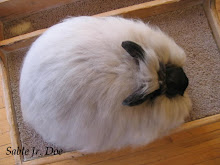
Here are some before and after pics of Juno before she was clipped and bred. She was (as usual:)) totally unconcerned with how she looks in full coat and was just thankful to get the darn thing off so that she could get back to what she was doing, whatever that was. I bred her to Fabrice who is now also bald, and hopefully this breeding took because I think it should produce some nice buns:).

BEFORE


AFTER


More stuff again next time. Hopefully Spring will come our way soon and the snow will melt here once and for all. We are all desperate for green grass and the bunnies are desperate for dandelions (along with parsley and a little plantain, too:).


Have a great week!