Sunday, May 24, 2009

Rutland, VT Show

Yesterday was a busy but fun day at the double show in Rutland, VT. I brought 7 buns along with me, and there were approx. 20-25 entered overall by several different breeders.

I have very few pictures of this show due to all the running around that was happening, LOL. The judge for the first show was Rusty Westhoff, and Giacomo took BOB in that one while the BOS was won by a beautiful Steel doe owned by Brenda (Sorry, I can't remember her last name but she is an extremely nice lady who is just getting into FAs:) ). The second show was judged by Josh Humphries, and this time Indira took BOB while the BOS went to Giacomo, and in the BIS competition for Show B Indira also took Reserve in Show, next to Linda Cassella's Colored EA Sr. doe:).

I also decided to bring two 4 month old does along from Morwenna's last litter, and both did pretty well also, placing at the tops of their classes with one taking first in each show.

As far as the Registrar's Test went, I think I passed though I don't want to say anything for sure because we all know what happens to people who count their chickens before they're hatched, LOL. I will know the results in 2 weeks and if everything went well I will start looking for judges to work with to fulfill the second half of the requirement:).


Below are two quick pictures that were taken by my mother (and perpetual travel partner:)) while I was off doing bunny stuff. The first is of me grooming somebunny (either Giacomo or Indira, I think), and the second is of the buns sitting around in their carriers between shows.


I will be sure to post a good picture of Indira as soon as there is time, but this coming week will otherwise be devoted to clipping down rabbits and getting 5-6 does bred while the temperatures are still cool:(. I will also start the fun work of getting babies separated and evaluated over the next couple of weeks, and then I will have some idea of who is who and what is what in each litter, LOL.


More again next week and have a FUN Memorial Day weekend!:-)

Thursday, May 21, 2009

Pearls (and Stuff)

This has been a rabid, insane week, which hopefully will come to an end soon:-). Our whole barn has been taken apart and scrubbed from top to bottom, cages have been pulled out and disinfected, babies have been weaned and tattooed, show rabbits have been entered and groomed for the VT show this weekend, and I have been studying my HEART out for this Registrar's Test I am taking this Saturday after the show. Just a word of advice for anyone who has ever considered studying for a Registrar's test, btw---do NOT try and do it in one month, or 3 weeks, or even 2 weeks (like I am trying to do right now-!!!!!!---not smart, practical, or even responsible:( ). There is a ton of information to know here, and hundreds of details that you would never have thought meant anything except that they really do--especially to those who work like crazy trying to raise and perfect all these breeds. There are tons of details as well as requirements/measurements to remember/DQs/class rules, faults, and colors. I will do the best I can but it may not pan out. I'll probably be repeating the same rant in another 6 months when it comes time to take this thing again (*grin*).

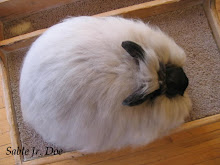
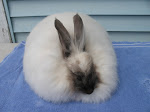
Below I have a recent picture of one of Juno's Sable Pearl babies at age 7 weeks. Below that is the original I took of the same baby at about 3 weeks. As you can see, the wool is growing out nicely now, and the cream color is beginning to show beneath the shading, and this baby (along with the others in the litter including 1 Tort) should be very nicely shaded as adults.

After reading some of the threads on the Genetics List and looking it up on my own I have come to the conclusion that what I have here is probably NOT the standard c(chl)c Pearl which is lighter in body color, but a Chin-based pearl, otherwise known as a Sallander. This particular line has definitely thrown Chins in the past which is what brought me to this conclusion, and this particular doe (Juno) has thrown heavily shaded Torts and Pearls in every litter without exception. I will have to look into this some more and work out the details, but if this is what I have then it is the ONLY way to go for Pearl, IMO:-). Despite the fact that it is not preferred according to the genetics books which advocate the c(chl)c combination, I will always love that heavier degree of shading. As long as it continues to be showable I will breed as much of it as I can:-).


More again this weekend and enjoy the spring weather!

Lotsa fun with the buns:-)

Sunday, May 10, 2009

HAPPY MOTHER'S DAY.

to all the Moms out there (both bunny and human:):)


Sunday, May 3, 2009

First Spring Litter (Growing Up!)

Here are just a few quick pictures of Morwenna and Henryi's litter, which is currently 14 weeks of age and approaching real Juniorship:-). There were nothing but Torts and Fawns in this litter, and there was actually one 5th baby who went home with his new owner a week or so ago because his mom accidentally bit off a toe at birth, rendering him unshowable.

These guys all look fairly good, with exceptionally calm, quiet dispositions for FAs (how unusual is it for every baby in a 14 week old litter to sit this still for a picture, anyway? LOL!)

This pick of the group at this point is a little Fawn doe, the second picture from the top. She is very typey and looks like she'll have excellent wool, but since this is a slow maturing line it will take time to determine how good she actually is.

Morwenna will be re-bred very shortly, this time to Giacomo for an all-Tort litter that I'm hoping will concentrate all the best traits in the barn. The other babies are coming along and eating me out of house and home which is a sure sign that everyone is healthy. Spring is the greatest time for new possibilities and potentially spectacular showbunnies!!

More again next week:-)


Saturday, April 25, 2009

Hot Weather

--This is another post from the old blog that seemed timely since many parts of the country are experiencing hotter weather than usual right now much earlier in the year. It is important to remember that the first heat wave of the summer (or spring) is the most dangerous, and that the most vulnerable members of your herd will always be the pregnant and lactating does. Here in NY our temperatures reached 92 today and I spent the day at home running fans, running ice bottles back and forth, and just generally keeping an eye on everyone for signs of stress. Best of luck to those of you who are experiencing early high temps, and hopefully the weather will revert back to it's normal range soon:-).


August is the month here in NY where we can typically expect the hottest weather. Though the trend has varied somewhat in recent years, the general pattern is 2 weeks or so above 90, and most of that time falls in the month of August.
Since the rabbits' least favorite time of year is here, it seems like a good week to review ways of keeping them cool in the summer months. There are lots of other excellent ideas for summer bunny care out there, but here are just a few that I have tried or used in my rabbitry that seem to provide effective relief:
1) Always, always have an emergency supply of ice bottles in your freezer, starting with the month you can typically expect the highest temps to hit your area. Any type of plastic bottle will do, but the best kind seems to be the 2L soda bottles filled 1/2-3/4 with water and frozen. The round shape of a soda bottle discourages bunnies from chewing on them because they can't get a grip on the plastic, and the larger size bottle keeps it frozen longer. On extremely hot days I can expect a frozen 2L bottle to stay cold for 2 hours, and on cooler days it will last longer, or you won't have to use one at all.
2) Frozen ceramic floor tiles can be effectively used to keep bunnies cool. Plain tiles are inexpensive and easy to get at Lowe's or Home Depot, but it is important to purchase the kind that has a rough surface so that the rabbits don't slip when they become wet with condensation. The advantage of ceramic tiles is that they are easy to stack in the freezer, are not easily chewed, and are convenient for a bunny to sit and lay on top of. The disadvantage of tiles is that they defrost relatively quickly (much faster than ice bottles), and if you want to use them all day you will need several in storage for each rabbit, which can be tedious in large herds.
3) Keep fans in your rabbitry. Depending on the size of your barn, be sure to have enough fans installed on every side to keep air moving throughout the building, but be certain that they are never pointed DIRECTLY at the rabbits to create a draft. In my rabbitry I have 2 industrial sized fans positioned on each end of the building, and they are pointed to blow BETWEEN the cage aisles, so that rabbits can lay against the fronts of their cages to catch a breeze if they need one, but move over to get out of the draft entirely, too. Fans may be positioned on ceilings, in corners, in walls, or anywhere that they are deemed feasible in a rabbitry setup. While it is true that a fan cannot change the actual temperature of a rabbitry, they WILL provide vital air movement that may mean the difference between life and death for many rabbits, particularly Angoras in coat, pregnant does, and does with litters. One way that I have heard of to use fans to bring temperatures down is to hang bags or empty milk jugs full of ice directly in front of the fans so that the air being forced out is cooled. Again, this will require a large store of ice in your freezer and might not last that long depending on temperature.
4) Try not to bother your rabbits during the hottest times of the day. While it is important to keep close tabs on how everyone is handling the heat, it is best to do any maintenance, cleaning, or other work early in the morning or late in the evening when temps are cooler and the herd is not as stressed. Rabbits are most active at dawn and dusk, but on hot days in particular they will lay stretched out on their stomachs in order to expel heat, and keep still and quiet in every other way (again, in order to remain cool and stress free). Do not disturb them aside from regular checks at these times unless it is absolutely necessary, and once the weather has cooled off they will get up and go back to their normal activities.
5) Water on the ears. Another way to cool a bunny off quickly is to spray it's ears with water during the day. Since rabbit regulate their body temperature through their ears, cooling this part of the body will provide instantaneous relief. A spray bottle works well as long as you try not to get water directly into the ear canal, and I have also taken a bowl of cold water outside with a washcloth and soaked the bunny down by holding a cold, wet cloth around both ears for several minutes. Even the jumpy bunnies rarely mind this since it brings such relief, and some even come to the door for immediate attention as soon as I come in with the bowl:).
6) Learn what the hottest time of the day is for your area and concentrate your cooling strategies into this timespan. In my area and where my barn is situated the worst time of day is 4-5PM when the temperature and humidity inside the building absolutely peaks. This is the time I head out with ice bottles,washcloths, and cold water.
7) Water the herd in the evening. After a hot day, fill water bottles and dishes with very cold water and Acid Pak for relief and rejuvenation overnight.
8) Keep some clean cages or carriers inside the house where it is air conditioned or at least very cool (like in the basement, etc). For the hottest days when you have no choice but to move them indoors, it is important to have housing set aside for rabbits who are on the verge of overheating. Here in NY last summer we had temperatures in excess of 100 degrees several days in a row while I was growing out litters and putting on show coats, so every day I spent 2 hours in the morning bringing rabbits inside and setting them up in carriers, and 2 hours at night bringing them out again:(. It was extremely tedious and I didn't look forward to doing it, but it was critical at the time in order to keep everyone alive and eating:(. Whether you need it or not, it is a good idea to have some sort of setup on standby in the house, just in case.
7) Do not allow Angoras to grow full coats in the summer. Unless there is an important show coming up in the Fall and wool growth must begin in July/August or you have a business that requires yields all year round, there is no reason to force an Angora to hold 5-10 inch coats in the heat of the summer. There are few if any shows held at this time of year in most areas due to the risks involved, so it is usually safe to keep most of the herd shaved, clipped, or plucked down during the hottest months, particularly if you have does who are pregnant or nursing, or bucks that have to stay cool in order to remain viable. The only rabbits I have in coat (early coat) at this time of year are rabbits who will show in the Fall, but everyone else gets sheared to the skin at the beginning of each month until the temperatures go down again.
8) Reserve your bottom cages for breeding bucks, pregnant and nursing does, and rabbits who are in coat. Since heat rises, it is always a good idea to house the most valuable rabbits down low in the summer, and high in the winter. If you have stacking cages this is easy to do, if you have single rows then it doesn't apply and everyone must remain at the same level. I also put newly weaned babies into bottom cages in the summer to lessen the stress on their delicate systems and to keep baby ears from growing too quickly and lopping in the heat.
9) Shade. If you are able to do it, try to make sure that your rabbitry is located in a shady part of your property, or at least someplace where there is shade over the building during the hottest part of the day. If your rabbitry is freestanding, plant trees, vines (non-poisonous) and other shrubs nearby to provide shade and keep the interior of the rabbitry cooler.
10) Reserve grooming for the coolest part of the day. This is a no brainer, I think, but unfortunately there are people who don't consider this and insist on dragging animals out at all times of the day for grooming, carrying, exercise, and other activity when it is all that the rabbit can do to stay alive under such handling. While it is good to keep a herd that is not coddled, it is also important to recognize the biological limitations of rabbits in the heat. While they are able to acclimate to warmer climates to some extent, rabbits (and Angoras in particular) CANNOT withstand prolonged periods of heat without proper housing/ help/ and intervention from their owners, and this fact has nothing to do with genetic predisposition

Sunday, April 19, 2009

Rhinebeck Show and Babies:)

This past Saturday my local club held it's annual show in Rhinebeck, NY. It was a double show instead of the usual single, and it was a nice chance to meet up with friends that I haven't seen in a while, (or at least that I haven't seen since the last show:)). I recently decided to get my Registrar's license also, so I spent a lot of time yesterday getting the signatures I needed and just running around in general to talk to certain people and folks in other breeds.

Our first show yesterday was judged by Robert Frizzell and was won by Nancy Platte, who took BOB and BOS. The second show was under Howard Keller and was won by my bunnies, with Giacomo as BOB and Spang's Indira as BOS. Unfortunately I do not have any pictures to post of this show because the few times that I did remember to take my camera out the pictures did not come out:(. I have been learning how this new camera works and eventually I will get the hang of it and become a perfect photographer (maybe, haha), but until then some of the shots will be fuzzy or maybe even non-existent:).

On the homefront here I have been very busy with new litters, and I posted pictures today of some of the latest babies I have, the youngest of which are 11 days old. Evariste and Ismati are also due this coming week and I think that both are pregnant. I will also be breeding another group of does next weekend: Morwenna will be bred to Giacomo, Etienne to Akeno, and Margaux to Giacomo.

Colors in my current litters include (as usual!) Tort, Fawn, Black, REW, and Pearl, but a Blue baby has also surfaced surprisingly in Althea's litter. Below there are a bunch of pictures of the newest little rascals, but since they are incapable of sitting still for even 2 seconds, some of them are fuzzy:).

First below is a cute photo of Juno's litter and one of the beautiful, DARK Pearls that she produced. Juno is not the best mother in the herd by any means, (she is the classic case of a great show rabbit who is a less than perfect parent, LOL) but there are still a couple of Pearls left in her litter, all of whom have this beautiful dark shading that grows into an exemplary senior coat.


And here are a few shots of Althea's litter. Althea is a black doe that I held back out of Pascha who does not have wonderful type and is not being used as a show rabbit, but who has beautiful intense color that is a throwback to old style French who had poor wool but outstanding color. I named her Althea (which means 'black night'), and I am trying to preserve her color and inject it into the main line. The colors on these babies look good so far, so I am hoping that there will be buns in the bunch with her fabulous color and Angelo's solid type.


And here is a picture of Natalya's litter (at 11 days old). These are mainly Torts and Blacks:)


And here is the most MISCHIEVOUS bunch in the group---Donatella's NZ/FA cross litter (surprise!:)). This morning these bunnies decided that a nestbox was a very boring place to be, and so they took it upon themselves to jump into the box next door to pay Juno's babies a visit. At this moment they are situated on the other end of the living room under a laundry basket, and that should put an end to their adventures for now until they go into the barn permanently and become their patient mommy's problem:-).


Here are some pictures of Keith holding one of Juno's little Pearls. This dark color will eventually extend itself along the hair shaft as the wool grows out and her coat will become off white with a nice Sable shading. I will be sure to post continual pics of these babies as the weeks go by.


And these last two pictures are of Yvonne's older litter that is now 4 weeks old and permanently living in the barn. They will all be weaned in about 2-3 weeks.


There are five more little ones in the barn (Morwenna and Henryi's litter) who are 12 weeks old and will be taken out today for grooming and evaluation (my favorite part of rabbit raising:-)).

Well, that's it for today and I hope all of you are enjoying the beginning of spring and lots of full nestboxes!

Have a wonderful week.

Saturday, April 4, 2009

Wool Growth and Clipping

--another post from the old blog


Someone asked me a very good question the other day, and I remember that this was something that confused me too when I began raising rabbits, so I thought I would write a post about it:).

The question had to do with what would happen if you clipped a coat before it was technically ready to molt----would the growth that began again be considered the new coat or simply an old coat continuing to grow out?

The answer to this question can be understood when we take a look at how an Angora coat cycles. Hold times for Angora coats rely on many different factors--different breeds hold coats for different lengths of time with the English Angora being capable of holding a coat for 12-15 months while the German and Giant Angora coats never "truly" molt, either. As of now the Satin and French Angora coats hold for the smallest amount of time, with the French ranging anywhere from 4-10 months and the Satins holding approx. the same amount of time (*I have never raised SAs, btw, so it is possible this estimation is not 100% accurate).

Other factors that affect rate of wool growth and hold time are genetics (different lines hold for different periods of time), climate, stress, and nutrition. Also, the time of year can play a significant part in how a coat grows, which is why it is important to account for faster growth in the winter and slower growth in summer when planning your breeding schedule.

After harvest (assuming that the harvest was done at molt time), an angora coat will begin to grow back in at the rate of about 1 inch per month. Some rabbits grow wool more quickly and others grow it back more slowly, but the average rate is 1 inch. Also, as mentioned above, the wool grows back more slowly in summer to keep the rabbit cooler, and more quickly in winter to keep it warmer.

Typically (and I am using the growth of my own line as an example), the first 3 months of growth are the "building" phase of the coat. Wool is actively growing at this time and the rabbit is eating a substantial amount of food to supply the protein needed to maintain growth.

At about the beginning of the 4th month, the coat begins to Prime, which is the desired phase to Show or harvest Prime spinning wool in. The tips of the coat are well-defined at this point and the coat has decent length (it should be 4 inches long at least), and this is the point at which wool growth begins to slow down. In my own herd, this is considered the peak time for the coat, and full Prime condition remains for approx. 6 weeks longer (which is why I breed them to be entering this phase for the biggest shows).

At 5-5 1/2 months of age, the coat begins to slip. Growth has ceased entirely at this point and the condition of the coat begins to decline and trail off in strings and strands of loose fiber. Also, the rabbit begins to eat less now because excess protein is no longer needed once the period of growth is over.

At 6-7 months the coat goes into a complete molt and it is time to remove it. At this point it is critical to harvest the fleece because it becomes dangerous for the rabbit to consume loose wool during self-grooming. A molting coat is completely dead and finished, so once you clip the wool in this stage the new coat will rapidly begin growing in underneath, and you will begin the cycle of growth all over again.
What would happen if you were to interrupt the cycle by clipping a rabbit before the coat was molting or even in the slipping stage? The answer is, absolutely nothing---the cycle will continue on as though the clip never took place.

An Angora coat cannot be manipulated to change it's growth pattern according to when the coat is harvested. If a coat is clipped early, the same hair shafts will simply continue to grow out (minus the tips), until the stage of molt is reached. At this point the hairs will release completely from the follicles, fall out, and new hairs will take their place and begin to grow again. If you find that you are forced to clip early for any reason (such as a heat wave or pregnancy, etc), then don't worry, simply mark down the date of the clip on your calendar, and then clip again as soon as the existing coat begins to slip/molt on it's normal schedule. Once this happens, the old coat is gone for good and you are back to Stage 1:).

This is just an overview of a typical FA growth pattern. As I mentioned earlier, various factors can influence growth on individual animals, so it is important to make your own observations and learn when to identify the signs of a slipping coat in your herd.