Sunday, June 7, 2009

Frankfort, NY Show

This past Saturday the Mohawk Valley Club held their annual show in Frankfort, and I zipped out for the first time in several years to attend it. This is a very nice show in a very nice venue, and even though it was a warm day the doors on the ends and sides of the hall were all open so there was a perfect flow of cool air coming in throughout the day.

I normally don't have anything in coat left at this time of year, but I did manage to dig 4 bunnies out (LOL)---one near the end of her coat, one near the end of her jr weight limit, and two who were NOT in full coat yet but will have to be clipped soon anyway for breeding and for the upcoming summer temperatures.

There were about 25 FAs entered in the shows with 5 exhibitors. The judge for the first show was Helen Brose, and the judge for Show B was Paul Jurgelonis. In Show A the BOB went to Spang's Fabrice and the BOS went to Spang's Sabini (Spang's Karenina picked up her 3rd jr. leg also), and in Show B the BOB went to a Jr. buck that was owned by Marilyn DeMaree and BOS went to a Colored Sr. doe who was owned by either Marilyn or Charlotte Schweikart (sorry, I should have found out exactly who owned these bunnies, LOL).

Here are several pics that were snapped during the show:

The first is of the Angora grooming area (which actually took up a lot more space than just this one wall, LOL).


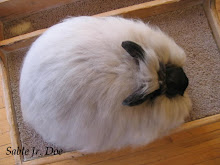
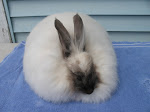
And these are my own bunnies resting in their carriers after grooming:


This is a picture of my good friends Brian Sawchuk and Donna Grimm who live near my house and are also members of my local rabbit club. Brian is a judge already but Donna is currently working on her license. This was her 6th show out of 8 toward finishing the whole thing up.


This is Dru Shepherd moving stuff around and taking care of her pretty EAs (Hey Dru!:-)


And this is Nancy Platte who came to the show with her buns and also with her husband who was judging. Nancy writes for him often at the shows and occupies herself in between classes with knitting (as any wool person will:-))


And these are Linda Cassella's bunnies (also EAs):


This is Marilyn DeMaree and myself watching the judging in Show B:


And this is the judge in the second show lining up one of the FA Senior classes on the table.

Now, I do not want to openly criticize this judge (I do not know him and this is the first time I have ever had him at a show), but there is no reason whatsoever to be lining angoras up like this in front of their cubbies, mashing them together harder like sardines every time they moved, and then leaving them there during the entire course of judging while checking for DQs and everything else. I realize that not everyone here raises wool breeds, but long term judges like these should at least be aware that random, comical stunts like this result in nothing more than matted coats and overheated, ANNOYED rabbits. I won't say anymore because I do not want a verbal lashing from anyone (at least not tonight:)), but it was a very good thing that these rabbits were healthy and a VERY good thing that it was the end of the show season rather than the beginning:(. I am glad he found this amusing and got a kick out of it all, but it is not the way to handle ANY wool breed, particularly one in full coat in 80 degree weather (end of commentary:( )


Anyway, so that is about it for this week. The next few days here will be spent in separating and evaluating babies since everyone else is pretty much clipped (whew!). Hopefully we will luck out and have a nice cool summer, and the next litters will be born in 70 degrees.

More next time and have a great week!:-)

Monday, June 1, 2009

Posing and Handling

--Another post from the old blog:


Here are some interesting excerpts from an article I found on Handling and Posing rabbits in the ARBA Handbook (pg. 35), written by Joey E. Shults. Joey writes:

"Proper handling technique is very important for the safety of not only the rabbit, but the handler as well. Before we begin, I would recommend the beginner should wear long sleeves for added protection. First and foremost, remember that you do not handle the rabbit in a rough or careless manner---rabbits have feelings, too".

"How do you safely take a rabbit out of its cage? To remove a rabbit from its coop (cage), if you are right-handed, put your left arm in the coop. Place your left hand palm down over the rabbit's shoulder with your thumb in front of the ears. Gently cup your hand around the shoulders and squeeze your thumb against your index finger, grasping the rabbit to the point that you feel you have control of the rabbit. Then put your right hand in the coop underneath the rabbit's belly, lifting the rabbit to the cage door".

"It is very important to lift rather than drag the rabbit toward you, so as not to pull or break the rabbit's toenails on the wire."

A few paragraphs down Shults goes on to say, "When placing a rabbit back in its coop, use the same procedure, being sure to place rabbit back in cage tail end first".

At shows, in particular, I have noticed that people have many different ways of handling their rabbits:). Joey Shults advocates removing them from the cage head first, but other breeders prefer removing them tail first, and placing them back in the same way. The head first method is fine as long as you make certain to LIFT the animal at the same time to avoid ripped out toenails, but never grab the skin over the shoulders and drag a rabbit forward under any circumstances:(. At home in my own barn, I almost always take bunnies out of their cages rear-end first. I turn them so that their backs are facing me, and place one hand underneath the chest and the other directly under the hindquarter to lift them straight up and out. When removing rabbits from upper level cages it is a good idea to use a stepstool so that you are at an even level with the cage door. If you remove a rabbit tail-end first there tends to be less chance of getting bitten or scratched since you are not approaching the rabbit head on and they perceive you as less of a threat, but DO always remember to speak as you approach so they are all aware that you're coming.

Shults also gives excellent advice about posing in the same article (pg. 36). He says,

"Posing, by definition, is to "strike an effect", or in this case to put a rabbit in a comfortable position so one can determine conformation and bone structure. To pose the rabbit, place the rabbit on the table and put the tip of the front feet even with the eyes and the tip of the rear feet even with the hip bone. The hipbone is the bulge of the thigh on the rabbit's side while in the sitting position. Be sure that the rabbit's tail is showing and not tucked underneath the body. The rabbit should be allowed to assume a comfortable pose, but should remain still for close scrutiny".

"Many rabbits have been beaten at a show, not for lack of type, but for lack of being able to show off that type to the judge, or pose. The rabbit should never be poked rudely, or pushed down during the posing. Remember, the properly handled and posed rabbit is not only a joy to behold, but a joy to handle as well."

Even with a breed such as the Angora, the importance of posing cannot be underestimated. When I attended the Convention in IN last year, the posing ability of the animals on the BIS table was nothing short of remarkable, and I am certain that it had at least something to do with their excellent placements. If a well-typed bunny can freeze on the showtable long enough for the judge to get a look at it from all angles, it certainly has a chance to do well, or at least get a more accurate evaluation. Whenever you take a bunny out for grooming, set it on the table in the commercial pose and put it back into place every time it moves for approx. 5 min. If you repeat this exercise often enough you will eventually have a rabbit who poses automatically whenever it is placed on a table, and you will have a better chance of showing your bunnies to their best advantage.

Sunday, May 24, 2009

Rutland, VT Show

Yesterday was a busy but fun day at the double show in Rutland, VT. I brought 7 buns along with me, and there were approx. 20-25 entered overall by several different breeders.

I have very few pictures of this show due to all the running around that was happening, LOL. The judge for the first show was Rusty Westhoff, and Giacomo took BOB in that one while the BOS was won by a beautiful Steel doe owned by Brenda (Sorry, I can't remember her last name but she is an extremely nice lady who is just getting into FAs:) ). The second show was judged by Josh Humphries, and this time Indira took BOB while the BOS went to Giacomo, and in the BIS competition for Show B Indira also took Reserve in Show, next to Linda Cassella's Colored EA Sr. doe:).

I also decided to bring two 4 month old does along from Morwenna's last litter, and both did pretty well also, placing at the tops of their classes with one taking first in each show.

As far as the Registrar's Test went, I think I passed though I don't want to say anything for sure because we all know what happens to people who count their chickens before they're hatched, LOL. I will know the results in 2 weeks and if everything went well I will start looking for judges to work with to fulfill the second half of the requirement:).


Below are two quick pictures that were taken by my mother (and perpetual travel partner:)) while I was off doing bunny stuff. The first is of me grooming somebunny (either Giacomo or Indira, I think), and the second is of the buns sitting around in their carriers between shows.


I will be sure to post a good picture of Indira as soon as there is time, but this coming week will otherwise be devoted to clipping down rabbits and getting 5-6 does bred while the temperatures are still cool:(. I will also start the fun work of getting babies separated and evaluated over the next couple of weeks, and then I will have some idea of who is who and what is what in each litter, LOL.


More again next week and have a FUN Memorial Day weekend!:-)

Thursday, May 21, 2009

Pearls (and Stuff)

This has been a rabid, insane week, which hopefully will come to an end soon:-). Our whole barn has been taken apart and scrubbed from top to bottom, cages have been pulled out and disinfected, babies have been weaned and tattooed, show rabbits have been entered and groomed for the VT show this weekend, and I have been studying my HEART out for this Registrar's Test I am taking this Saturday after the show. Just a word of advice for anyone who has ever considered studying for a Registrar's test, btw---do NOT try and do it in one month, or 3 weeks, or even 2 weeks (like I am trying to do right now-!!!!!!---not smart, practical, or even responsible:( ). There is a ton of information to know here, and hundreds of details that you would never have thought meant anything except that they really do--especially to those who work like crazy trying to raise and perfect all these breeds. There are tons of details as well as requirements/measurements to remember/DQs/class rules, faults, and colors. I will do the best I can but it may not pan out. I'll probably be repeating the same rant in another 6 months when it comes time to take this thing again (*grin*).

Below I have a recent picture of one of Juno's Sable Pearl babies at age 7 weeks. Below that is the original I took of the same baby at about 3 weeks. As you can see, the wool is growing out nicely now, and the cream color is beginning to show beneath the shading, and this baby (along with the others in the litter including 1 Tort) should be very nicely shaded as adults.

After reading some of the threads on the Genetics List and looking it up on my own I have come to the conclusion that what I have here is probably NOT the standard c(chl)c Pearl which is lighter in body color, but a Chin-based pearl, otherwise known as a Sallander. This particular line has definitely thrown Chins in the past which is what brought me to this conclusion, and this particular doe (Juno) has thrown heavily shaded Torts and Pearls in every litter without exception. I will have to look into this some more and work out the details, but if this is what I have then it is the ONLY way to go for Pearl, IMO:-). Despite the fact that it is not preferred according to the genetics books which advocate the c(chl)c combination, I will always love that heavier degree of shading. As long as it continues to be showable I will breed as much of it as I can:-).


More again this weekend and enjoy the spring weather!

Lotsa fun with the buns:-)

Sunday, May 10, 2009

HAPPY MOTHER'S DAY.

to all the Moms out there (both bunny and human:):)


Sunday, May 3, 2009

First Spring Litter (Growing Up!)

Here are just a few quick pictures of Morwenna and Henryi's litter, which is currently 14 weeks of age and approaching real Juniorship:-). There were nothing but Torts and Fawns in this litter, and there was actually one 5th baby who went home with his new owner a week or so ago because his mom accidentally bit off a toe at birth, rendering him unshowable.

These guys all look fairly good, with exceptionally calm, quiet dispositions for FAs (how unusual is it for every baby in a 14 week old litter to sit this still for a picture, anyway? LOL!)

This pick of the group at this point is a little Fawn doe, the second picture from the top. She is very typey and looks like she'll have excellent wool, but since this is a slow maturing line it will take time to determine how good she actually is.

Morwenna will be re-bred very shortly, this time to Giacomo for an all-Tort litter that I'm hoping will concentrate all the best traits in the barn. The other babies are coming along and eating me out of house and home which is a sure sign that everyone is healthy. Spring is the greatest time for new possibilities and potentially spectacular showbunnies!!

More again next week:-)


Saturday, April 25, 2009

Hot Weather

--This is another post from the old blog that seemed timely since many parts of the country are experiencing hotter weather than usual right now much earlier in the year. It is important to remember that the first heat wave of the summer (or spring) is the most dangerous, and that the most vulnerable members of your herd will always be the pregnant and lactating does. Here in NY our temperatures reached 92 today and I spent the day at home running fans, running ice bottles back and forth, and just generally keeping an eye on everyone for signs of stress. Best of luck to those of you who are experiencing early high temps, and hopefully the weather will revert back to it's normal range soon:-).


August is the month here in NY where we can typically expect the hottest weather. Though the trend has varied somewhat in recent years, the general pattern is 2 weeks or so above 90, and most of that time falls in the month of August.
Since the rabbits' least favorite time of year is here, it seems like a good week to review ways of keeping them cool in the summer months. There are lots of other excellent ideas for summer bunny care out there, but here are just a few that I have tried or used in my rabbitry that seem to provide effective relief:
1) Always, always have an emergency supply of ice bottles in your freezer, starting with the month you can typically expect the highest temps to hit your area. Any type of plastic bottle will do, but the best kind seems to be the 2L soda bottles filled 1/2-3/4 with water and frozen. The round shape of a soda bottle discourages bunnies from chewing on them because they can't get a grip on the plastic, and the larger size bottle keeps it frozen longer. On extremely hot days I can expect a frozen 2L bottle to stay cold for 2 hours, and on cooler days it will last longer, or you won't have to use one at all.
2) Frozen ceramic floor tiles can be effectively used to keep bunnies cool. Plain tiles are inexpensive and easy to get at Lowe's or Home Depot, but it is important to purchase the kind that has a rough surface so that the rabbits don't slip when they become wet with condensation. The advantage of ceramic tiles is that they are easy to stack in the freezer, are not easily chewed, and are convenient for a bunny to sit and lay on top of. The disadvantage of tiles is that they defrost relatively quickly (much faster than ice bottles), and if you want to use them all day you will need several in storage for each rabbit, which can be tedious in large herds.
3) Keep fans in your rabbitry. Depending on the size of your barn, be sure to have enough fans installed on every side to keep air moving throughout the building, but be certain that they are never pointed DIRECTLY at the rabbits to create a draft. In my rabbitry I have 2 industrial sized fans positioned on each end of the building, and they are pointed to blow BETWEEN the cage aisles, so that rabbits can lay against the fronts of their cages to catch a breeze if they need one, but move over to get out of the draft entirely, too. Fans may be positioned on ceilings, in corners, in walls, or anywhere that they are deemed feasible in a rabbitry setup. While it is true that a fan cannot change the actual temperature of a rabbitry, they WILL provide vital air movement that may mean the difference between life and death for many rabbits, particularly Angoras in coat, pregnant does, and does with litters. One way that I have heard of to use fans to bring temperatures down is to hang bags or empty milk jugs full of ice directly in front of the fans so that the air being forced out is cooled. Again, this will require a large store of ice in your freezer and might not last that long depending on temperature.
4) Try not to bother your rabbits during the hottest times of the day. While it is important to keep close tabs on how everyone is handling the heat, it is best to do any maintenance, cleaning, or other work early in the morning or late in the evening when temps are cooler and the herd is not as stressed. Rabbits are most active at dawn and dusk, but on hot days in particular they will lay stretched out on their stomachs in order to expel heat, and keep still and quiet in every other way (again, in order to remain cool and stress free). Do not disturb them aside from regular checks at these times unless it is absolutely necessary, and once the weather has cooled off they will get up and go back to their normal activities.
5) Water on the ears. Another way to cool a bunny off quickly is to spray it's ears with water during the day. Since rabbit regulate their body temperature through their ears, cooling this part of the body will provide instantaneous relief. A spray bottle works well as long as you try not to get water directly into the ear canal, and I have also taken a bowl of cold water outside with a washcloth and soaked the bunny down by holding a cold, wet cloth around both ears for several minutes. Even the jumpy bunnies rarely mind this since it brings such relief, and some even come to the door for immediate attention as soon as I come in with the bowl:).
6) Learn what the hottest time of the day is for your area and concentrate your cooling strategies into this timespan. In my area and where my barn is situated the worst time of day is 4-5PM when the temperature and humidity inside the building absolutely peaks. This is the time I head out with ice bottles,washcloths, and cold water.
7) Water the herd in the evening. After a hot day, fill water bottles and dishes with very cold water and Acid Pak for relief and rejuvenation overnight.
8) Keep some clean cages or carriers inside the house where it is air conditioned or at least very cool (like in the basement, etc). For the hottest days when you have no choice but to move them indoors, it is important to have housing set aside for rabbits who are on the verge of overheating. Here in NY last summer we had temperatures in excess of 100 degrees several days in a row while I was growing out litters and putting on show coats, so every day I spent 2 hours in the morning bringing rabbits inside and setting them up in carriers, and 2 hours at night bringing them out again:(. It was extremely tedious and I didn't look forward to doing it, but it was critical at the time in order to keep everyone alive and eating:(. Whether you need it or not, it is a good idea to have some sort of setup on standby in the house, just in case.
7) Do not allow Angoras to grow full coats in the summer. Unless there is an important show coming up in the Fall and wool growth must begin in July/August or you have a business that requires yields all year round, there is no reason to force an Angora to hold 5-10 inch coats in the heat of the summer. There are few if any shows held at this time of year in most areas due to the risks involved, so it is usually safe to keep most of the herd shaved, clipped, or plucked down during the hottest months, particularly if you have does who are pregnant or nursing, or bucks that have to stay cool in order to remain viable. The only rabbits I have in coat (early coat) at this time of year are rabbits who will show in the Fall, but everyone else gets sheared to the skin at the beginning of each month until the temperatures go down again.
8) Reserve your bottom cages for breeding bucks, pregnant and nursing does, and rabbits who are in coat. Since heat rises, it is always a good idea to house the most valuable rabbits down low in the summer, and high in the winter. If you have stacking cages this is easy to do, if you have single rows then it doesn't apply and everyone must remain at the same level. I also put newly weaned babies into bottom cages in the summer to lessen the stress on their delicate systems and to keep baby ears from growing too quickly and lopping in the heat.
9) Shade. If you are able to do it, try to make sure that your rabbitry is located in a shady part of your property, or at least someplace where there is shade over the building during the hottest part of the day. If your rabbitry is freestanding, plant trees, vines (non-poisonous) and other shrubs nearby to provide shade and keep the interior of the rabbitry cooler.
10) Reserve grooming for the coolest part of the day. This is a no brainer, I think, but unfortunately there are people who don't consider this and insist on dragging animals out at all times of the day for grooming, carrying, exercise, and other activity when it is all that the rabbit can do to stay alive under such handling. While it is good to keep a herd that is not coddled, it is also important to recognize the biological limitations of rabbits in the heat. While they are able to acclimate to warmer climates to some extent, rabbits (and Angoras in particular) CANNOT withstand prolonged periods of heat without proper housing/ help/ and intervention from their owners, and this fact has nothing to do with genetic predisposition