Saturday, September 26, 2009

Back again (with Babies for Sale:))


Hey everyone! After a super busy summer it looks like Fall is here again and it is time to get back to the usual work and blog schedule, LOL. Hopefully everyone out there has had a productive summer with lots of litters and great show/wool prospects. I did a load of breeding here also, and as of now there are 7 litters of various ages jumping around in the barn. In addition to breeding I also took the time to wrap up the practical requirement for my Registrar's license, and once I get the certificate in the mail I will be a true blue bonefide ARBA Registrar!:-) It was incredibly interesting working at the various shows with different judges (I worked under Josh Humphries, Bob Shaftoe, and Brian Sawchuk) to see how they all bring different strengths and points of view to the judging table. There is nothing (I mean nothing) like handling umpteen zillion rabbits over the course of one day to teach a person everything there is to know about type, but even if I never got anything else out of it besides the experience, this was definitely a fascinating and unbelievably educational summer:).

I will also be attending my first show of the season in Syracuse this weekend (at the NYS Convention). I did not bring rabbits to any of the shows I was working at because it would have been a nightmare trying to work behind and in front of the table at the same time, but now I have about 5 bunnies who are in full coat and seem ready to strut their stuff (I hope, LOL).

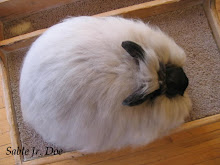
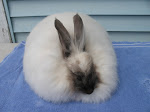
Also, there are a couple of bunnies for sale in this post who can be delivered to shows in Syracuse, NY on Oct. 3, the Rhinebeck Sheep & Wool Festival on Oct. 17-18, or the Fulton, NY show on Oct. 24. The REW and Tort babies pictured above (and below) are two of five that will be offered for sale out of Spang's Indira's litter--born 7/16/09. Indira is a Registered Tort doe with 2 legs who will go back to the tables to finish her GC as soon as the next coat comes in. She earned an Open RIS at the last show she was entered in in Rutland, VT. Spang's Giacomo, the sire, is a GC Tort buck. Both parents have Red/White/Blue pedigrees.

3 REWs are for sale in this litter (2 does and 1 buck), and 2 Torts (both bucks). Pictured here are pics of one baby of each color, but the rest of the litter is pretty much identical. All rabbits are priced at $100.00 ea, and interested individuals may contact me at amy@spangangoras.com.


This last photo below is just one of a 12 week old girl out of Devaki's litter (see what a difference 2 weeks can make? This baby can actually pose!:-D). I will be holding onto this one for awhile because she seems to be a carbon copy of her mother who produces 10 oz. of wool at every shearing (!G) Out of Etienne and Yvonne (whose litters are about 14 weeks old now), I will keep 2 does and 2 bucks, and the other litters are still too young to know anything about, LOL.


Anyway, more again next week when I will have a full report (with pictures!) of the Syracuse show, and other interesting things to chat about. I hope:-).

Happy Fall and get ready for the wool to start growing!

Monday, July 27, 2009

Summer Break

Hi Everyone,

I hate to admit it but I am going to have to take a summer break from blogging once again from today until the middle of September rolls around:(. I have a ridiculously full plate at the moment with kid and other activities, and I am arranging shows to finish up the practical part of my Registrar's license which needs to be handled as well. I will be back right away as soon as Fall starts and the shows get going, and I should have an entirely new crop of babies to show off and post pics of as well:). So far there are 4 new litters in my barn with 5 more coming up over the next week or two, so things will definitely be insanely busy:-).

Anyway, have a great, GREAT summer, and I hope all the buns stay happy and cool until Fall comes again and we all have the chance to relax:-). I can easily be reached by email if anyone needs to get in touch with me, otherwise I'll see you all again in Sept.

Happy Grooming!
Amy:-)

Sunday, July 19, 2009

Wool

--another post from the old blog!

Well, I was happily taking pictures of my babies at 9 weeks when my camera batteries suddenly went dead, and the absence of a spare set forced me to stop what I was doing and put the batteries into the recharger til tomorrow:(. Well, that works out alright since I can just post them tomorrow instead---but as I was grooming and checking out coats and texture on the babies and some of the adults today, I noticed a few extra things about wool that I thought I would brainstorm with tonight:).


Lately I've been in the habit of grooming out my babies, plopping them onto the grooming table, and then standing back to look at them from zillions of different angles:). First of all I look hard at the profile (which is probably the best angle to check for balance), and then I check them from the front and then from the TOP, in a kind of aerial view. When looking at the profile the thing I am mainly checking for is balance. Now, good balance means that no part of the rabbit is out of sync with any other part. No part is too high, or too low, or too flat, and no part sticks out abnormally far in any direction (if that makes sense:)). A rabbit with excellent balance looks good any way it sits from pretty much any angle, but a rabbit that lacks balance looks awkward, and when you look at it you find yourself wishing that it had more height, depth, roundness, etc. etc. etc, making the concept a very difficult thing to define. The longer I am in rabbits the more I realize that MUCH of what we look for in a good one is hard to explain and put our finger on, but as is so often said about anything exceptional, you'll know it when we see it:).


Next, I try to examine the rabbit head on to determine ear carriage, headset, and the 'evenness' of the coat from the front. The FA is widely known for it's distinctive 'oval' shape, but what we don't realize at first is that it is oval from the front of the animal as well. A good coat should present even density all around the head and back, and the hem of the dewlap should be perfectly even so as not to break up the baseline of the coat. Ear carriage and headset are not critically important in angoras, but I like to see that they are still in balance with the rest of the animal and the head snuggles back into a 'pillow' of wool behind the face.


Today I just had two baby REW does out (which I'll post pictures of tomorrow), and while both were perfectly equal in terms of type, one had a distinctly silkier coat than the other, which had the type of textured coat that you would usually expect to find on an adult. Interestingly, there was no real difference in density between the two rabbits because the same amount of of underwool was present on both, but there was certainly a difference in the shape of the animal, which could clearly be seen by viewing the coat from above.


In FA coats (and probably all angoras to different extents), everything seems to come down to this: there are two types of 'hair' in a French Angora coat, and each has a specific and unique function. The underwool, which is CRITICAL for density in the angora breeds, is a 'crimped' type of wool with tiny zigzags present in each shaft of hair from the skin level to the tips. These 'zigzags' are what give strength to the wool, meaning that their shape enables them to support a heavy coat from underneath. The zigzags in underwool also provide Compression (like springs), so that when you grab a fistful of healthy prime wool in your hand and let it go, it 'springs' back rather than falls limply out of your hand. An excellent coat with a BALANCE of guard hair and underwool should be completely self supporting in an FA. It should stand out evenly all around the animal and give it life and density, while a 'bad' coat will look flat and limp because there is no crimp or 'strength' to support the hair from underneath and give it loft.


Guard hair has a completely opposite function in a wool coat----it provides Shape and Finish. When I looked at these two little does today I realized that while both had equal amounts of density, the one with the textured coat had a beautiful, uniform shape which remained the same no matter how she sat or moved. The baby with the silkier coat had an oval shape too, but it was not as defined as the other one's, and it was more likely to alter it's shape as it moved around. Time would prove the difference here, but if I had to guess I would say that the silkier baby is going to have a harder time holding it's coat in the future. She may not be able to hold it as long, and when it starts to slip it will probably look disheveled and much 'messier', shortening her time on the showtable and making the quality of the wool decline more rapidly. It is very clear to me today that what I am shooting for is a perfect ratio of guard hair to underwool to provide balance and density, but I am ALSO looking for the proper TEXTURE, because that is the quality that ropes in density and gives it the shape, form, and longevity that a good FA coat needs.


I think the next thing I will check out is what happens to the crimp when the coat gets old and starts to molt. If my observation about the zigzags holds up, the underwool should gradually lengthen, relax, and straighten, which would explain why the compression of an old coat decreases (or we get 'lack of life to the wool', as a judge would say), and we find that the coat as a whole gets flatter with the straightening and begins to lose it's shape before it actually releases.


In conclusion, I guess we could say that an excellent prime coat with lots of density HAS to have nice, tight, crimp from the skin to the tips, while a molting coat or a coat without density will be lax, fairly straight, and in some cases lack crimp entirely when you blow into the wool. When choosing your keepers it is important to feel the wool but also look at it, and never hold onto anything that does not show evidence of the critical supporting underwool and textured guard hair that make an outstanding FA coat !

Monday, July 6, 2009

Current Events

It's been a busy couple of weeks in the rabbitry so I thought I'd give an update of what's been going on this week:).

At this point all the spring litters have been sorted out and the keepers have been set aside, and the summer litters are starting to come in:). Starting last week there were 2 litters from Etienne and Yvonne. Etienne is a Tort who hasn't been shown yet---she had 3 Torts and 2 REWs with Giacomo. Yvonne (one of my REW F3 doe) gave birth to a litter of 7 with the same sire as Etienne---2 Torts and 5 REWs. Yesterday and early this morning Devaki and Juno had litters. Devaki had 1 Black, some Torts and a REW or two (it is hard to tell what is what yet colorwise:)), and Juno had only 2, which were promptly fostered into Devaki's bunch.

There are more litters expected over the next couple of weeks, and I will be rebreeding Juno tomorrow along with Sabini, who was just sheared yesterday and is ready for her first litter. Morwenna was due earlier in the week but didn't have anything. It is rare for her to miss, but she is getting older now at age 3. She was rebred also and I'll see how she does in a month:).

We have had UNBELIEVABLY cool weather here in NY this summer, including a ridiculous, record amount of rain:(. The holiday weekend was the first sunny time we've had in weeks, and hopefully things will continue to improve as the summer goes on:).

I took a few pics of my new buns, though there are many more babies in the barn that need to be brought out and photographed. I am really excited about the type on some of these new buns. Both the NZ crosses and the purebreds are getting higher and higher, and there was only one DQ this spring out of 63 babies born. This bunny below is a keeper out of the first litter of the year (born 1/25) right before her clipping. This is Spang's Karenina--9SP1:


I also kept another doe out of this litter from Morwenna--Spang's Davita:).

Below is one of the dark Pearls that came out of Juno's last litter, a very nice (and BIG) buck that I am calling Anton. He has a sister who was very small in the beginning but that I have decided to hold onto to see how she turns out. She also has really wonderful type.


These next two photos are of 2 REWs that came out of NZ/FA does. Both have good NZ type, though the wool on the buck (2nd picture) is much better at this point (there are about 6 of these babies total in the barn right now). It will be interesting to see what happens with these rabbits in the F4 generation. As yet none of the crosses have been able to be shown after the senior coat came in, but maybe some of these will finally make it:).


This last series of pictures is of Spang's Sabini, who grew a beautiful prime coat this summer just as soon as all the shows were over (LOLOL!). I sheared her last night in preparation for her first breeding, so hopefully she will have some nice little ones to show off this fall:).


Aside from this there is not much else going on (other than the day-to-day maintenance stuff). I have several rabbits to get registered this week, and I need to line up shows for the fall to finish up my Registrar's license (which by some miracle I did happen to pass. LOL!).

Hope everyone out there is having a COOL summer (though I hear the temps have been high out west). Be back again next week with more stuff:-).

Tuesday, June 30, 2009

Dandelions (the Bunny Miracle Food)

-another post from the old blog


Dandelions today are viewed as modern day nuisances that are impossible to kill, but in reality this weed is nothing short of a miracle food for bunnies and humans alike. They were grown as an extremely valuable medicinal plant long before they popped up in the cracks of our sidewalks, so I thought I would research the benefits of this important plant and list them here.

Here are a few facts about the Dandelion (taraxacum officinale) that I dug up on the web earlier today. After reading about all the benefits this so-called weed offers, you will understand precisely why they are so healthy for bunnies and why you may want to start feeding them to your own family in the future as well!

FACTS
-Dandelion leaves are higher in beta carotene than carrots
-Dandelions have a greater iron and calcium content than Spinach
-Dandelions contain more potassium than bananas
-Dandelions contain more lecithin than soybeans
-Dandelions contain 64 nutrients and health promoting substances, including the vitamins B-1, B-2, B-5, B-6, B-12, C, E, P, D, biotin, inositol, potassium, phosphorus, magnesium, zinc, thiamin, and riboflavin
-There are approx. 14,000 IU of Vitamin A in 100 grams of Dandelion
-Dandelion root contains the sugar 'inulin' (helpful to diabetics), along with numerous other medicinal substances
-Dandelions are high in trace minerals
-Dandelions are considered a traditional tonic. They strengthen the entire body, especially the liver and gallbladder, working as a gentle diuretic to improve the way kidneys cleanse the blood and recycle nutrients. They also act as a general stimulant to the system, especially the urinary organs. They are helpful in use with kidney and liver disorders, and are also beneficial for the bladder, spleen, pancreas, stomach, and intestines.
-Dandelions detoxify the body and are a great invigorator. They help to cure woolblock, ease indigestion, stimulate milk production in lactating does, and stimulate appetite in general. They also boost the immune system.
-Early colonists brought dandelions to America from Europe to plant in the New World because of their well-known medicinal properties.
-The reason Dandelions are so rich in nutrients is because of the long tap root (extending 2-3 feet in some cases). The roots are able to grow down into the mineral rich subsoil, suck the nutrients in and transport them to the surface.
All parts of the dandelion plant are edible, but the roots are more potent than the leaves.
-Dandelions are so healthy that they can be used as the sole diet for animals off feed, capable of sustaining life for weeks.
-Dandelions can be taken regularly and the entire plant can be dried for use during the winter

Basically, for the Angora bunny, dandelions have three great functions. They stimulate appetite in bunnies who have gone off feed for any reason, they stimulate milk production in does with large litters, and they cure woolblock:). Since they have started to grow again in the yard and garden I will be passing them out regularly to my herd, (particularly on hay and seed days), but considering that there are so many other good things about them, I am also going to start adding them to our own meals in the form of salads and maybe even teas:).

*Note---ALWAYS be sure never to use dandelions for yourself or your bunnies that have been directly sprayed or are located in the vicinity of any kind of chemical herbicide or fertilizer. Grow your weeds naturally for the sake of your bunnies and family, LOL:).

Sunday, June 21, 2009

Breeding

--This is a post from the old blog, but it seemed relevant to re-post in the middle of the Spring/Summer breeding season.

Someone at a show recently asked that I write a post about breeding, so here it is, LOL.

Some people have a great deal of trouble getting their angoras bred, and others have very few issues at all. I believe that there are several factors involved in a successful breeding program, and different lines and breeds may exhibit different rates of conception as well.

First of all, it is very easy to encourage and increase problem breeders in your herd. What I mean by this, is that angora breeders generally focus on breed traits such as wool yield and coat quality to the extent that the more basic fundamentals of rabbit raising often get overlooked, and a herd can become less "functional" over time. As I have often said before, the strength of a breed such as the French Angora is that it is a true multi-purpose livestock animal. It produces heavy wool yields on a commercial quality meat body, and is pound for pound one of the most efficient livestock animals that exists. It is important, with a breed such as this, not to neglect it's meat value at the expense of wool only. The FA is primarily a Fiber animal, but when we fail to select for strong breeders in our herds we make it impossible for the meat aspects of the breed to perpetuate themselves, and the wool qualities fail at the same time.

If you have reluctant breeders in your herd----or rabbits who almost never conceive/fail to get milk, etc.----do NOT keep these rabbits or any of their offspring in your herd if you are serious about improving your production. A heavily line/inbred herd will normally have a decreased reproductive rate to begin with due to homozygosity, so it is a good idea to occasionally introduce an outside doe if you find the vigor of your herd declining. If your herd is NOT heavily linebred then basic culling is the only answer----do not keep those rabbits who are poor mothers or poor milkers, and eventually the production of your herd will improve. Selection for these types of traits is not always something that Angora people think of, but we need to remember that rabbits are rabbits, so if we fail to pay attention to the basics of herd management we will have nothing to show or harvest to begin with:(.

Conception can become a problem if a doe is allowed to sit dormant for an extended period of time between breedings. In my own barn I try not to let 'older does' (the 2-3 years and older) go for more than 2 months between litters after weaning. What I try to do is keep only those bunnies who are capable of being championed early so that they can have their first 3 legs by the time they are 9 months--1 year old. At this point I clip them down and breed them immediately to get the first litter out of the way, and then if the doe happens to be one who can bounce back with good wool growth and type again after the litter, I bring them back to the show table again, and then shear and breed them again. If a doe is retired from showing OR it is a doe who was never shown to begin with (a "parts rabbit", so to speak), then those rabbits will be bred all year round with one month off between litters until approx. 3-4 years old, when they are retired completely due to their age.

The does who are the most heavily bred have the best conception rates of all. They almost never miss breedings and almost always have good sized litters who grow up healthy and robust. It is important to note that the longer an adult doe goes unbred, the greater the opportunity exists for fat to build up around the internal organs to inhibit reproduction and make it less likely that the doe will ever conceive. A good rule of thumb is to get your bunnies championed early if possible (if you show), and then don't be afraid to breed heavily afterward and continue a tight schedule until their retirement. A rabbit in good health is essentially a breeding machine (as any good meat producer will tell you), so it is important to encourage good production by maintaining a regular breeding schedule.

Other things to remember when preparing to breed are to breed at appropriate times of the year. Rabbits breed all year round if kept on a tight schedule, but the ideal seasons are Spring and Fall (particularly Spring). In Spring even the hay we feed contains a higher amount of a compound called 6-MBOA (6-methoxybenzoxazolinone) which stimulates reproductive readiness in wild animals and enhances libido. The length of the days are also directly related to receptivity, and the sperm counts of younger bucks are quicker to bounce back after the heat of summer into Fall as well.

Here is a list of other tips to encourage the breeding process:

1--clip bucks and does down before breeding so that the coat is out of the way and the doe's wool will only be approx. 1 in. long when it comes time to kindle (making it less likely to wrap around baby necks and feet).
2--Breed once first thing in the morning, and then again one hour later.
3--Cage reluctant does next to smelly bucks at least 2 hours before breeding to increase receptivity.
4--take the doe for a ride in the car along bumpy side roads.
5--make positively certain that your herd is well-nourished with a good quality pellet that contains adequate supplies of Vitamins A and E. Supplement brood does with lots of green, leafy plants and herbs which contain a great deal of Vitamin A such as Comfrey before breeding and during gestation.
6--If you feel that your does are overweight, place them on a restrictive diet for 3-4 weeks before breeding to enhance conception rates. In sophisticated meat operations, rabbitry owners are careful never to let their breeding does get too fat----they want them lean and mean, not overweight and lazy:).
7--Try to keep bucks as cool as possible in hot weather. Whenever the temperature goes above 80 degrees F for any length of time, the fertility of bucks will almost always decrease. Younger bucks recover their sperm counts fairly quickly, but older ones can remain sterile for up to 4 months.
Restrained breeding is a technique that some breeders use when a doe seems reluctant, but the conception rates for this method is lower than if you simply let the doe and buck breed naturally. Try to let nature take it's course whenever possible.

To summarize (here at the end now), here are the best ways to encourage good production in your herd:

----Select away from bad mothers, reluctant breeders, and bad milkers, and breed only the offspring of those does who have an excellent track record in the production department.

----Keep your herd does in production, working show dates around your litters, and then keep them constantly bred afterward until they are old enough to retire.

----Clip coats down before breeding and expose the doe to the buck ahead of time (in separate cages).

----Maintain a healthy herd with no vitamin or mineral deficiencies.

One more thing I forgot to mention comes back to what I have often said about the importance of maintaining a predictable schedule in your rabbitry. If your rabbits are managed in the same way every day with no surprises or changes in routine, they will have much lower stress levels which contribute to increased readiness for breeding. A well-cared for herd is much more likely to perform better in EVERY area, including showing, conditioning, and most definitely breeding.

Sunday, June 14, 2009

Bunny for Sale

I have a very nice bunny here for sale out of a litter born last winter on 1/25. She is a Fawn out of Spang's Morwenna (a Tort GC with 3 legs) and Spang's Henryi (a Fawn buck who will be registered next week:)). She is very solid with a good body and really fantastic wool and density.

There were 3 does in this particular litter, and since I am keeping 2 I will not need the third, LOL. This girl will have a 3 generation Red/White/Blue pedigree with 8 Grand Champions included, and she will be priced at $125.


For more info. please email me privately at amy@spangangoras.com. I will be moving litters around all week (now that work is finished. Yippee!:)) and getting ready for the next batches of litters that are due at the end of this month. More to come later on. Hope all of you are having a great week!:-)