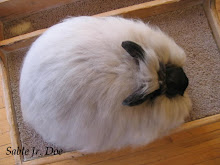
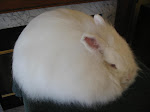
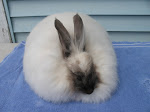
After getting some much needed grooming in today between all the baking, cooking, decorating, gingerbread house building, and normal daytime school stuff (LOL!), I snapped pictures of a couple of buns who are busy growing coats.
This first shot is one that was taken of Anton (a Sable Pearl buck) months ago when he was just a baby. The second is how he looks today, a whole lot bigger and growing in his very first Senior coat:).
These next two pics are of the best baby that was born here during the Fall breeding season. She is a little Tort doe that I will probably name Nadia if she ends up keeping all her great qualities:). She is 5 months old today and came out of a breeding between Margaux and Giacomo.
Btw, there were also two more litters born this week for a total of four boxes now sitting in my living room! Margaux had a litter of 7, and Yvonne (my F3 NZ/FA cross doe) delivered a litter of 8 REWs with Akeno as the sire.
More again next week, but until then have a wonderful, WONDERFUL holiday and may all your bunny wishes come true for the New Year!
---This is another post from the old blog. Sorry about all the older posts lately, but December is a busy month and I do want to get all the old posts transferred so that they will be readily available in the archives. Have a great week and stay warm!:-).
The best way to know what your rabbits carry genetically is by looking at what they produce in the nestbox. Of course, it is a great help to know what colors the parents were because alot can be ascertained that way, but breeding a rabbit several times and recording the colors that result can make it much easier to formulate a genotype for the sire and dam.
The basic rule of genetics is that a rabbit can only pass on what it carries or expresses to it's offspring, and since each offspring inherits half of each pair of genes from it's dam and the other half from it's sire, the colors that result will depend on how those genes interact with each other.
Some genes are dominant, which means that they will always express themselves first if the other half of the gene pair is recessive. In order to express itself (be visible in the nestbox) a recessive gene has to be paired with another recessive gene. If a certain recessive is always paired with a dominant gene in a particular herd it may never have the chance to express itself, which is why some colors can 'hide' themselves for many, many generations before finding like recessives to pair with and reproduce themselves.
A good example to use in describing how genes get passed on is the color White (or REW). White in rabbits is represented by a lower case 'c', and it takes 2 lower case 'c's to make a white rabbit in a litter. Since 'c' is a purely recessive gene, it is entirely possible for a Colored rabbit (such as a Chestnut or Self, for ex.) to be carrying it with no surface evidence whatsoever. If you were to breed that 'c' carrying rabbit to another rabbit though (White or Colored) that also carried a recessive 'c', then the result will be at least a few REW babies in the nestbox. There is a great deal of White in the majority of the Angora breeds because REW is a very competitive color in Angoras, but some non-wool breeds consider the gene a serious liability because White is not a recognized color in every type of rabbit. If two colored parents are bred and REW babies appear in the litter (even just one), then you can be 100% certain that both parents carry the 'c' gene. Similarly, if both parents are Selfs (or one is even a REW) but you get one of the 'ee' colors in the nestbox (that would be Fawn, Red, Cream, Pearl, Tort, or Ermine) then you know that each parent must carry a recessive 'e', and so on.
To determine what color a REW really is under the white 'sheet' (because there is always a different, 'real' color in those rabbits), the best thing to do is breed it to a Self and examine what comes up in the litter. If you find Agouti babies in a nestbox out of a Self/REW breeding then you can be certain that the REW parent must be an Agouti under the White because the Agouti gene is dominant and could never have come from a Self (which is recessive too). Conversely, if you get nothing but Selfs in a good sized litter then you can be fairly certain that the REW must be Self underneath too, and you can use that information in future breedings to produce fewer unrecognized colors.
Why is it important to know what a REW is underneath in the first place? Well, the worst color combination that can be performed in rabbits is usually the Agouti/Shaded combination. Babies out of these pairings will often be a complete mishmash of color and can be so jumbled phenotypically that they cannot even be identified. They can never be shown, registered, or even sold very often because the majority of breeders will not accept unrecognized varieties into their gene pools. Even if they could be sold as pets or woolers there is always the chance that someone will take it upon themselves to experiment and breed 2 rabbits together just to 'see what happens' and end up producing an even larger cache of unrecognized colors that are unshowable, unregisterable, and unsellable.
Testing a REW first to know what color truly lies beneath the blanket allows you to use that rabbit according to it's real color in future breedings. If a White rabbit is genetically an Agouti, then you know that you can use this rabbit only with other Agoutis or Selfs, and should never use it with a Shaded. If your REW is genetically a Self then you have greater flexibility and can use it with other groups without fear of strange colors turning up. Combining 2 REWs can ONLY result in an all-White litter so you would not know what either parent carried in that case, but since REWs cannot carry Shaded genes (the 'c' being completely recessive) you would not be adding those genes to your pot to begin with.
Note: Breeders of other breeds are often mortified at the rate at which Angora breeders mix colors, and IMO they have a very legitimate point. The best and truest color comes from breeding pairs of the same variety together over several consecutive generations, and we in the Angora world would do well to imitate that policy if we want to weed out most of the color issues that plague our breed. Since wool animals are often raised by spinners as well as showpeople the desire for variety in color is strong, but the best way to achieve both variety and quality is to focus on each color separately and improve it slowly over time.
Two litters were born this week to Spang's Natalya and Spang's Kimba:). Juno's breeding did not take which wasn't a surprise given her age, and Althea (my Black 'plucking' doe:)) was not pregnant either, which will earn her a trip to the 'retirement' home of my local friend who has a fiber business and uses angora in her products exhaustively:). Given the fact that Althea is young and could not conceive twice under normal conditions means that she will not be fertile/ dependable enough to stick around here, especially if she is not a show rabbit and cannot earn her keep some other way. She will now live the rest of her life at a 'luxury' bunny house where her new owner will use her wool and happily keep an FA who molts on a regular basis:).
Margaux will be due in approx. a week and half and is definitely prego (carrying hay around like there's no tomorrow:))----and Yvonne is due around the same time, though it is harder to tell what is happening with her because she never carries hay or begins building nests until the Day Of, LOL.
Below are two pics of the new litters snapped earlier today (at 2 days of age). The first is of Natalya's litter with 3 REWs and 2 Blacks, and the second is of Kimba's bunch consisting of Black, REW, Tort, and Sable. Kimba is a Sable F4 FA/NZ cross and this was her first litter. She kindled a day early with 11 kits so all her Sable babies (the little Blue looking things in the first picture:)) were promptly moved to Natalya's box because Natalya had only 5 and I wanted to be extra sure that the Sables survived. Kimba was bred to Giacomo (a Tort) since he was the best choice at the time to produce more Sables, but next Spring she will be bred to Anton (a Sable Pearl buck) which will definitely produce more Sables and Pearls to get my Sable/Pearl line off the ground:).
Other than this not a whole lot is happening at this time of year with cold weather and the holidays:). Since there are no shows at the moment there is nothing to do but breed and gear up for the PA Convention in Feb, along with growing out coats for the 2010 Spring Season, which looks as though it is going to be nice with a great selection of buns.
Btw, for those of you who don't know (and I will be posting about it again in a few weeks:)) the United Angora Club (UARC) will be hosting TWO Specialties at the PA Convention this year on Feb. 6 & 7---a Saturday and Sunday. This year's PaSRBA show is expected to bring in over 12,000 rabbits, which is only 1,000 shy of the entry at this year's ARBA Convention in San Diego! The official catalog for the PA Convention is not available yet, but it will be posted mid-December on the PaSRBA Website at http://www.pasrba.org/.
More again next week, and hopefully everyone is fully winterized and holed up for the coming winter!:-)
I took a close look at the nutrition labels on my feed bags the other day, and did a little reading up on what types of information a breeder could expect to glean from the 'Guaranteed Analysis' and 'Ingredients' list.
First of all, different feeds have different formulations depending on what the intended use is. Commercial Meat operations normally require a high protein feed that supports fast growth and an intensive breeding schedule (about 18%), while Wool herds require a high level of protein coupled with high fiber levels to encourage healthy gut motility and maximum wool growth (usually about 17-18%). Pet rabbits or rabbits who are not being bred or stressed in any way generally just require a 'maintenance' formula, which can be lower in both fiber and protein (15-16%). While ingredients and amounts on assorted labels may vary, the essential nutrients can be grouped into the following categories:
Protein Carbohydrates Fats Minerals Vitamins
These components are listed on feedbags in various orders, usually followed by (min) or (max) to show how much or how little of the ingredient is included. In the book 'Rabbit Production' a clear description of how to read a feed label is included:
"By law, a feed tag must provide certain information, varying somewhat by state or province. Crude protein is usually listed as "minimum" or "min." In other words, the feed manufacturer can provide more protein than listed on the tag. The manufacturer is not likely to consciously do so, as protein is expensive. Similarly, the crude fiber is listed as "maximum" or "max." Again, this is to protect the buyer. Fiber sources are generally cheaper than grains. By stating a maximum fiber level, the manufacturer assures the buyer that cheap, low quality fibrous feedstuffs haven't been added to dilute the feed. If the feed has less than the maximum fiber content listed, it means that higher cost ingredients have been used. As a result, rabbit feeds generally have protein contents very similar to the tag values, whereas crude fiber levels are often lower than listed. This regulation has caused misunderstanding by some rabbit raisers, who may want their feed to contain a particular fiber level. They would prefer that the tag read "minimum" for crude fiber. However, this is not required by feed regulations. It is impossible to look at a feed tag and say conclusively that the feed is good or bad. The information provided is insufficient to allow a judgment to be made. Crude protein is not a measurement of protein at all, but a measure of nitrogen. There is no indication on the tag of the quality of the protein (its content of essential amino acids). There is no indication of the digestibility of the protein. A crude Protein analysis does not distinguish between soybean meal and shoe leather. There is no information on a feed tag about the energy content of the feed or about the specific level of minerals and vitamins." (pgs. 150-151)
Since we cannot get specific information from the 'guaranteed analysis' itself, it often helps to look beneath at what is contained in the ingredient list. First, the best source of roughage in rabbit feed is generally considered to be Alfalfa meal. While Alfalfa is an excellent source of high fiber, it is also significantly high in a type of protein that is well digested by rabbits. It is also an excellent source of phosphorus, calcium, and potassium, and contains indigestible fiber which is helpful in preventing enteritis. In addition to this, it contains vitamin A and carotene. Considered altogether, the virtues of Alfalfa usually make it the very first ingredient in high quality rabbit feeds.
Significant sources of grain (carbohydrates) are Corn, Wheat, Milo, Barley and Oats. Corn, wheat, and milo are high energy grains, while barley and oats tend to be on the lower end of the spectrum because of their fibrous hulls. Corn (especially) is not recommended for use in hot climates or during the summertime because of the possibility of gut imbalances leading to diarrhea, and barley and oats should be scaled back during the warmer seasons as well. Oats and corn are highest in fat content, while barley is the highest in fiber content. Corn is considered to be the highest energy grain available.
The best and most reliable source of protein in rabbit feed is Soybean meal. Soybeans (heated/roasted, never raw) are palatable to rabbits, have high digestibility, and are well balanced in amino acids. Other supplements for protein found in rabbit feed include Cottonseed meal, Sunflower meal, Rapeseed meal, Safflower meal, Linseed meal, and Peanut meal.
Additional ingredients found in rabbit feed are probiotics (to reduce growth of pathogens in the digestive tract), pellet binders (such as bentonite or lignin sulfonate), flavoring agents such as thyme or molasses, Salt (a necessary ingredient to satisfy sodium chloride and trace mineral requirements), Copper Sulfate (to inhibit growth of pathogenic bacteria in the digestive tract), Yucca Extract (to reduce the release of ammonia into the air and keep odor down in the rabbitry), and enzymes such as those found in pineapple and papaya to break down hairballs in the wool breeds.
A well formulated pellet will ensure that herds are kept healthy and productive in every capacity, but a poorly formulated one can result in a range of health problems, some of which can be fatal. The storage of feed is also very important. Bags must be stored in a dry location that is rodent proof, and pellets must either be kept in the bag or stored in metal or plastic bins. The milling dates of all feeds should be checked upon pickup, and anything older than 3-6 months should likely be discarded due to loss of vitamin content and the increased likelihood of rancidity (mold or toxins developing in the feed). The best feed is a feed that is freshly milled with the highest quality ingredients. If you use your rabbits as a guide, the freshest feed is also the one that is most readily eaten, while older pellets tend to offend a rabbit's sensitive palate and are often left sitting in the dish.
It's a simple thing that might seem obvious but after just having groomed a bunch of bunnies this week it is important to remember that the short hair on Angora faces molts too!! From what I see here it doesn't always seem to molt at the same rate as the body wool---especially if a bunny doesn't fully release to begin with, but it definitely does blow several times a year and it is important at those times to take a slicker and brush their little heads vigorously to get the stuff all off:). I groomed some bucks recently and couldn't get over how much fur was coming off their foreheads, so do make a point of grooming the WHOLE rabbit every time you take your bunnies out for maintenance!
I have been thinking quite a bit lately about Stress in rabbits. I have always been a strong proponent of routine and consistency with animals, and I believe this idea translates to every other thing that we do in our lives. When I first got into bunnies I realized that the calmer the surroundings of the herd were and the more consistent their daily routine, the less health problems they seemed to have. I often heard (and continue to hear today) stories of problems people are having with their bunnies' health: breeding problems, conditioning problems, woolblock problems, eating problems, weight problems, etc. etc. etc. When you question them further about the details, it almost always comes out that some sort of inconsistency in management is taking place that the person often has no idea is having any effect on their herds. What exactly does 'inconsistency' mean? Let's use feed as an example. Say you buy a certain feed for your bunnies that is considered a 'quality pellet' for angoras, and begin feeding it. After a certain period of time you notice that the condition of your rabbits has not improved despite the fact that you have switched from a standard pellet to one that contains more protein to sustain and grow a wool coat, and you were told by breeders with excellent stock that you would get results. All other things being equal, it is now time to go beyond your feed and take a look at your feed routine. Begin by asking yourself these simple questions:
1) Do you feed your bunnies at the same time every day?
2) Do you feed your bunnies the same amount every day (measured)?
3) Do you continue to feed the same brand without switching to other feeds when you run out--substituting cheaper pellets to stretch the expensive stuff, let the bunnies go several days on hay and grain before picking up the next batch of feed, and so on and so forth?
4) Do you add lots of treats to the bunnies' diets that are not technically 'bunny approved'? For ex, do you allow 'human' foods such as processed foods or foods that contain sugar, artificial ingredients, and other additives? Are treats given often?
5) Do you supply fresh water daily?
6) Are parts of the bunnies' individual days unpredictable as a rule?
The point I am trying to make is that simply buying good products won't do the job in producing high quality show bunnies and excellent woolers. The ingredient that is much more important (that we neglect to mention or think about) is the importance of routine. Rabbits are flight animals, which dictates that they live in a constant state of alertness and experience chronic levels of stress. In Nature this is beneficial because it enhances survival, but in domestic rabbits it can pose serious problems in terms of achieving maximum growth, optimal weight, and most of all, good condition. In human beings Stress is at the root of serious health problems, and in children it has been connected with learning difficulties, psychological problems, and interference with physical growth in some cases. Rabbits are even more susceptible to stress than people, so in order to raise good stock we need an environment that is healthy and a routine that is consistent and regular.
Pick one time of day to feed your bunnies and stick with it. Try aligning your feed schedule with the time rabbits normally eat in the wild, (near or around dusk), and fill their dishes in the late afternoon or early evening. Feeding on a schedule decreases stress by allowing the herd to know exactly when it can expect to be fed. A regular schedule also leads to improved eating and more predictable weight gain.
Always feed your bunnies the same amount each day. Keep an old measuring cup in your feed bucket and bring it out with you religiously to measure feed for every rabbit every day. If you need to increase feed for whatever reason (wintertime, does with litters, etc.), do so slowly, at an amount of no more than 1/8 cup extra feed per day until you reach the desired ration. Erratic feeding leads to upset stomachs, and upset stomachs lead to bunnies who won't eat or drink properly and lose condition.
Pick the best brand of feed you can afford and feed it day in and day out no matter what. This is not to say that emergencies don't happen and feed supplies at stores don't run out unexpectedly (because they do), but always do your part to have the same fresh feed on hand, enough bags in storage to last you through the month, and (ideally) more than one source for the same brand of feed should one location run out at the last minute. I have an agreement worked out with my own feed store so that they order enough of what I need each month in addition to the normal feed order and put it aside for me to pick up the same week. Keeping the feed brand consistent in your herd is important for obvious reasons---again---less digestive upset and a better chance for the feed you're using to pass on it's benefits over time.
Human treats for bunnies are never a good idea. Rabbits are herbivores, which means that they have NO REQUIREMENT for deli meat, bacon, dried fruit with sugar added, or sweetened human cereal. Certain herbs and greens will do no harm and can even be beneficial in small amounts, but even they should not be dietary staples, and overuse will accustom your rabbits to foods that cannot possibly sustain them or keep them healthy in the long run.
Fresh water is critical to good condition because bunnies with no access to water will not eat. The best Conditioners are usually the rabbits who drink the most, and these also tend to have the fewest problems with woolblock.
Paying attention to wool cycles and removing coats promptly when a molt begins is also important for maintaining condition, since a woolblocked bunny obviously won't eat at all. Timing is a critical issue. Bunnies who are fed good quality feed on a timely schedule thrive---bunnies who are maintained on a regular harvest schedule thrive, also. In other words, WHEN and HOW you do a thing is almost always more important than WHAT you do to your bunnies to develop a quality line. Keep rabbit schedules as boring and regimented as possible so that stressful surprises do not occur. Handle your bunnies only as much as necessary to avoid excessive self grooming and added stress. Provide the best quality feed and care possible and do not change it without a very, very good reason.
So anyway, that is the bunny philosophy for tonight:). I realize that there are people out there who claim rabbits should be 'bombproofed' to make them 'cope' better with the stresses of life and showing , but there really are physical limits to how much any rabbit can tolerate by nature, and a stressed rabbit will NEVER condition as well or look as good as a rabbit in a solid, regular management program at the end of the day. Quality and consistency are key and the most important ingredients in any endeavor, particularly bunny raising!
There has been a great deal of discussion lately on the lists regarding French Angoras who are raised to be plucked vs. those that are bred to be sheared. While grooming last weekend I took a doe out of the barn that I had been experimenting with to see how far she would go into 'total molt', and she definitely delivered:).
To back up a little, the majority of rabbits in my breeding program do not molt. What I mean by this is that most do not ever get to the point where their wool is released totally, making it possible to pluck their coats. Most go into a long drawn-out slipping stage where their wool declines in quality and has to be removed by clipping. Many of them will drop bits of wool here and there in the cage pan when the time for a harvest is near, but none ever blow their coats completely to the point where it is falling off and the fluff is flying around 24/7, LOL. This is acceptable and exactly what I prefer my rabbits to do because they are bred for show before anything else, but it is different from what the original French Angoras were bred to do, and different from what many fiber breeders at the present time prefer their animals to do. My own feeling is that a rabbit that is sheared is healthier than one that is plucked, but this is my personal opinion.
When I first got into FAs, the first bunnies I had were serious pluckers. I was told to comb their wool out when they began to molt so I did, but later on I acquired different stock that did NOT molt easily, and the rabbits had to be clipped in order to harvest their wool. Clipping worked better for my management needs than combing/plucking because the rabbits could be bred to molt (or 'slip') on a schedule that coincided with the spring/fall show schedules. The wool could be removed all at once with no delay and less strain on my hands, and there were far fewer issues with woolblock in my herd. I began breeding more rabbits who did not 'molt' and I crossed those who did into the ones that didn't so the offspring gradually grew even coats as well. For several years I had 'tweens' in my herd who seemed to both molt and need clipping (if that makes sense), but most eventually evened out with several babies still cropping up with non-synchronized senior coats a couple times a year. At present, 95% of my herd are clipping rabbits (not counting the NZ crosses), but there is still a tiny core in the barn that leans more toward the plucking-style coats.
This rabbit shown below is one of my 'pluckers:)'. Her name is Althea which means 'Black Night', and she is an old line rabbit that I kept exclusively because of her excellent color. She was born dark with no white hairs, snips, or faded color, and she managed to keep this color throughout her 2 years, throwing it onto a beautifully colored litter that was kindled last spring. She is not a show rabbit as she does not have good type and can never grow wool densely enough to compete with the buns that are sheared, but I keep her in an effort to pass her color to the rest of the herd.
After reading a discussion on the FA List about plucking and clipping, I decided to let Althea revert back to her natural molt cycle to see how long it would last and whether she would really release her coat to the point where it could be harvested without any pull or resistance. In the past I have clipped her even though she grows back unevenly because her function has been solely as a breeder (I did not want her to go off feed or shed multiple coats, etc). This time I let her go for a period of 5 months during which I was able to see two distinct coats coming in. At the end of the 5th month there were two coats of two different ages present (one new and one just coming into molt), and at this point Althea began to consume less feed and drink less water. She continued to look healthy and move normally, but instead of 1 mounded cup of feed she scaled back to 3/4 cup. Soon thereafter the water consumption fell off, so I decided to remove both coats and give her a break before the next breeding.
This first picture below shows Althea after she came in and I set her on the grooming table. You can see the various lengths of different coats growing in here. The newer growth is much darker than the old.
I picked up a slicker brush and began brushing out her old coat. Within a few minutes of grooming the old growth COMPLETELY and totally released with no resistance whatsoever (I mean completely off and onto the floor!). I am convinced that Althea is indeed a full-fledged 'plucker' of the sort that was described in our FA list discussion:-).
Here is a picture of her back after I had brushed out most of the old coat, leaving a patch of new growth in the middle:
After brushing for awhile I then clipped her down completely, and you can still see the pattern of growth coming up beneath her skin.
Anyway, so this was an interesting demonstration of a true plucking-style FA that develops a coat in stark contrast to the shearing rabbits on the other end of the spectrum. Plucking vs. shearing makes for an interesting comparison that every FA breeder should have the chance to observe sometime. I have always said (and very strongly feel) that it is important for every person to know what they have in their breeding programs so that they do not wind up clipping rabbits that should be plucked, and vice versa. Every FA is different (especially nowadays), so it is vital to know what you have in your herd so your goals can be aligned with your functions.