Monday, June 14, 2010

Feed and Other Stuff

It is continuing to be busy around here with new litters born and new breedings being planned and carried out. Last week Spang's Margaux gave birth to a litter of 8, and Juno (surprise, surprise!) gave birth to a litter of 6. Over the last several days I re-bred Etienne (this time to Diego), and Diana (to Beauregard), and also took 3 or 4 does to my black Giant buck Milo, so we will see how everything goes over the next couple of months as these babies are born and the existing ones get weaned:).

Out of the lack of anything better to say (I am totally strung out on kid activities this month and have little to no brain matter left:-)), I figured I would post a picture of my feed storage corner in the basement, since this type of thing always fascinates me in other peoples' rabbitries:).

Anyway, once every month or so a friend of mine from our local rabbit club coordinates a one ton order of Heinold feed for several breeders in the area. I drive out to the next town where it is stored in another guy's hardware store (a guy who is the president of the rabbit club, LOL), and I pick up enough to last me for 3-4 weeks.

In a corner of my basement where it is clean, cool, and dry, my dh put a wooden pallet next to the ramp we installed to make it easy to roll dollies loaded with feed in and out. I store my feed in two piles---one for the Wool formula (used for all adult rabbits including those over 14 weeks old), and one for the General formula, which is used for babies up to 14 weeks. Next to my feed piles I have three large rubbermaid tubs that hold 'Adult feed', 'Baby feed', and 'Grain mix', consecutively, and on top of those closed tubs are the buckets and containers I use to haul the feed and supplements in and out (luckily, my rabbitry is located right outside the basement door, LOL).


There are lots of efficient ways to store feed, but the main requirement is always that it is kept in a cool and stable environment in airtight containers to keep everything fresh and palatable to the bunnies.

More again next week when life calms down and there is more time to snap pics and do other interesting bunny work:). I hope everyone out there is enjoying a mild summer so far with tons of litters and LOTS of promising new herd dams/sires:).

Monday, June 7, 2010

Bunny Bulletin Board:)

--another post from the old blog


At some point in the future I plan on setting up a nice bulletin board above my computer to put all of my bunny-related paperwork into one place:). I realize that many breeders keep all their bunny records on computer nowadays using the Evan's program or related software, but I have always been a person who needs things directly in front of me (being primarily "visual"), and have always had lists and pieces of paper all over the walls and doors of my house in order to keep our life and my bunnies' lives organized, LOL:).


Anyway, here are a few of the "bulletin board" records that I keep on hand for my herd:

1) Ivomec Schedule--This list has each bunny's name or ear # on it and a date posted as to when they were last ivomeced. Clearly this information is important in order to keep everyone on a regular schedule during show season, but it is also important to know who was dosed when to be sure that at least 3 weeks have elapsed before I do any breeding and risk a possible birth defect:(. I try to Ivomec all my showbunnies during the show season and summertime, and then give them a long break in the winter.
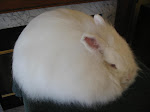
2) Clipping Schedule--Another list I keep has the names of each bunny alongside dates as to when each was clipped so I can keep track of how quickly the wool grows back and also get an idea of how long each bunny holds a coat. Information like this has been invaluable so far in determining the average hold time for each bunny as well as the average for my herd. I try to always clip during the slipping stage so as not to cut off the ingrowing tips of the next coat, so knowing when to expect this stage really helps me to time my coats. The next thing I hope to do in the future is get even more specific and have information next to each bunny stating how long each stage of wool growth lasts--for ex. New Growth/ Prime/Slipping/ Molt/, etc.

3) Breeding Schedule--I also have a chart hanging up that shows a list of my most important show dates and what month/week the does need to be bred in order to get Juniors and Seniors of the proper age for each one. Before breeding anyone I always try to refer to this list to find out when I OUGHT to be breeding according to a certain show date (such as Convention). However, there are times when I have to disregard this totally, like when I have a schedule change, or if a doe is older and needs to squeeze in a few extra litters before she 'retires'. Breeding really depends on the factor being considered at the moment, but I do always try to breed my best buns on the most 'important' show schedule dates.

4) Grain Mix Recipe and Schedule--I also have a list hanging up containing my exact grain mix recipe (since it has changed a few times and I don't really have it memorized:)), and also the measured amounts that my herd receives depending on the time of year or individual circumstances (ex. prego does get a specific amount until they kindle, after which they get no supplements at all until the babies come out of the nestbox and begin eating pellets with her out of the group feed dish).

These are just a few of the bunny records that I will be including when I get a bulletin board set up, but I'm sure I will be adding more info. such as tattoo numbers (where I left off after the last baby batch, etc.), calendars with breeding and kindling dates listed (instead of using my everyday family calendar:)), and a host of other tidbits that I could easily enter in my computer program but that I prefer to stare at instead:).

Sunday, May 30, 2010

Current Events

Busy, busy, busy! Oh my gosh,the last few weeks have been insane with three kids playing baseball (on different teams!), my job, end of year school testing, garden chores, litters being born and weaned, and as usual, too many other things to count and keep track of:).

Yesterday and today two litters were born to Bijou and Carmen, and I am waiting for two more over the next day or two from Diana and Kimba. Bijou gave birth to 6 kits yesterday (1 Black and 5 REW), and Carmen had the same exact number with some Black in her litter also, combined with a bunch of regular Torts. I can't wait to see the quality of these babies since I used a REW buck for both that is probably one of the best typed buns I have ever bred out. Spang's Diego is a REW F4 cross with fabulous type and density, but I have not been able to get him to the show table as yet due to his unfortunate tendency to spray himself and all others, LOL. With an incoming coat he has been moved to 'solitary confinement' in a corner of the barn with no neighbors to the top, bottom, or sides of him. He seems to be neater as a result, but we'll see how far it gets and if the temptation to hose something winds up getting the better of him anyhow, haha:).

Aside from this there is not much else going on, except that we are having warmer days and summer is on it's way along with heat, fans, ice packs, and all the other things that make this time of year a living hell for rabbit breeders:(. I weaned all the first litters of the year now and they are doing well at 7-8 weeks. In a little while I will begin taking them out and seeing how everyone looks (who seems to have potential and who doesn't) and begin the sorting process that peaks at week 12 when I decide who will stay and who will be sold to new homes and new breeding programs.

And as if all this weren't enough, a friend who is a 4-H Poultry leader emailed me recently about some ducklings who had been hatched in a Manhattan classroom and needed new homes. Although I have never owned ducks before (and wouldn't have minded keeping it that way), my dh and kids thought differently and decided to build a new place here for them to stay:). Needless to say we now have 9 little ducklings in our yard (one of whom is pictured below). There were 2 Cayugas and 7 Welsh Harlequins in the bunch, so hopefully they will provide lots of eggs and entertainment:).


More again next time and have a great week!

Sunday, May 23, 2010

Disease Factors in Rabbits

--another post from the old blog

I was browsing through the Rabbit Production book again today (which I have said time and time again is my favorite rabbit resource:)), and I found an excellent description of the three most important factors in preventing disease in a rabbit herd. As everyone knows, illnesses such as Pasteurella (aka Snuffles) are among the most feared health problems in rabbits, and since there are virtually no vaccines available for rabbits, it is imperative that our herds are genetically sound and that we pay continual attention to the three factors mentioned in RP's 'Rabbit Diseases and Health Problems' chapter.


According to the book on pages 198-199, the three most important factors involved in disease control are Ventilation, Sanitation, and Observation.


1) Ventilation is crucial to healthy rabbitries because "air dilution" serves to reduce the concentration of harmful bacteria, viruses, and protozoa. This in turn gives the rabbit's immune system a better chance of fighting off a germ that may otherwise have overwhelmed it if the ventilation was poor and the population of these organisms increased.

2) Sanitation is the "physical or chemical" removal of potential disease causing organisms by scrubbing or through the use of disinfectants such as Bleach, Vanodine, or Listerine (for ex). Cage pans and floors should be kept clean, and hair and wool that is stuck to the wire in various places should also be removed. According to RP, "a single rabbit hair can carry thousands of bacteria or viruses".

3) Observation is exactly what it appears to be----keeping a close eye on how your rabbits feel from day to day. The problem with maintaining large rabbit herds is that it is easier to miss potential health problems due to the lack of time devoted to each animal. Watch your herd carefully and be aware of those who suddenly look peaked, unthrifty, or ill, or who stop eating and display signs that they are stressed or under the weather. Remove sick rabbits from the main herd immediately and isolate them in quarantine until you determine the problem and prevent the spread of contagious bacteria or viruses throughout the herd. Do NOT be soft on sick animals when they appear-----ANY sign of disease, particularly Pasteurella, should be dealt with immediately and the animal should be humanely disposed of if the disease proves incurable and the rest of your herd is at risk. Pet owners who keep a few isolated rabbits for wool may elect to pursue medical options that are available to forestall the effect of these diseases, but a show or production breeder cannot risk the health of an entire herd by coddling the weak and permitting disease symptoms to go unchecked:(.

Many individuals specialize in trying to prevent disease with the use of regular doses of antibiotics, products that keep ammonia smells down in the rabbitry, and the liberal use of drugs and medications when their rabbits get sick. All of these measures are expensive and usually unnecessary, and unfortunately serve to mask the root of a problem. The simpler solution is to breed for strong immune systems, keep the rabbitry as clean as possible, and make sure that there is an excellent exchange of air at all times. The importance of good nutrition should not be ignored either, as a rabbit in good health will be much more able to fight off disease than one who is malnourished. These tips are simple but effective, and all that any rabbit breeder needs to know to produce a healthy herd:).

Sunday, May 16, 2010

Rabbit Handling

I have been wanting to post an entry about rabbit handling after a discussion that took place on the FA list. A great point was made during this discussion that since handling (and rabbit holds) are such a difficult thing to explain in words it would be nice to have a film or pictures available to study and imitate as needed. I decided to take a bunny out and post a few pics for anyone who might be interested:).

I decided to use a recently clipped rabbit for this tutorial because my hand placement would be easier to see, as well as the location of both ends of the rabbit. LOL. This is Spang's Miriam, a young REW doe who has recently been clipped.

The first picture below shows the standard method breeders and show people use to transport their rabbits from place to place. You can see that the bunny's head is tucked beneath my elbow on one side and the entire rabbit is being supported in a 'football' hold to keep it calm and avoid unnecessary movement.


The first step in the process of flipping a rabbit over to check teeth, etc. is to place it down in front of you on all fours. Grasp the rear of the rabbit with one hand, and the BASE of the ears (and back of the head) with the other so that the head is firmly in place and cannot move from side to side.


Supporting the hindquarters strongly, lift the rabbit gently and turn it over deliberately, allowing for no twisting or struggling.


To check teeth, LIGHTLY balance the rabbit on it's back and use the hand that previously held the head to quickly lift the top lip of the rabbit. A quick look is all that's necessary to rule out malocclusion. Do not dawdle in this part of the bunny examination. Most rabbits absolutely hate having their teeth checked:(.


When you are finished checking teeth (or any other part of the underside that requires checking), gently grasp the rabbit in the same position as before (on the rump and head) and flip it back to it's original position on the table, facing you on all fours.


In order to flip an angora over for belly grooming, all you have to do is employ the above method over your lap instead of the grooming table. If you prefer to sit on the floor with your legs extended out in front of you that's fine, but you can also sit on a chair and rest the rabbit between your knees where it cannot escape or injure itself.


In this position (wedged between your knees with one hand supporting head and ears firmly again), it is extremely easy to groom or clip the underside of your rabbit, even on the chin or chest, which are difficult areas to reach. Again, once you are finished, simply flip the rabbit over right side up again using the method shown above.


Bunny handling takes some time to learn, but with practice it truly becomes second nature and the rabbit feels safe and secure. There are different ways of handling rabbits and everyone must find their own comfort level, but the method shown above is the same one judges employ at shows and it has been tried and true for decades.

Hopefully this 'tutorial' has been helpful:). I will see if I can find other step by step subjects to blog about, especially since my 12 year old son is getting to be such a good photographer that I don't have to take all the pictures myself anymore, LOL.

Have a great week and see you again next time:-)

Saturday, May 8, 2010

Giant Stuff!

I have been running around like a crazy person since baseball season started and there are three kids playing ball here at the same time--!! Today's game got rained out and the other kids' practice was canceled, so now there are a few minutes to sit down and shift to bunny mode:).

I am planning on posting a detailed entry about how to carry and flip a rabbit for grooming (with pictures) ASAP, but first I have to get the pictures taken and everything else assembled. By next week I will be ready to post it for sure:).

All of my juniors in the barn are currently clipped down to grow Sr. coats for Fall, and we are in full-fledged breeding mode at this point. All the does I needed to breed have pretty much been done and the first crop of litters will soon be weaned. The only rabbits currently in coat now are Spang's Beauregard (a REW buck I kept in his first Sr. coat), and JG's Milo, a Black Giant Jr. buck that I picked up from Janet Gruber a couple of weeks ago:).

Milo is a spunky little guy with fabulous type and a nice coat coming in (if he was White he would make a great show rabbit *grin*). At this point I am doing absolutely nothing but keeping him groomed and watching him. I am trying to see exactly how his wool develops, what types of maintenance requirements he has, and how long he can go from coat to coat without needing shearing. So far he has a monstrous appetite (which is fantastic), and doesn't seem to need grooming more than once a week, at least not yet:). When he does get groomed it definitely takes longer than FAs of the same age because of his feet and furnishings, etc. but once he gets older I will probably just hit him with the blower once a week and do the furnishings by hand, which should save more time.

Here are some pictures I took of Milo below. In the GA breed bucks tend to have heavier furnishings than the does, and IMO this is a great thing because I don't plan on having more bucks than I need, LOL! I think (being a French person:)) that I would rather have lots of does with the cleanest allowable heads here:-).

Anyhow more again next week when there is much more time. Hope everyone is having a great spring with lots of babies!


JG'S MILO-10JG5


Saturday, April 24, 2010

Babies!

Today the first four litters of the year passed the 2 week mark, and I took everyone out of their nestboxes to change the stuffing and disinfect everything. While the bunnies waited for their little 'houses' to dry and become livable again, they all hung out in towel-lined laundry baskets, which gave me the perfect opportunity to take pictures without all that hay and wool in the way:-).

This first picture is of Etienne's litter---a few Torts, Blacks, and one Sable:


This is Marin's litter--also Torts, Blacks, Sables, and one Sable Pearl thrown in:).


Yvonne's litter had lots of variety in it--Sable, Sable Pearl, Tort, and 1 Seal there in the middle:


The three pictures below are of Natalya's litter with Sables, Sable Pearls, Torts, a Black, and 3 Seals (shown close-up in the first shot):


And this is a close-up of the two Pearls in Nat's litter, where you can see the great shading that will probably indicate very good color in the Senior coats.


After each box was cleaned and filled with fresh hay, all the litters were returned to their respective nests where they promptly and instantly fell asleep (a laundry basket can wear a baby out, alright--grin). Of course all these nests will have to be covered overnight in order to keep the occupants from jumping out as soon as they get hungry in the morning, but for now they are still content to sleep most of the day and not worry about much else:).


Anyway, more again next week when new breedings are added to the schedule and everyone who is inside will permanently be moved outside. Have a great week!