It's been a long time since I've posted (I mean really, obscenely long:( ), and I think that every year from now on at this time I will have to take a formal break from blogging until the baseball season is over because with 3 kids going in 3 different directions for MONTHS there is little time for anything but cooking, cleaning, sleeping (if I'm lucky:)) and washing uniforms. Whew!!
Anyway, the season is mostly over now, so it is time to get caught up on rabbit stuff again. I did manage to get my barn pulled apart and deep cleaned several weeks ago, so everyone is now housed in a bright, clean, shiny, happy barn:). I bred LOTS of babies over the spring/summer---probably more than I've bred in years----so now it is a matter of weaning those litters off and evaluating them several weeks later to determine who stays around and who has their destinies decided elsewhere. Since so many babies were born this spring I have decided to give my does the summer off and not breed again til the fall. Clearly this was a good choice since along with everyone else on the eastern seaboard (and the entire country!), we are having HORRIBLE high temps that have more than likely rendered all the bucks sterile.
Tomorrow we have another near-100 degree day here, and then it is supposed to cool down somewhat. I've spent most of the last few days shearing as many rabbits as possible down to the skin. Aside from a few of the French adults growing in showcoats (who will be lounging in the basement to stay cool), there is no reason to keep anyone else in coat in these high temperatures.
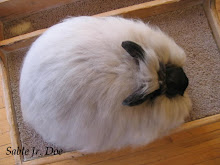
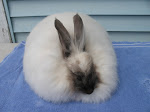
I have found that the Giants, especially, suffer terribly in this weather. Notwithstanding their thicker, more insulative coats, they also have the problem of heavy ear and facial furnishings which prevent them from dissipating heat the way a clean-headed rabbit breed would. FAs seem to handle the weather well and so do Satin Angoras, but as long as any wool rabbit is either sheared or kept groomed so that no matting occurs to make it even hotter, most are able to cope well and get through these dog days of summer:(.
More again this weekend as I can get some pictures taken of the latest buns and get my show on the road once more:). I may be making a trip to the state of VA sometime later this summer and bringing buns down south as a result. Stay tuned for more details!
Have a great week and STAY COOL:-)
Thursday, July 21, 2011

Tuesday, May 17, 2011
Economy in the Rabbitry--Feed
As gas prices go up and the price of everything seems to be rising each day, it is a good idea to look over our rabbitry routine periodically to see if we can cut costs:).
As we have all noticed, feed prices go up when gas costs go up. Lately, feed prices have skyrocketed, which makes any breeder pause to think about how their costs can be contained. Since feed is by far the most expensive ingredient in raising rabbits, it is the first factor to consider.
Quality angora feed is not cheap, but there are things we can do to lower the price:
1) Order it by the ton. A ton of feed sounds overwhelming, but when you consider the fact that a rabbitry of 40 or more adults including nursing does and babies can easily polish off 4 or more 50 lb. bags of feed a week, it becomes a logical and attractive option. A ton of 40 lb. bags of feed amounts to 50 bags. A ton of 50 lb. bags equals 40 bags. If you order a ton of feed straight from a company you will not only get it at the wholesale price, but even with the cost of shipping you may find that you can save 5$ or more per bag under the cost at your local feed store. Add this benefit to the fact that you are eliminating a middle man who may a) be storing your feed improperly, b) forgetting to order at the right time thus leaving you hanging at the worst possible moment, and c) neglecting to keep track of expiration dates. Ordering feed yourself often makes it possible to get a batch right after it has been milled, and even if you do not have anyone to share a ton with (another breeder to split it with you, etc.), you would still have a good chance of using up the full amount by the time it expired. 1/2 tons are also available to order from most companies, but shipping costs are often the same and it is usually more economical to order the full ton.
2) Choose a less expensive feed. Though you would never want to use a feed with poor quality ingredients, there are certainly variations in price between most of the major brands. Depending on where you live, feeds which are manufactured nearby are going to be cheaper (and fresher) than brands which are milled far away. Also, some brands are available in 50 lb. bags while others are available in 40, making it smart to calculate cost effectiveness.
3) Use a lower protein feed for younger rabbits and a higher protein one for adults, especially if a lower version in the same feed line is cheaper. Angora juniors, for example, are not typically competitive on the show table and baby wool is not of great value to the spinner either, so it does not necessarily pay to feed babies a top of the line feed with a high protein level to promote wool growth. Most major feed lines offer an assortment of feed preparations with varying protein levels. A Standard 16% (or even 15%) feed will work very well for babies up to 4 months, and may better safeguard gut health since juniors of 14 weeks and below are more susceptible to enteritis.
4) Cut down the number of rabbits in your herd. This can be difficult if you are trying to maintain a gene pool of a certain size or are working on a project which requires frequent, heavy breeding. However, if cutting back means the difference between continuing or going out of rabbits altogether, you will simply have to prioritize. If you are forced to downsize, one option to consider is to take on a partner who has similar breeding goals and animals of similar quality who would be willing to trade rabbits and breedings to keep the line/gene pool healthy. Since agreements of this nature can often run into conflict, it is important to partner with someone who shares your breeding goals and is someone with whom you get along well.
More again next time as I add to this topic and try listing ways to save $$ on hay, supplements, meds, tools, cage equipment, and so on. Also, I will add a list at the end to suggest ways of bringing money in while raising rabbits. Rabbits are not typically known as money makers, but it is certainly possible to make enough profit while raising them (particularly angoras) to cover the cost of feed and other needs.
Have a great week!:-)
As we have all noticed, feed prices go up when gas costs go up. Lately, feed prices have skyrocketed, which makes any breeder pause to think about how their costs can be contained. Since feed is by far the most expensive ingredient in raising rabbits, it is the first factor to consider.
Quality angora feed is not cheap, but there are things we can do to lower the price:
1) Order it by the ton. A ton of feed sounds overwhelming, but when you consider the fact that a rabbitry of 40 or more adults including nursing does and babies can easily polish off 4 or more 50 lb. bags of feed a week, it becomes a logical and attractive option. A ton of 40 lb. bags of feed amounts to 50 bags. A ton of 50 lb. bags equals 40 bags. If you order a ton of feed straight from a company you will not only get it at the wholesale price, but even with the cost of shipping you may find that you can save 5$ or more per bag under the cost at your local feed store. Add this benefit to the fact that you are eliminating a middle man who may a) be storing your feed improperly, b) forgetting to order at the right time thus leaving you hanging at the worst possible moment, and c) neglecting to keep track of expiration dates. Ordering feed yourself often makes it possible to get a batch right after it has been milled, and even if you do not have anyone to share a ton with (another breeder to split it with you, etc.), you would still have a good chance of using up the full amount by the time it expired. 1/2 tons are also available to order from most companies, but shipping costs are often the same and it is usually more economical to order the full ton.
2) Choose a less expensive feed. Though you would never want to use a feed with poor quality ingredients, there are certainly variations in price between most of the major brands. Depending on where you live, feeds which are manufactured nearby are going to be cheaper (and fresher) than brands which are milled far away. Also, some brands are available in 50 lb. bags while others are available in 40, making it smart to calculate cost effectiveness.
3) Use a lower protein feed for younger rabbits and a higher protein one for adults, especially if a lower version in the same feed line is cheaper. Angora juniors, for example, are not typically competitive on the show table and baby wool is not of great value to the spinner either, so it does not necessarily pay to feed babies a top of the line feed with a high protein level to promote wool growth. Most major feed lines offer an assortment of feed preparations with varying protein levels. A Standard 16% (or even 15%) feed will work very well for babies up to 4 months, and may better safeguard gut health since juniors of 14 weeks and below are more susceptible to enteritis.
4) Cut down the number of rabbits in your herd. This can be difficult if you are trying to maintain a gene pool of a certain size or are working on a project which requires frequent, heavy breeding. However, if cutting back means the difference between continuing or going out of rabbits altogether, you will simply have to prioritize. If you are forced to downsize, one option to consider is to take on a partner who has similar breeding goals and animals of similar quality who would be willing to trade rabbits and breedings to keep the line/gene pool healthy. Since agreements of this nature can often run into conflict, it is important to partner with someone who shares your breeding goals and is someone with whom you get along well.
More again next time as I add to this topic and try listing ways to save $$ on hay, supplements, meds, tools, cage equipment, and so on. Also, I will add a list at the end to suggest ways of bringing money in while raising rabbits. Rabbits are not typically known as money makers, but it is certainly possible to make enough profit while raising them (particularly angoras) to cover the cost of feed and other needs.
Have a great week!:-)
Monday, May 2, 2011
Bijou and---Baseball!
I just clipped Bijou recently, but since she had this beautiful, beautiful coat ahead of time I figured it would be necessary to post 15 million pictures of it first, LOL. It was a little windy that day so she's slightly unkempt, but she yielded close to 11 oz. at this clip, and it will all be going to members of my mother's local spinning group:).
I had a few more litters born last week, and am expecting many more next week, including several FA litters. I will be breeding 3-4 more French does this week, and I think I will have to build many more nestboxes soon too, because the usual supply just isn't cutting it anymore, LOL.


And just as an aside, we went to my son Keith's first Babe Ruth double header game this weekend. There he is (#11!) first in the huddle with his team, then in the yard in his uniform, and last in the batter's box right before he got a big hit:). All three boys are on different teams this year so it is going to be crazy trying to keep up with them this season (much less trying to transport everyone, LOL!!)


Anyway, have a great week and more again next time!:-)
I had a few more litters born last week, and am expecting many more next week, including several FA litters. I will be breeding 3-4 more French does this week, and I think I will have to build many more nestboxes soon too, because the usual supply just isn't cutting it anymore, LOL.


And just as an aside, we went to my son Keith's first Babe Ruth double header game this weekend. There he is (#11!) first in the huddle with his team, then in the yard in his uniform, and last in the batter's box right before he got a big hit:). All three boys are on different teams this year so it is going to be crazy trying to keep up with them this season (much less trying to transport everyone, LOL!!)


Anyway, have a great week and more again next time!:-)
Sunday, April 24, 2011
Happy Easter!
Just a series of pics that remind us all of Spring around here (and Easter!!:-)). I hope everyone has a wonderful holiday with many, many bunny babies this spring.
HAPPY EASTER!!:-D


HAPPY EASTER!!:-D


Saturday, April 16, 2011
Rhinebeck, NY Show
I just got home from the Rhinebeck show a couple of hours ago and I am still shivering even as I write (ugh!) due to the miserable weather and pouring rain we all endured. I am really glad to be home and even more glad to be taking the coats off the three remaining does I brought so everyone can finally be bred:).
There were very few Angoras present at Rhinebeck this year, but perhaps better weather next year will encourage more to attend. I brought three does to show since I was also working as Registrar, but two of them managed to earn BOB in both shows----Spang's Midori in Show A, and Spang's Bijou in Show B. I did not end up bringing my camera for pictures since I accidentally left it in my son's backpack yesterday (LOL!), but I will try to get a picture up later of Bijou in particular, who is in super, duper full coat right now.
Right now every single doe (and I mean every SINGLE one!) of breeding age with the exception of the above three rabbits are bred right now. Most are pure French litters, but others are French/Giant and a few others are Satin, so it is going to be a busy, BUSY spring:). I have realized also lately that my FA herd needs to be beefed up, so I'll be breeding lots of those through the spring and summer too. All this breeding will mean that there will be little if anything left to show this spring, but occasionally it is necessary to skip a show season or two in order to stabilize the herd and redefine one's direction:). I have always considered myself to be a breeder before anything else (including showing), so it is important to stop every once in awhile to examine plans and make adjustments accordingly.
Anyway, more again next time as I post some pictures and get on track with different subjects. Hopefully everyone out there is experiencing a HUGE surge in litters with the warmer spring weather, so have a great week!:-)
There were very few Angoras present at Rhinebeck this year, but perhaps better weather next year will encourage more to attend. I brought three does to show since I was also working as Registrar, but two of them managed to earn BOB in both shows----Spang's Midori in Show A, and Spang's Bijou in Show B. I did not end up bringing my camera for pictures since I accidentally left it in my son's backpack yesterday (LOL!), but I will try to get a picture up later of Bijou in particular, who is in super, duper full coat right now.
Right now every single doe (and I mean every SINGLE one!) of breeding age with the exception of the above three rabbits are bred right now. Most are pure French litters, but others are French/Giant and a few others are Satin, so it is going to be a busy, BUSY spring:). I have realized also lately that my FA herd needs to be beefed up, so I'll be breeding lots of those through the spring and summer too. All this breeding will mean that there will be little if anything left to show this spring, but occasionally it is necessary to skip a show season or two in order to stabilize the herd and redefine one's direction:). I have always considered myself to be a breeder before anything else (including showing), so it is important to stop every once in awhile to examine plans and make adjustments accordingly.
Anyway, more again next time as I post some pictures and get on track with different subjects. Hopefully everyone out there is experiencing a HUGE surge in litters with the warmer spring weather, so have a great week!:-)
Sunday, April 10, 2011
Rabbitry Planning
Well, it looks like the miserable winter has come to an end and spring has finally sprung:-). I have been spending most of my time this past week opening up the rabbitry, cleaning things out, moving bunnies around, and replacing dirty dishes, footboards, and water bottles, etc. One evening last week I made up this drawing in which I designated certain parts of my rabbitry for different breeds:

The most spacious part of the plan (that is, the inside of the barn) will always be used to house the FAs. There are approx. 40 cages in there which give me enough space (most of the time, haha:)) to fit all my babies and adults every year as long as I stagger litters instead of breeding every doe at once.
Since my Giant program is growing now, too, I am going to need more space for babies. I moved all the GAs to the outside of the barn in which there is a long row of large size cages. Opposite these cages, and up against the back of my house, there will eventually be a third row (with a walkway in between) in which I will raise a few Satin Angoras.
I may not have mentioned it before, but I recently picked up two new SA bucks at the PaSRBA show in February. I never thought of myself as owning Satins in the past, but my mother Lesa absolutely LOVES Satin fiber and spins it whenever she gets the chance:). Since she has graciously accompanied me to shows now for years and has been a constant source of help and support, I thought the least I could do was get her a couple of rabbits, LOL!
I don't know if I will ever show Satins or raise them for the long term, but they are certainly interesting to observe and contrast with the other angora breeds, and it is always good to have the experience of raising several different kinds of rabbits. Having said this though, I doubt I will ever own an English Angora because the maintenance requirement is just too high and I would never be able to cope with that many furnishings, LOL.
Anyway, lots of clipping and breeding happening tomorrow. My five most recent litters are now growing like weeds and will be in the barn soon permanently. The next wave of babies appears soon after that:).
More again next time as the spring bunny chores really take off. Most important of all there is the annual pull-the-whole-barn-apart-and-clean-every-square-inch-of-the-walls-floors-and-ceilings weekend to think about, but since that is one of the biggest jobs of the year around here, I try not to stress myself about it before I have to (*grin*).
Have a great week!

The most spacious part of the plan (that is, the inside of the barn) will always be used to house the FAs. There are approx. 40 cages in there which give me enough space (most of the time, haha:)) to fit all my babies and adults every year as long as I stagger litters instead of breeding every doe at once.
Since my Giant program is growing now, too, I am going to need more space for babies. I moved all the GAs to the outside of the barn in which there is a long row of large size cages. Opposite these cages, and up against the back of my house, there will eventually be a third row (with a walkway in between) in which I will raise a few Satin Angoras.
I may not have mentioned it before, but I recently picked up two new SA bucks at the PaSRBA show in February. I never thought of myself as owning Satins in the past, but my mother Lesa absolutely LOVES Satin fiber and spins it whenever she gets the chance:). Since she has graciously accompanied me to shows now for years and has been a constant source of help and support, I thought the least I could do was get her a couple of rabbits, LOL!
I don't know if I will ever show Satins or raise them for the long term, but they are certainly interesting to observe and contrast with the other angora breeds, and it is always good to have the experience of raising several different kinds of rabbits. Having said this though, I doubt I will ever own an English Angora because the maintenance requirement is just too high and I would never be able to cope with that many furnishings, LOL.
Anyway, lots of clipping and breeding happening tomorrow. My five most recent litters are now growing like weeds and will be in the barn soon permanently. The next wave of babies appears soon after that:).
More again next time as the spring bunny chores really take off. Most important of all there is the annual pull-the-whole-barn-apart-and-clean-every-square-inch-of-the-walls-floors-and-ceilings weekend to think about, but since that is one of the biggest jobs of the year around here, I try not to stress myself about it before I have to (*grin*).
Have a great week!
Monday, March 21, 2011
Just a Few Pics
These are just a few pics today of Giant Crosses that were out for grooming this weekend. There are more in the barn waiting for their own photo sessions (LOL), but here are 3 of my does who are FA/GA and FA/NZ/GA crosses. These girls have about 2 months worth of growth on them now. I am waiting to see how far they can go (wool-wise) before needing a clipping. Once these coats are finished all three girls will be bred to Spang's Tundra, the largest REW FA/NZ/GA cross I bred this winter, and I will see what comes out:). All three of these girls are 8 months old; the Black does weigh 9 1/2 lbs. each and the Chocolate is currently at 11.
SPANG'S BOCA-0SP102

SPANG'S LOLO--0SP107

SPANG'S DAFFODIL--0SP91

More again next week as the weather continues to thaw. Happy Spring!!:-)
SPANG'S BOCA-0SP102

SPANG'S LOLO--0SP107

SPANG'S DAFFODIL--0SP91

More again next week as the weather continues to thaw. Happy Spring!!:-)
Subscribe to:
Posts (Atom)