--Another post from the old blog:
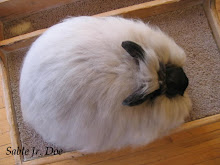
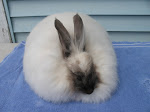
After lots of reading and lots of time spent wracking my brain about what a good conditioning regimen might be for an Angora rabbit, (AARGH!!) I have finally come up with something to try with my rabbits that may provide a slightly increased holding time and an enhanced condition during the Prime period.
The problem with figuring out how to condition an Angora vs. any other short haired breed seems to be that A) the composition of the coat is very different from that of a short haired rabbit, and B) the growth and molting schedule is also different and often more frequent. Some people feel that Angora is susceptible to 'wool breaks' just like sheep wool is when the nutritive content of the feed is changed dramatically, and others believe that Consistency is the key overall and the same supplement/ration level should be used year round regardless of wool, growth, or molt cycle. Most short-haired rabbit breeders change feed schedules abruptly depending on coat phase and season, but since a sudden change can have an adverse effect on Angora wool, whatever gets added or taken away from the diet must be added and withdrawn slowly, and the feed schedule that is in place must be followed consistently so that negative effects on the coat can be minimized.
What I did to work out a usable formula for angoras was to read different accounts of conditioning programs used by short haired and angora breeders alike, and I talked to a few experienced breeders of both in order to get their opinions. What all articles and people said in common were the things that I tried to include in my own formula, and here is the diet I came up with that I am going to institute with my own herd:
1) Up until the age of 6 months give plain pellets only, with Oats mixed in or fed separately each day. Do not overfeed pellets----make sure that your babies always have plenty to eat but try to make sure that they clean their dishes out completely before giving them more (overfeeding at this age can prevent them from developing good skeletal structure and muscle before the conditioning process begins)
2) After the main growing period is over (6-9 months for an FA, depending on line and genetics), begin supplementing pelleted ration with a grain mix containing barley, oats, milk pellets, horse sweet feed, black oil sunflower seed, OR roasted soynuts, birdseed, barley, oats, OR any other combination of grains that you have found to work with your rabbits. Offer the Mix in the morning and Pellets at night or vice versa, and try to spread feeding the two approx. 12 hours apart. It is important to reduce your pellet level to accomodate this supplement, so if you feed 1/4 cup grain mix, you need to reduce your pellets to 3/4 cup later on.
3) Feed normal Pellet plus Supplement ration until RIGHT before the rabbit hits Prime (in many angoras this will work out to be about the third month of growth), and then slowly reduce the pellets about 1/4 cup, feed plenty of hay, and ADD MORE OATS to the grain mix so that the energy level goes down and you can shift the coats from 'growth' to 'maintenance' mode.
4) Keep the ration amount lowered to about 3/4 cup total until your coats slip and molt. Afterward, begin the whole process over again once the coat has been harvested and you are sure that the molt is completely finished. In addition to this, remember to adjust your feed program according to the season and individual needs. In hot weather be sure to scale back grain mix and feed somewhat, but in cold weather remember to add more to maintain coat and flesh condition. Also, disregard all of the above when feeding pregnant and nursing does, and also realize that you will occasionally have rabbits who will just eat more or less according to their own constitutions, and prepare to treat them accordingly no matter what the 'norm' may be.
I realize this formula is not much different than most of the other ones out there, but the main difference when feeding an angora is simply that changes need to be made gradually to accomodate the needs of a unique coat. I will give this regimen a try for a year or so through approx. 2 growth cycles in my own breeding program, and if it works I will jump around and celebrate, LOL, but if it doesn't I will scrape together the pieces and look for something else that does.
Til next time.....:)
Sunday, February 22, 2009

Wednesday, February 11, 2009
PA Convention 2009
I meant to post about this show much earlier but work got in the way and after a huge windstorm the internet went down too, making this week a wash and forcing me to wait til Saturday, LOLOL.
The PA Convention last weekend was a wonderful and incredibly fun show, as always:). The showing part is always fun but it is never quite as great as seeing tons of friends and fellow breeders that you never get to see during the year, in addition to new people that you meet on the net but never put a name to until this show comes along:). Since the PA Convention is two days long there is plenty of time for catching up with friends, going out to dinner, and hanging out to talk rabbits ad nauseum, which is never acceptable in any other place but is actively encouraged with fellow angora nuts:).
There were 2 Open shows this year, and one Specialty. I only managed to bring 2 bunnies this year because the rest of my show string had fallen by the wayside due to woolblock or less- than- ideal condition. Fabrice, my REW Sr. buck, was one of the entries, but while he won his class and did well in the first show he was beginning to mat up seriously underneath, so rather then risk embarassing (but well deserved, haha) comments, I pulled him out of the last two shows:). The only other rabbit left then was Juno, who is 3 now but who seemed able to maintain flesh and wool condition despite the bad winter, and who had a fabulous weekend with BOBs in all three shows and a BIS in the Specialty!
The numbers for this show were lower than usual, the total angora entry being somewhere around 70-75 with approx. 20 FAs being shown, 25 EAs, and fewer entires in the other two breeds (GA and SA). The UARC Specialty went very well also, though it will certainly be better next year when we have more time to prepare and our entry info. is listed in the main PaSRBA catalog. All in all there were approx. 6 exhibitors in the FA class, and the judges for each show were Bill Patrick, Chris Hayhow, and Jay Hreiz.
Here are some pictures that I (or my ever-helpful mother:)) took over the weekend. The first is of the Show Hall/Wool Room on Friday afternoon, before everyone came:


Next is the showroom on Saturday morning, with everyone frantically grooming and getting ready for the AM show:

This is the other end of the showroom, from the judging table side. PaSRBA is absolutely fabulous at arranging their shows so that there are tables set up in every hall for people to put their carriers on and store supplies underneath. Nothing is ever too crowded here and there is always plenty of room for people to go up and down the aisles as much as necessary.


And here is Julie George, our wonderful Secretary, chatting with Charlotte Schweikart and holding her FA boy in prep. for the Wool judging:

This (fuzzy:)) picture is of me holding Juno after the first or second show-- I can't quite remember which. I hate having my picture taken (as you can see here) and I will do anything I can to avoid it, LOL:). Unfortunately I was painfully trapped in this situation and had no choice, but next time I will be sure to find a closet or something to hide in and leave the rabbit on the table or so, hahaha!

Below is Linda Cassella with two of her beautiful EAs before the BISS. The BOB for this show was her REW buck (or doe:).

And this is Lisa Rodenfels with her winning SA doe, who won her 7th leg at this show and was sold to an excited new owner when the whole thing was over:). This rabbit had fabulous, smut-free color:

And this is Terri Robertson, who won the BOB with her Giant Angora. She had a fantastic day:).

This picture is of all the BOB Winners from the UARC Specialty show. The results were as follows:

The PA Convention last weekend was a wonderful and incredibly fun show, as always:). The showing part is always fun but it is never quite as great as seeing tons of friends and fellow breeders that you never get to see during the year, in addition to new people that you meet on the net but never put a name to until this show comes along:). Since the PA Convention is two days long there is plenty of time for catching up with friends, going out to dinner, and hanging out to talk rabbits ad nauseum, which is never acceptable in any other place but is actively encouraged with fellow angora nuts:).
There were 2 Open shows this year, and one Specialty. I only managed to bring 2 bunnies this year because the rest of my show string had fallen by the wayside due to woolblock or less- than- ideal condition. Fabrice, my REW Sr. buck, was one of the entries, but while he won his class and did well in the first show he was beginning to mat up seriously underneath, so rather then risk embarassing (but well deserved, haha) comments, I pulled him out of the last two shows:). The only other rabbit left then was Juno, who is 3 now but who seemed able to maintain flesh and wool condition despite the bad winter, and who had a fabulous weekend with BOBs in all three shows and a BIS in the Specialty!
The numbers for this show were lower than usual, the total angora entry being somewhere around 70-75 with approx. 20 FAs being shown, 25 EAs, and fewer entires in the other two breeds (GA and SA). The UARC Specialty went very well also, though it will certainly be better next year when we have more time to prepare and our entry info. is listed in the main PaSRBA catalog. All in all there were approx. 6 exhibitors in the FA class, and the judges for each show were Bill Patrick, Chris Hayhow, and Jay Hreiz.
Here are some pictures that I (or my ever-helpful mother:)) took over the weekend. The first is of the Show Hall/Wool Room on Friday afternoon, before everyone came:

The second is one corner of the grooming area (with many more tables behind me and along the other wall) on Saturday:

Next is the showroom on Saturday morning, with everyone frantically grooming and getting ready for the AM show:
This is the other end of the showroom, from the judging table side. PaSRBA is absolutely fabulous at arranging their shows so that there are tables set up in every hall for people to put their carriers on and store supplies underneath. Nothing is ever too crowded here and there is always plenty of room for people to go up and down the aisles as much as necessary.
This is Lisa Rodenfels and Annette Boose (on the left) writing for the UARC show. Both did a fabulous job and are hyper organized people= great writers:)

This is the UARC show also with Chris Hayhow judging and the FA people looking on.
And here is Julie George, our wonderful Secretary, chatting with Charlotte Schweikart and holding her FA boy in prep. for the Wool judging:
This (fuzzy:)) picture is of me holding Juno after the first or second show-- I can't quite remember which. I hate having my picture taken (as you can see here) and I will do anything I can to avoid it, LOL:). Unfortunately I was painfully trapped in this situation and had no choice, but next time I will be sure to find a closet or something to hide in and leave the rabbit on the table or so, hahaha!

Below is Linda Cassella with two of her beautiful EAs before the BISS. The BOB for this show was her REW buck (or doe:).

And this is Lisa Rodenfels with her winning SA doe, who won her 7th leg at this show and was sold to an excited new owner when the whole thing was over:). This rabbit had fabulous, smut-free color:

And this is Terri Robertson, who won the BOB with her Giant Angora. She had a fantastic day:).

This picture is of all the BOB Winners from the UARC Specialty show. The results were as follows:
Giant Angora:
BOB--Terri Robertson
BOS--Janet Gruber
Satin Angora:
BOB--Lisa Rodenfels
BOS--Trina Dunn
French Angora:
BOB--Amy Spang
BOS--Charlotte Schweikart
English Angora:
BOB--Linda Cassella
BOS--Alex Stepnoski
BIS--French Angora/ Amy Spang

This is a really great prize that I got at the end of the first Open show. It's a standard ceramic crock with 'Best of Breed' etched onto the side. A really creative award I thought, and one that litters of bunnies will certainly appreciate:-)

This is part of the UARC gang hanging out at the check-in table. That's my mom on the left who always travels with me and knits socks while I tear around the showroom like a crazy person, LOL! Next to her is Janet Gruber, Lisa R, and Julie:

Here are some EAs sitting in their carriers waiting for the show:

Here is more grooming going on on the other side of the room:

And this is Julie with her CUTE new little baby EA Wooler named 'Peanut'!


This is Janet grooming her GA buck on Sun. morning:

This is Trina taking a well-deserved rest at the end of the day:)


Here are some EAs sitting in their carriers waiting for the show:

Here is more grooming going on on the other side of the room:

And this is Julie with her CUTE new little baby EA Wooler named 'Peanut'!

This is me grooming Fabrice on Fri. night:

This is Janet grooming her GA buck on Sun. morning:

This is Trina taking a well-deserved rest at the end of the day:)

This is Jay Hreiz judging the last Open show on Sunday, looking at Juno in the Colored Sr. doe class:

And this is Jay again at the beginning of the CSD class, waiting for all bunnies to arrive at the table.


And this is Jay again at the beginning of the CSD class, waiting for all bunnies to arrive at the table.
All in all this was a spectacular weekend and a very fun way to break up a long and depressing winter:) . Now that everyone is home I have spent the better part of this week grooming, clipping, and breeding, and soon the Spring String will be ready to hit the tables while the Fall bunch takes a break and goes on hiatus:).
Have a Fantastic Week!
Sunday, February 1, 2009
Babies!:-)
There is nothing like a litter of bunnies to brighten up a long, dark, winter:-). Here in NY we have been enduring one of the worst winters in almost 20 years, with abnormally low temps for our area and a whole lot of precipitation. The bunnies for the most part have held up well with lots of running back and forth to thaw and refill water dishes, add hot water to 'almost' frozen dishes, and scrape cage pans with ice scrapers and rinse them off in hot water in the absence of a working hose, LOL. Winter is tough under any circumstances if you have livestock, but the nice thing about angoras is that you can pretty much be sure that no one is cold in any temperature as long as there is a 1/2 inch of wool on them, and the water is liquid and warm (bunny tea is the beverage of choice in sub zero temps:)).
Breeding-wise it has been a different story, with much more difficulty. I bred three does a month ago and all seemed receptive at the time, but unfortunately only one kindled. I switched back to my trusty Heinold feed so hopefully this will help, but the lack of litters are mostly due to the awful weather conditions IMO, and are being shared by most of the rabbit breeders in my area from what I have heard.
Anyway, so a litter of 6 was born to Morwenna and Henryi on 1/25 with one stillborn. When I got out to the barn to check her, she had buried 4 of the babies in the back of her nestbox to keep them warm, but 2 were exposed in the front of the box in 5 degree temps:(. I grabbed the box and ran it into the house. One of the kits was already gone and the sac still covered it's face, but the other was cleaned and moving very very slightly, so we set up a heat lamp and laid the baby on a towel beneath it.
*Just a word about heat lamps, btw. As anyone who has ever raised chicks or other animals knows, a heat lamp is a potentially dangerous 'tool' because it can start fires and overheat a baby or litter to the point of death. I have used heat lamps in the past to heat entire litters who were scattered at birth, and I use it to heat individual babies too, but very, very carefully. It is extremely important not to heat a cold baby too quickly when you first find it. The core body temperature must be raised slowly in order to avoid shock, and I began by putting this baby in a warm place in the sunshine at first until it began to take deep breaths. At that point I turned the lamp on but mounted it very high above the kit, and as the baby became more active I moved it closer still (constantly checking the heat levels). I sat at the table next to the baby while it was rehabilitating so that I could keep very close tabs on it, and once it became active I began flipping it from side to side to warm it evenly (as one might a little bunny burrito, LOL!). I took a warm, wet washcloth at one point and briskly rubbed it down also until it squeaked, and then left it alone again to keep heating.
After about an hour of recuperation the baby was very warm to the touch (which it needed to be before putting it back in the nest), and I put it on the bottom of the bunny pile in the nest of clipped up wool and hay. It is important to mention here (just for those who have never have done this before), that a kit can appear absolutely 100% dead with no signs of life whatsoever, but still come back to life if the right treatment is used and you are willing to wait. I have to admit that I practically wrote this baby off because it didn't move for a solid 10 minutes, but with a little more time it began to come around again, and after an hour of slow warming it was ready to join it's littermates.
Here is a picture of the 'dead' kit taken about a half hour after coming inside. In this photo it is just beginning to stretch it's front legs:

This is the bunny nest after each kit was taken out, checked, and counted, and the wool was clipped, cleaned, and replaced.
 And this is the sleeping bunch as of this morning at 1 week old. Everyone is nursing well and looking fabulous, and Mom is doing a wonderful job of keeping everyone clean and full:). At this point it looks as though there are 3 Torts and 2 Fawns, which was what was expected given the color of the parents. Once the PA show is over we will breed 5-6 more girls, and hopefully many more litters will join the herd.
More next week after the Lebanon show, where I will be sure to take lots of pictures and post them here, LOL:-).
Have a great week!
Friday, January 23, 2009
First Cull
-another entry from the old blog:
When I begin the culling process in my barn to single out potential show bunnies, woolers, and fryers, I usually begin at 12 weeks. The very first thing I check on each bunny before inspecting anything else is whether or not they have any DQs. If it is a colored rabbit I make sure that the color is correct for the standard description with no faults such as lack of ring definition in an Agouti, stray white hairs on the faces, feet, or ears of Selfs, and white or mismatched toenails in any color. I also select for bunnies who carry color as far down the hairshaft as possible, and display lots of intensity of color in the face.
Next I check to make sure that the tail is straight with no curves, twists, knobs, or bumps, and I check the teeth to make sure that there are no signs of malocclusion. I then hold the bunny under the armpits with the back legs hanging straight down to determine if they are parallel or turn out to the sides indicating a cowhocked HQ.
At this point the bunny gets placed on the grooming table and tucked into a correct commercial pose to assess the general type. I make sure that the front feet are parallel and directly in line with the eyes, and the back feet are parallel and directly in line with the top of the hips. Starting at the shoulders, I run my hand smoothly backward over the entire body of the rabbit from shoulder to tail. What I 'should' feel is a perfectly smooth body with no angles, low spots, or hips jutting out. My hand should not stop or get stuck from beginning to end, but should run over the entire rabbit like butter, indicating that everything is properly filled out and all the muscles are in proportion with one another.
The shoulder should be high, meaning that the average person (woman, at least) cannot touch the table with her fingertips when they are cupped over the shoulders behind the ears. Width of shoulder is important, but not particularly worrisome at this age since shoulders often widen with age. A low shoulder, however, rarely fixes itself.
The RISE of the rabbit should be good---in other words, the spine should rise immediately from behind the rabbit's ears to peak over the hip and slope gently down and around the hindquarter. There should not be any flat sections over the shoulder or anywhere else on the topline of the rabbit, and when your hand slides down to the table from the hindquarter, it should fall STRAIGHT down to the table, with no pinched-in area at the bottom of the rear end (your hand should not slope INWARD the farther down it goes, in other words).
Next, and very importantly, feel the quality of bone on the baby. Wrap your fingers around the bunny's front leg directly above the ankle and select for those rabbits who feel solid and substantial. Avoid holding onto any baby whose bones feel thin, delicate, or rickety, or you will breed rabbits into your program who do not have the framework necessary to sustain the muscle and weight associated with a good commercial type.
After evaluating color and type, it is time to take a hard look at the wool. An FA baby coat is considerably different in texture than an FA senior coat, so what you need to do is assess the coat based on what CAN be ascertained at this point, and eventually you find that you get a feel and ' gut instinct' for which coats are likely to pan out in adulthood. Ask yourself the following questions when inspecting a baby coat:
1) Is the coat evenly dense (thick) over the entire body of the rabbit? Is it equally as dense on the stomach and chest?
2) Are they any 'weak spots' in the coat--for ex.--areas where the wool is thinner or more sparse than in other places? A typical FA coat leans toward being densest along the sides of the coat including the rear end directly above the tail. Weaknesses are most often found along the spine and especially behind the ears and directly over the shoulders. Select for coats that have good thickness in these areas.
3) Can you see the guard hairs beginning to poke through in the soft coat? Proper baby texture should be neither too coarse nor too soft. You do not want a very guard hairy baby but you also don't want a coat where guard hairs are not evident anywhere. They should be present but not overly abundant, and they should definitely not be dominating the coat at this point.
4) How does the coat feel?? A baby coat should be soft but NOT cottony. If it is sticking out in a thousand different directions no matter what you do to try to groom it, chances are excellent that the texture is incorrect and the coat will remain soft and difficult to manage into adulthood. Note: Always remember that a good French coat should NOT be a chore to maintain. Even in babyhood you should be able to get away with grooming approx. once per week, particularly up to the ages of 4-- 4 1/2 months. As a baby coat gets longer and older it will be more prone to tangling, but it still should not matt up constantly if you are failing to groom it every other day.
5) Be sure that guard hair is evenly distributed throughout the coat. You do not want to see an abundance of guard hair in one section, and nothing but underwool in another section. The guards should be combined with the underwool and evenly distributed over the entire body of the rabbit with no concentration anywhere (this fault is usually more evident in adult coats, but signs of it can sometimes be seen in a baby coat if you look hard enough:)).
These are just a few things to look for when doing a first evaluation of a young rabbit. After you make your selections, hold onto the better rabbits for another 2-3 weeks and then take them out and assess them again. You will either find that the good traits you noticed first have become more pronounced, or the type has worsened or failed to fill in where you thought it would, and a good prospect has become a cull. I usually single out the bunnies who pass the first assessment, and then look at them again at 14 weeks. Those who pass the second cull at 14 weeks stick around to be looked at again at 16 weeks, and by that time I usually have a fair idea of whether I will keep and show them, at least until the senior coat comes in. The final cull comes around 9 months when adult bunnies who continue to look good and have grown in even senior coats are designated as keepers.
More next time and have a great week!:-)
When I begin the culling process in my barn to single out potential show bunnies, woolers, and fryers, I usually begin at 12 weeks. The very first thing I check on each bunny before inspecting anything else is whether or not they have any DQs. If it is a colored rabbit I make sure that the color is correct for the standard description with no faults such as lack of ring definition in an Agouti, stray white hairs on the faces, feet, or ears of Selfs, and white or mismatched toenails in any color. I also select for bunnies who carry color as far down the hairshaft as possible, and display lots of intensity of color in the face.
Next I check to make sure that the tail is straight with no curves, twists, knobs, or bumps, and I check the teeth to make sure that there are no signs of malocclusion. I then hold the bunny under the armpits with the back legs hanging straight down to determine if they are parallel or turn out to the sides indicating a cowhocked HQ.
At this point the bunny gets placed on the grooming table and tucked into a correct commercial pose to assess the general type. I make sure that the front feet are parallel and directly in line with the eyes, and the back feet are parallel and directly in line with the top of the hips. Starting at the shoulders, I run my hand smoothly backward over the entire body of the rabbit from shoulder to tail. What I 'should' feel is a perfectly smooth body with no angles, low spots, or hips jutting out. My hand should not stop or get stuck from beginning to end, but should run over the entire rabbit like butter, indicating that everything is properly filled out and all the muscles are in proportion with one another.
The shoulder should be high, meaning that the average person (woman, at least) cannot touch the table with her fingertips when they are cupped over the shoulders behind the ears. Width of shoulder is important, but not particularly worrisome at this age since shoulders often widen with age. A low shoulder, however, rarely fixes itself.
The RISE of the rabbit should be good---in other words, the spine should rise immediately from behind the rabbit's ears to peak over the hip and slope gently down and around the hindquarter. There should not be any flat sections over the shoulder or anywhere else on the topline of the rabbit, and when your hand slides down to the table from the hindquarter, it should fall STRAIGHT down to the table, with no pinched-in area at the bottom of the rear end (your hand should not slope INWARD the farther down it goes, in other words).
Next, and very importantly, feel the quality of bone on the baby. Wrap your fingers around the bunny's front leg directly above the ankle and select for those rabbits who feel solid and substantial. Avoid holding onto any baby whose bones feel thin, delicate, or rickety, or you will breed rabbits into your program who do not have the framework necessary to sustain the muscle and weight associated with a good commercial type.
After evaluating color and type, it is time to take a hard look at the wool. An FA baby coat is considerably different in texture than an FA senior coat, so what you need to do is assess the coat based on what CAN be ascertained at this point, and eventually you find that you get a feel and ' gut instinct' for which coats are likely to pan out in adulthood. Ask yourself the following questions when inspecting a baby coat:
1) Is the coat evenly dense (thick) over the entire body of the rabbit? Is it equally as dense on the stomach and chest?
2) Are they any 'weak spots' in the coat--for ex.--areas where the wool is thinner or more sparse than in other places? A typical FA coat leans toward being densest along the sides of the coat including the rear end directly above the tail. Weaknesses are most often found along the spine and especially behind the ears and directly over the shoulders. Select for coats that have good thickness in these areas.
3) Can you see the guard hairs beginning to poke through in the soft coat? Proper baby texture should be neither too coarse nor too soft. You do not want a very guard hairy baby but you also don't want a coat where guard hairs are not evident anywhere. They should be present but not overly abundant, and they should definitely not be dominating the coat at this point.
4) How does the coat feel?? A baby coat should be soft but NOT cottony. If it is sticking out in a thousand different directions no matter what you do to try to groom it, chances are excellent that the texture is incorrect and the coat will remain soft and difficult to manage into adulthood. Note: Always remember that a good French coat should NOT be a chore to maintain. Even in babyhood you should be able to get away with grooming approx. once per week, particularly up to the ages of 4-- 4 1/2 months. As a baby coat gets longer and older it will be more prone to tangling, but it still should not matt up constantly if you are failing to groom it every other day.
5) Be sure that guard hair is evenly distributed throughout the coat. You do not want to see an abundance of guard hair in one section, and nothing but underwool in another section. The guards should be combined with the underwool and evenly distributed over the entire body of the rabbit with no concentration anywhere (this fault is usually more evident in adult coats, but signs of it can sometimes be seen in a baby coat if you look hard enough:)).
These are just a few things to look for when doing a first evaluation of a young rabbit. After you make your selections, hold onto the better rabbits for another 2-3 weeks and then take them out and assess them again. You will either find that the good traits you noticed first have become more pronounced, or the type has worsened or failed to fill in where you thought it would, and a good prospect has become a cull. I usually single out the bunnies who pass the first assessment, and then look at them again at 14 weeks. Those who pass the second cull at 14 weeks stick around to be looked at again at 16 weeks, and by that time I usually have a fair idea of whether I will keep and show them, at least until the senior coat comes in. The final cull comes around 9 months when adult bunnies who continue to look good and have grown in even senior coats are designated as keepers.
More next time and have a great week!:-)
Sunday, January 18, 2009
Bad Rabbit Day:(
This last week in the rabbitry has been mortifying, frustrating, and fraught with fainting spells, temper tantrums, and screaming fits. Not really (actually it hasn't been THAT bad:)), but I was definitely crying in my soup for long hours this week when two of my best entries for the PA Show went off feed incurably and had to be sheared:(. One of the buns was a nice doe with good type and wool which was upsetting, but the OTHER one was unquestionably the hands-down top gun in my show string at the moment, and that was what had me on the verge of jumping off a cliff and throwing myself in front of a moving train for 5 or 6 days, LOL.
The cold weather we have been having lately has been VERY cold for this area, and I noticed that the rate of wool growth has been speeding up over the past few weeks. Wool always grows faster in the winter, but with the sub zero temperatures we were having it seemed to be coming in faster still. Last week---3 weeks before the big show date---my does Sabini and Devaki suddenly went off feed with no hope of getting them back on. Sabini was unexpected because she was only in the 5th month of growth and had more length to add, I thought, but Devaki almost threw me into cardiac arrest that I will not recover from until sometime next year, LOL.
After trying all the classic woolblock remedies, I finally bit the bullet (literally:( ) and clipped everything off. Sabini yielded just an average amount of wool for the month she was in, but Devaki came up just short of 10 oz. with 9 inches of length at almost 6 months (of growth). I had hoped like crazy that she would make it to PA because she has never been in a show before and I was hoping to earn some legs for her, but I could see that she was slipping and there was no question that the coat she had was not long for the world, LOL.
At times like these I find that it is always helpful to remember what I am doing, and exactly why. No matter how many rabbits miss how many shows or no matter how devastating/crippling/horrifying the losses all are, I always have to remember that I am a breeder first and a show person second. As hard as it is to admit that a coat is OVER (and boy oh boy is that ever HARD to admit, LOL!!!), there is no question that I have to do what is best for my herd at all times. A good breeding rabbit is infinitely more valuable than a good show rabbit, so what matters most is that Devaki and Sabini stay healthy and have carbon copies of themselves in the future. This is what I try to think about on days like this, and sometimes it works:-).
The other thing to examine when several rabbits go off feed for a period of time AND earlier than it seems they should have, is what management issues could possibly be contributing to that. I have had several rabbits in coat go off feed with woolblock symptoms over the last few months, and since I haven't changed anything in my management except my feed, I have decided to get rid of the Blue Seal and go back to Heinold, which supported healthier guts, larger coats, and better condition (at least in my barn).
Anyhow, so here are several pics of the 'fallen' buns who were clipped. Both are now happily scampering around their cages, thrilled to death that their clever ruse worked and I fell for it so quickly, and completely oblivious to myself--the poor owner--lying facedown on the floor beside them sobbing uncontrollably. LOLOL!
The first bunny here is Sabini, a daughter of Morwenna, and the next (THREE!) are of Devaki:). Both girls will now be bred after the PA Show along with everyone else, and I am busy now planning dates and breeding pairs.
SPANG'S SABINI

SPANG'S DEVAKI


More stuff next time, and have a great week!:-)
Sunday, January 11, 2009
PA Convention and the UARC

Since I haven't discussed it before I guess I'll post something today about the United Angora Rabbit Club (the UARC). I was previously the president of this club when it first got off the ground, but I took a break for several months when life got busy with the kids, and I am now in that position again looking forward to a great year of wonderful angora activities!
The UARC is hosting it's first specialty of the year at the PA State Convention on Feb. 7, 2009. Awards for this show will include BOB, BOS, BOV, and BOSV, and the show will be Open Entry only and Day-of-Show Entry only.
Also included with this show will be a Skein and Garment contest hosted by the Pangora Club of PA, which all exhibitors are encouraged to enter and attend. Hotel information for the town of Lebanon, PA can be found on the PaSRBA website at http://www.pasrba.org/ (click 'Convention'), and we are looking forward to a great turnout and seeing lots of good angora friends at the show:).
Btw, information for this show is NOT included in the general PA Convention catalog, so we will continue to post reminders as the show date draws near and the information will also be on the UARC Website Home Page at http://www.unitedangorarabbitclub.org/.
Other exciting projects planned for the coming months in this club include more shows, regular wool runs, a future Angora calendar (yipee!!), a Sweeps program, and a radically expanded website with a great deal of rabbit-related information on it. We will also be continuing with our regular newsletter among other things, and there is a very active list included with membership as well:).
In current events around my house, life is getting a little busier and I am gearing my bunnies up for the first big (early:)) 'spring' breeding of the year to be started after the PA show is over. I think I've got about 5 or 6 does ready to go at that time, and several bucks who are now of age and ready to sow their wild oats (if all goes well, LOL).
Have a great week:-)!
Thursday, January 1, 2009
Blowing Coats
--another post from the old blog:
I blew out ALOT of coats today in preparation for this Saturday's show, so I thought I would write something about this subject tonight since the use of this particular piece of equipment is a fundamental part of angora husbandry today:).
First of all, before I begin, blowers are NOT necessary to raise healthy angoras. It is perfectly acceptable never to use anything but a slicker brush on your bunnies, provided you don't mind the work and the extra time it may take to get a brush down to the bottom of the densest coats. Also, it is not 100% necessary to even purchase a 'standard' blower since something like a shop vac on reverse flow will work just as well, and is far less expensive. Some breeders use a blow dryer on the cool setting, and while this will fluff up the coat somewhat, it is unlikely that it will penetrate down to the roots, which is the function for which a blower is designed to begin with.
I own a standard 4.0 HP Metro Airforce Commander model blower with the high/low speed setting available from Klubertanz and most other cage companies. I use the Low speed for Junior coats, and the High Speed for seniors. When I want to blow out an FA coat, I place the rabbit on the grooming table (after brushing the underside of the bunny by hand first with the slicker), and then I turn on the blower while holding the nozzle straight up in the air and away from the rabbit for the first few seconds. This gives the bunny time to get accustomed to the noise (especially if it is young or has not been blown out often). As soon as we are ready, I turn the nozzle onto the backside of the rabbit directly above the tail and concentrate on blowing that area out first. I hold the nozzle at least 6-10 inches away from the wool so that the airflow does not blow the coat "in" on itself, and I hold it over any webbed areas until the sections "melt apart" and I can see the skin clearly. The purpose of blowing is to untangle a coat clear down to the skin, invigorate the skin, and blow off any loose wool that is stuck to the coat to keep it clean, open, and lively looking.
The parts of a coat that you will find need the most attention are the shoulders, dewlap (front and sides), rear end above the tail, and the skirting (base of the coat), especially in the armpit areas. Be sure to keep your showbunnies ivomeced during the show season or employ some other method of mite control to avoid complicating grooming, and keep up with a regular schedule once you start.
There are many different methods of using the blower, but I usually begin right above the tail, and then work my way around the skirting of the bunny on both sides. The bottoms of an FA coat are the most critical to keep straight and untangled, to avoid creating the illusion of an uneven coat and disrupting the characteristic oval shape of the breed. You always want to pay very strict attention to the 'baseline' of an FA when you are grooming:).
After concentrating on the bottom half of the rabbit, you then want to move up both sides of the coat 'line by line' until you finish up at the very top of the coat-----at the wool along the spine. Always hold one hand over the bunny's head and ears as you blow to avoid upset and keep the rabbit from jumping off the table (which does happen with FAs from time to time, particularly the younger ones:( ). Once you've finished, turn the blower off and flick off loose strands that remain with the slicker or steel comb. At some point you may also want to go over the baseline again with the slicker brush to straighten out any bunched up areas and make the wool even all around. All in all the entire grooming process should take no longer than 15 minutes----5 minutes for the underside, 5 minutes to blow out the topcoat, and (maybe) another 5 to go over the tips with the brush and comb.
As to how often to blow out an FA, that is something I am still experimenting with:). This breed can certainly get along with very little or NO blowing at all, but it also depends on the rabbit, the density of your coats, and your personal care preference. I recently heard that blowing a coat frequently will NOT dry it out, so blowing more often likely won't do damage provided you give each bunny about a 5 minute blast, and stay on top of your coats so that nothing gets irreversibly matted in the first place:).
SO anyway, I guess that's about it for today. As always this entry is just my own personal opinion and many other excellent breeders have methods of caring for their coats that work as well or better than what I have presented here:). The next time I do some blowing I will see if I can find an assistant to take some photographs of the process, LOL, and then maybe post them here as an addendum to the original 'Grooming Demo'.
I blew out ALOT of coats today in preparation for this Saturday's show, so I thought I would write something about this subject tonight since the use of this particular piece of equipment is a fundamental part of angora husbandry today:).
First of all, before I begin, blowers are NOT necessary to raise healthy angoras. It is perfectly acceptable never to use anything but a slicker brush on your bunnies, provided you don't mind the work and the extra time it may take to get a brush down to the bottom of the densest coats. Also, it is not 100% necessary to even purchase a 'standard' blower since something like a shop vac on reverse flow will work just as well, and is far less expensive. Some breeders use a blow dryer on the cool setting, and while this will fluff up the coat somewhat, it is unlikely that it will penetrate down to the roots, which is the function for which a blower is designed to begin with.
I own a standard 4.0 HP Metro Airforce Commander model blower with the high/low speed setting available from Klubertanz and most other cage companies. I use the Low speed for Junior coats, and the High Speed for seniors. When I want to blow out an FA coat, I place the rabbit on the grooming table (after brushing the underside of the bunny by hand first with the slicker), and then I turn on the blower while holding the nozzle straight up in the air and away from the rabbit for the first few seconds. This gives the bunny time to get accustomed to the noise (especially if it is young or has not been blown out often). As soon as we are ready, I turn the nozzle onto the backside of the rabbit directly above the tail and concentrate on blowing that area out first. I hold the nozzle at least 6-10 inches away from the wool so that the airflow does not blow the coat "in" on itself, and I hold it over any webbed areas until the sections "melt apart" and I can see the skin clearly. The purpose of blowing is to untangle a coat clear down to the skin, invigorate the skin, and blow off any loose wool that is stuck to the coat to keep it clean, open, and lively looking.
The parts of a coat that you will find need the most attention are the shoulders, dewlap (front and sides), rear end above the tail, and the skirting (base of the coat), especially in the armpit areas. Be sure to keep your showbunnies ivomeced during the show season or employ some other method of mite control to avoid complicating grooming, and keep up with a regular schedule once you start.
There are many different methods of using the blower, but I usually begin right above the tail, and then work my way around the skirting of the bunny on both sides. The bottoms of an FA coat are the most critical to keep straight and untangled, to avoid creating the illusion of an uneven coat and disrupting the characteristic oval shape of the breed. You always want to pay very strict attention to the 'baseline' of an FA when you are grooming:).
After concentrating on the bottom half of the rabbit, you then want to move up both sides of the coat 'line by line' until you finish up at the very top of the coat-----at the wool along the spine. Always hold one hand over the bunny's head and ears as you blow to avoid upset and keep the rabbit from jumping off the table (which does happen with FAs from time to time, particularly the younger ones:( ). Once you've finished, turn the blower off and flick off loose strands that remain with the slicker or steel comb. At some point you may also want to go over the baseline again with the slicker brush to straighten out any bunched up areas and make the wool even all around. All in all the entire grooming process should take no longer than 15 minutes----5 minutes for the underside, 5 minutes to blow out the topcoat, and (maybe) another 5 to go over the tips with the brush and comb.
As to how often to blow out an FA, that is something I am still experimenting with:). This breed can certainly get along with very little or NO blowing at all, but it also depends on the rabbit, the density of your coats, and your personal care preference. I recently heard that blowing a coat frequently will NOT dry it out, so blowing more often likely won't do damage provided you give each bunny about a 5 minute blast, and stay on top of your coats so that nothing gets irreversibly matted in the first place:).
SO anyway, I guess that's about it for today. As always this entry is just my own personal opinion and many other excellent breeders have methods of caring for their coats that work as well or better than what I have presented here:). The next time I do some blowing I will see if I can find an assistant to take some photographs of the process, LOL, and then maybe post them here as an addendum to the original 'Grooming Demo'.
Subscribe to:
Posts (Atom)