Sunday, January 24, 2010

Assorted Stuff

This week I set up a different way to evaluate the rabbits I have in order to set up compatible breeding pairs. I am always checking and rechecking animals whenever I have them out to see how type and wool are developing and to keep tabs on the herd in general, but I have found that there is also such a thing as too much 'face time', LOL. Every breeder at some point or another suffers from 'barn blindness', where the eyes begin to cross and you lose the ability to judge your stock objectively. At these times, it is a good idea to step back and take a somewhat more scientific approach:).

I took a piece of paper and drew two columns (entitled DOES and BUCKS) and listed every member of my base herd on one side or the other. FYI, a 'Base herd' is composed of all the rabbits that make up the core of your rabbitry--those who are proven to be the best woolers, show animals, breeders, producers, etc. Your base herd is the source of the best stock your rabbitry is able to produce, and consists of the most valuable animals you have.

After listing each member of my base herd, I went ahead and listed the positive and negative traits of each rabbit. For ex. my NZ/FA cross doe Spang's Yvonne was listed this way:

Yvonne:

+hardy
+good type
+good bone
+no woolblock
-poor wool

You could get much more detailed than this if necessary. Instead of simply writing 'good type' you could list exactly which parts of the type are good, such as good shoulders, good depth, etc. If you were planning breedings based strictly on type (if you were working on one specific trait in this breeding cycle), then this information would come in handy to know which strengths to combine with what flaws. For my purposes this week I only wanted an overview, so further detail was not necessary.

'-Poor Wool' in Yvonne's case referred to the quality of her Senior coat, which is uneven in length, non-synchronized, and uneven in texture. The only time I might pair this rabbit with another of poor wool quality is if I wanted to set a particular type trait as much as possible. Otherwise, I would choose a buck with excellent wool to complement her so that at least a portion of the resulting litter would contain both traits. It is important to note that good wool is much easier to set than good type, so a 'poor wool/poor wool' combination might not be out of the question if both parents were capable of producing typey babies. It all has to do with what your goals are at the time.

The overall categories I included for the rabbits in my herd are as follows, but there are many traits that others would find important in their herds or that they want to strive for in the future:

Good Wool
Good Type
No tendency to Woolblock (no woolblock)
Hardy
Good bone
Poor type
Medium type
Good eater
Good drinker
Good color
Poor color
Non-synchronized coat
Even growth

These categories may seem a little haphazard, but they fit with what I am working toward at the moment and I know what they all mean in reference to my rabbits. Other breeders will have different categories and sub-categories, but the standards in angoras typically revolve around type and wool.

'Hardy' refers to a rabbit's overall thriftiness or 'toughness'. In other words, it measures their ability to stay consistent in eating/drinking/wool growth/ and maintain good health. They are the most reliable rabbits.

A 'Good Eater' description is self-explanatory (and often ties in with rabbits who are not prone to woolblock). 'Good Drinker' seems like a wierd trait but it is very important because rabbits who consume a lot of water are healthier, rarely get woolblock, and are much, much easier to condition than rabbits who do not drink as often. Even growth vs. Non-synchronized refers to coat type but may be positive or negative depending on the type of rabbit you prefer (shearing or plucking).

Looking at the traits of your rabbits on paper can make things much easier and take some of the guesswork out of choosing compatible breeding pairs. Of course, the best breeders in the rabbit world may not use any of these things, but rely instead on an instinct for identifying rabbits with potential and combining them to produce specific results. The important thing is to always keep breeding, keep checking, and keep adjusting your priorities to stay on track with the type of rabbit you are trying to produce.


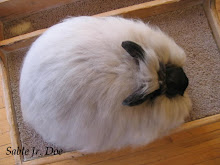
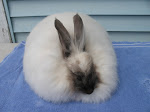
Last of all it looks like I finally got some baby pics snapped! The first two below are of Margaux and her litter by Giacomo (now 5 weeks of age), and the third is of two of Natalya's babies just before weaning (now 7 weeks old).


And last of all here is just a gratuitous shot of my three sons in the Baseball Hall of Fame, which we visited last week:). It was amazing to see all the old equipment everyone used and all the old uniforms (made out of WOOL!). The boys read all about Babe Ruth and got to sit in a locker that once belonged to Hank Aaron. BIG thrills!!:-)

Sunday, January 10, 2010

Current Events

There has not been a lot going on here lately other than bitter cold weather and a couple of litters of babies growing out. My oldest litters are now 5 weeks old and the youngest are 3, so there will be a few more juniors hopping around and it will be time for breeding again soon as soon as Spring rolls around.

The PA Convention is also coming up in a couple of weeks, and I won't have much to bring again this year since I didn't do a lot of breeding for Winter buns. My best rabbits seem to be lining up for the Spring season right now, so what will probably end up happening is that all the proverbial eggs will be in one bunny basket this year, LOL. Once the season is over (somewhere around May or June), I will breed all the best does for some (hopefully) very good litters.

As my own kids get older and hit the teenage years, life is getting a whole lot busier then it used to be:). Between driving to different activities, cooking TONS of food (who would have thought it was possible for three boys to eat so much??!!), and stepping up our homeschool schedule at the same time, life has gotten very, very hectic:). I have my herd at a stable number of rabbits right now that makes it possible to keep up with grooming and maintenance and still produce a number of litters, but I will have to keep things relatively small for a couple of years until everyone grows up and doesn't need as much 'upkeep' anymore, LOL. Eventually I will be able to expand my herd again, start breeding more, and show more often in places that are further away (especially Convention:)).

The great thing about cold weather, however, is that it makes wool grow at an unbelievable rate. No sooner do you clip a rabbit but the coat is springing right back, and even the babies' wool seems to be coming in faster than usual right now. Despite the difficulties of managing a rabbitry at this time of year, there are certainly benefits to raising angoras in sub-zero temperatures:-).

More next time when I try to get some baby pictures posted.

Have a great week!

Sunday, December 27, 2009

Nestbox Talk

-another post from the old blog

There are several kinds of nestboxes available for use with bunny litters, and all have their benefits and drawbacks according to purpose, season, and management style. Here are a few basic types that are easy to find, though there are other choices and a few models that are actually improvised with found materials, etc.


In my barn I use stainless steel nestboxes because I have access to some that are really well made from my meat processor, but I also keep them indoors 24/7 except for bringing them out for feedings, so temperature considerations are not an issue.
The first kind of nestbox that you ordinarily think of when breeding bunnies is all wooden. Years ago these were made of solid wood, but nowadays they are often constructed of plywood, and are easily made at home. The benefit of a wooden nestbox is that it is extremely warm for fall and winter litters, and quite durable if well made. They are relatively inexpensive, especially if made of plywood, and are heavy enough to stay in one place. The disadvantages of wooden boxes is that they are sometimes too hot in the summer (not as practical in warmer areas), and they are difficult to clean thoroughly after litters have lived in them for 3 weeks. The belief used to be that wood did not sanitize as easily as metal, but articles I have read recently indicate that wood DOES perform fairly well in that area, as long as it is cleaned thoroughly in all the nooks and crannies, disinfected, rinsed clean, and left to bleach in the sun whenever possible. Another downside to wood is that many rabbits find it irresistibly chewable, and a box that started out with nice smooth edges in the beginning may end up very jagged and splintery----a potential problem for wool coats.


If you decide to go with wooden nestboxes when first starting to breed, always make sure that the floor is either removable for easy cleaning OR there are good sized holes drilled into the bottom for drainage. One of the biggest dangers to newborn litters is the buildup of bacteria in a nestbox that does not get cleaned often enough and remains damp and moist for days or weeks at a time.


The second most popular type of nestbox is the stainless steel box. Steel boxes are useful in hot climates because they tend to be cooler, and they are extremely easy to clean and disinfect when a litter is finished with them. Most metal nestboxes come with removable floors which makes them easy to disassemble and scrub out, and they also tend to weigh less, which is an issue if you have a large breed with many babies per litter or you move your boxes in and out of the house.


Removable floors tend to be made out of a variety of materials, and there is one company that even sells them with solid metal floors, but that is a poor option because there is no drainage in a situation like that, and the use of it is asking for an immediate buildup of dangerous bacteria. I used to use layers of cardboard and newspaper, etc, in my nestboxes (after removing the original floors first), but the boxes I currently use have pegboard floors, which work wonderfully in terms of staying clean and keeping litters healthy. I used to get crusty eyes now and again with cardboard and other materials, but at this point I put a thick layer of hay on top of the pegboard and that is usually enough to keep everyone clean for 2 weeks along with wool that the doe pulled, and then a clean layer of bedding is added for week 3 which lasts until the box is removed altogether. Eyes are always open all by themselves by day 12, and there is never any dampness in the nest.


Another type of nestbox that is often used is called a 'drop box'. A drop box is a nestbox made of wire that is literally built into the floor of a large doe cage. The biggest advantage to a drop box is that it mimics the natural nesting conditions for a rabbit in the wild (which are underground), and it provides greater than average protection for kits who get pulled out of the nest after feeding because they simply crawl around the wire until they 'drop' back into the box. The disadvantage to this type of nestbox is that it is a permanent feature of the cage, and is thus unremovable without cutting up the floor and patching or replacing it. Another problem is that it cannot usually be used with stacking cages unless there is a wider than average space between each cage and the pan rests lower down beneath it. The best rabbitry setup for drop boxes is the single line of suspended cages such as one would find in a meat operation where does are bred almost constantly and there is no interference with any cages located below or above them.


Other options that people use when expecting litters consist of heavy cardboard boxes (which need to be secured because they tip easily though they can be discarded later), cat boxes and plastic tote boxes (which also need to be secured with wire and tend to retain alot of moisture), and homemade 'above' floor wire boxes. The primary considerations for any nestbox are that it be solid, heavy enough so that the doe cannot tip or flip it over while nesting or jumping in and out, it has excellent drainage, and it is easy to clean. Some boxes have metal or wooden lids on top that partially cover the box for greater privacy and protection from drafts, and others are completely open. Does sometimes have a greater preference for one over the other, so you have to watch your herd and experiment.


So this is a bit about nestbox 'pros and cons' (LOL). If you leave your litters outside all the time and breed over the winter, a wooden box may be the best choice. If you breed for meat and have a large herd operation, a drop box may be ideal. If you keep your boxes inside all the time except for nursing, metal may be the best choice for ease of transport and cleanliness, but everything depends on what your goals are and the kinds of management techniques you employ

Monday, December 21, 2009

Bunny Stuff

After getting some much needed grooming in today between all the baking, cooking, decorating, gingerbread house building, and normal daytime school stuff (LOL!), I snapped pictures of a couple of buns who are busy growing coats.

This first shot is one that was taken of Anton (a Sable Pearl buck) months ago when he was just a baby. The second is how he looks today, a whole lot bigger and growing in his very first Senior coat:).


These next two pics are of the best baby that was born here during the Fall breeding season. She is a little Tort doe that I will probably name Nadia if she ends up keeping all her great qualities:). She is 5 months old today and came out of a breeding between Margaux and Giacomo.


Btw, there were also two more litters born this week for a total of four boxes now sitting in my living room! Margaux had a litter of 7, and Yvonne (my F3 NZ/FA cross doe) delivered a litter of 8 REWs with Akeno as the sire.

More again next week, but until then have a wonderful, WONDERFUL holiday and may all your bunny wishes come true for the New Year!

Sunday, December 13, 2009

'Testing Your Stock'

---This is another post from the old blog. Sorry about all the older posts lately, but December is a busy month and I do want to get all the old posts transferred so that they will be readily available in the archives. Have a great week and stay warm!:-).


The best way to know what your rabbits carry genetically is by looking at what they produce in the nestbox. Of course, it is a great help to know what colors the parents were because alot can be ascertained that way, but breeding a rabbit several times and recording the colors that result can make it much easier to formulate a genotype for the sire and dam.


The basic rule of genetics is that a rabbit can only pass on what it carries or expresses to it's offspring, and since each offspring inherits half of each pair of genes from it's dam and the other half from it's sire, the colors that result will depend on how those genes interact with each other.


Some genes are dominant, which means that they will always express themselves first if the other half of the gene pair is recessive. In order to express itself (be visible in the nestbox) a recessive gene has to be paired with another recessive gene. If a certain recessive is always paired with a dominant gene in a particular herd it may never have the chance to express itself, which is why some colors can 'hide' themselves for many, many generations before finding like recessives to pair with and reproduce themselves.


A good example to use in describing how genes get passed on is the color White (or REW). White in rabbits is represented by a lower case 'c', and it takes 2 lower case 'c's to make a white rabbit in a litter. Since 'c' is a purely recessive gene, it is entirely possible for a Colored rabbit (such as a Chestnut or Self, for ex.) to be carrying it with no surface evidence whatsoever. If you were to breed that 'c' carrying rabbit to another rabbit though (White or Colored) that also carried a recessive 'c', then the result will be at least a few REW babies in the nestbox. There is a great deal of White in the majority of the Angora breeds because REW is a very competitive color in Angoras, but some non-wool breeds consider the gene a serious liability because White is not a recognized color in every type of rabbit.
If two colored parents are bred and REW babies appear in the litter (even just one), then you can be 100% certain that both parents carry the 'c' gene. Similarly, if both parents are Selfs (or one is even a REW) but you get one of the 'ee' colors in the nestbox (that would be Fawn, Red, Cream, Pearl, Tort, or Ermine) then you know that each parent must carry a recessive 'e', and so on.


To determine what color a REW really is under the white 'sheet' (because there is always a different, 'real' color in those rabbits), the best thing to do is breed it to a Self and examine what comes up in the litter. If you find Agouti babies in a nestbox out of a Self/REW breeding then you can be certain that the REW parent must be an Agouti under the White because the Agouti gene is dominant and could never have come from a Self (which is recessive too). Conversely, if you get nothing but Selfs in a good sized litter then you can be fairly certain that the REW must be Self underneath too, and you can use that information in future breedings to produce fewer unrecognized colors.


Why is it important to know what a REW is underneath in the first place? Well, the worst color combination that can be performed in rabbits is usually the Agouti/Shaded combination. Babies out of these pairings will often be a complete mishmash of color and can be so jumbled phenotypically that they cannot even be identified. They can never be shown, registered, or even sold very often because the majority of breeders will not accept unrecognized varieties into their gene pools. Even if they could be sold as pets or woolers there is always the chance that someone will take it upon themselves to experiment and breed 2 rabbits together just to 'see what happens' and end up producing an even larger cache of unrecognized colors that are unshowable, unregisterable, and unsellable.


Testing a REW first to know what color truly lies beneath the blanket allows you to use that rabbit according to it's real color in future breedings. If a White rabbit is genetically an Agouti, then you know that you can use this rabbit only with other Agoutis or Selfs, and should never use it with a Shaded. If your REW is genetically a Self then you have greater flexibility and can use it with other groups without fear of strange colors turning up. Combining 2 REWs can ONLY result in an all-White litter so you would not know what either parent carried in that case, but since REWs cannot carry Shaded genes (the 'c' being completely recessive) you would not be adding those genes to your pot to begin with.


Note: Breeders of other breeds are often mortified at the rate at which Angora breeders mix colors, and IMO they have a very legitimate point. The best and truest color comes from breeding pairs of the same variety together over several consecutive generations, and we in the Angora world would do well to imitate that policy if we want to weed out most of the color issues that plague our breed. Since wool animals are often raised by spinners as well as showpeople the desire for variety in color is strong, but the best way to achieve both variety and quality is to focus on each color separately and improve it slowly over time.

Sunday, December 6, 2009

Baby Time Again

Two litters were born this week to Spang's Natalya and Spang's Kimba:). Juno's breeding did not take which wasn't a surprise given her age, and Althea (my Black 'plucking' doe:)) was not pregnant either, which will earn her a trip to the 'retirement' home of my local friend who has a fiber business and uses angora in her products exhaustively:). Given the fact that Althea is young and could not conceive twice under normal conditions means that she will not be fertile/ dependable enough to stick around here, especially if she is not a show rabbit and cannot earn her keep some other way. She will now live the rest of her life at a 'luxury' bunny house where her new owner will use her wool and happily keep an FA who molts on a regular basis:).

Margaux will be due in approx. a week and half and is definitely prego (carrying hay around like there's no tomorrow:))----and Yvonne is due around the same time, though it is harder to tell what is happening with her because she never carries hay or begins building nests until the Day Of, LOL.

Below are two pics of the new litters snapped earlier today (at 2 days of age). The first is of Natalya's litter with 3 REWs and 2 Blacks, and the second is of Kimba's bunch consisting of Black, REW, Tort, and Sable. Kimba is a Sable F4 FA/NZ cross and this was her first litter. She kindled a day early with 11 kits so all her Sable babies (the little Blue looking things in the first picture:)) were promptly moved to Natalya's box because Natalya had only 5 and I wanted to be extra sure that the Sables survived. Kimba was bred to Giacomo (a Tort) since he was the best choice at the time to produce more Sables, but next Spring she will be bred to Anton (a Sable Pearl buck) which will definitely produce more Sables and Pearls to get my Sable/Pearl line off the ground:).


Other than this not a whole lot is happening at this time of year with cold weather and the holidays:). Since there are no shows at the moment there is nothing to do but breed and gear up for the PA Convention in Feb, along with growing out coats for the 2010 Spring Season, which looks as though it is going to be nice with a great selection of buns.


Btw, for those of you who don't know (and I will be posting about it again in a few weeks:)) the United Angora Club (UARC) will be hosting TWO Specialties at the PA Convention this year on Feb. 6 & 7---a Saturday and Sunday. This year's PaSRBA show is expected to bring in over 12,000 rabbits, which is only 1,000 shy of the entry at this year's ARBA Convention in San Diego! The official catalog for the PA Convention is not available yet, but it will be posted mid-December on the PaSRBA Website at http://www.pasrba.org/.

More again next week, and hopefully everyone is fully winterized and holed up for the coming winter!:-)

Sunday, November 22, 2009

Nutrition and Feed Labels

--another post from the old blog


I took a close look at the nutrition labels on my feed bags the other day, and did a little reading up on what types of information a breeder could expect to glean from the 'Guaranteed Analysis' and 'Ingredients' list.


First of all, different feeds have different formulations depending on what the intended use is. Commercial Meat operations normally require a high protein feed that supports fast growth and an intensive breeding schedule (about 18%), while Wool herds require a high level of protein coupled with high fiber levels to encourage healthy gut motility and maximum wool growth (usually about 17-18%). Pet rabbits or rabbits who are not being bred or stressed in any way generally just require a 'maintenance' formula, which can be lower in both fiber and protein (15-16%). While ingredients and amounts on assorted labels may vary, the essential nutrients can be grouped into the following categories:


Protein
Carbohydrates
Fats
Minerals
Vitamins


These components are listed on feedbags in various orders, usually followed by (min) or (max) to show how much or how little of the ingredient is included. In the book 'Rabbit Production' a clear description of how to read a feed label is included:


"By law, a feed tag must provide certain information, varying somewhat by state or province. Crude protein is usually listed as "minimum" or "min." In other words, the feed manufacturer can provide more protein than listed on the tag. The manufacturer is not likely to consciously do so, as protein is expensive. Similarly, the crude fiber is listed as "maximum" or "max." Again, this is to protect the buyer. Fiber sources are generally cheaper than grains. By stating a maximum fiber level, the manufacturer assures the buyer that cheap, low quality fibrous feedstuffs haven't been added to dilute the feed. If the feed has less than the maximum fiber content listed, it means that higher cost ingredients have been used. As a result, rabbit feeds generally have protein contents very similar to the tag values, whereas crude fiber levels are often lower than listed. This regulation has caused misunderstanding by some rabbit raisers, who may want their feed to contain a particular fiber level. They would prefer that the tag read "minimum" for crude fiber. However, this is not required by feed regulations.
It is impossible to look at a feed tag and say conclusively that the feed is good or bad. The information provided is insufficient to allow a judgment to be made. Crude protein is not a measurement of protein at all, but a measure of nitrogen. There is no indication on the tag of the quality of the protein (its content of essential amino acids). There is no indication of the digestibility of the protein. A crude Protein analysis does not distinguish between soybean meal and shoe leather. There is no information on a feed tag about the energy content of the feed or about the specific level of minerals and vitamins." (pgs. 150-151)


Since we cannot get specific information from the 'guaranteed analysis' itself, it often helps to look beneath at what is contained in the ingredient list. First, the best source of roughage in rabbit feed is generally considered to be Alfalfa meal. While Alfalfa is an excellent source of high fiber, it is also significantly high in a type of protein that is well digested by rabbits. It is also an excellent source of phosphorus, calcium, and potassium, and contains indigestible fiber which is helpful in preventing enteritis. In addition to this, it contains vitamin A and carotene. Considered altogether, the virtues of Alfalfa usually make it the very first ingredient in high quality rabbit feeds.


Significant sources of grain (carbohydrates) are Corn, Wheat, Milo, Barley and Oats. Corn, wheat, and milo are high energy grains, while barley and oats tend to be on the lower end of the spectrum because of their fibrous hulls. Corn (especially) is not recommended for use in hot climates or during the summertime because of the possibility of gut imbalances leading to diarrhea, and barley and oats should be scaled back during the warmer seasons as well. Oats and corn are highest in fat content, while barley is the highest in fiber content. Corn is considered to be the highest energy grain available.


The best and most reliable source of protein in rabbit feed is Soybean meal. Soybeans (heated/roasted, never raw) are palatable to rabbits, have high digestibility, and are well balanced in amino acids. Other supplements for protein found in rabbit feed include Cottonseed meal, Sunflower meal, Rapeseed meal, Safflower meal, Linseed meal, and Peanut meal.


Additional ingredients found in rabbit feed are probiotics (to reduce growth of pathogens in the digestive tract), pellet binders (such as bentonite or lignin sulfonate), flavoring agents such as thyme or molasses, Salt (a necessary ingredient to satisfy sodium chloride and trace mineral requirements), Copper Sulfate (to inhibit growth of pathogenic bacteria in the digestive tract), Yucca Extract (to reduce the release of ammonia into the air and keep odor down in the rabbitry), and enzymes such as those found in pineapple and papaya to break down hairballs in the wool breeds.


A well formulated pellet will ensure that herds are kept healthy and productive in every capacity, but a poorly formulated one can result in a range of health problems, some of which can be fatal. The storage of feed is also very important. Bags must be stored in a dry location that is rodent proof, and pellets must either be kept in the bag or stored in metal or plastic bins. The milling dates of all feeds should be checked upon pickup, and anything older than 3-6 months should likely be discarded due to loss of vitamin content and the increased likelihood of rancidity (mold or toxins developing in the feed). The best feed is a feed that is freshly milled with the highest quality ingredients. If you use your rabbits as a guide, the freshest feed is also the one that is most readily eaten, while older pellets tend to offend a rabbit's sensitive palate and are often left sitting in the dish.