I have been insanely, ridiculously busy the last two weeks, and this explains why I have been so delinquent in blog posting. LOL. Baseball and all the other organized activities have ended at this point, so now I am cleaning my house and trying to get organized with home stuff, summer (kid) stuff, and bunny stuff:).
Looking at baby production so far this year I think that I have probably bred more litters in 2010 than ever before (according to records up to July). The oldest bunches born in April have pretty much all been dispersed by now, and the next batches begin weaning tomorrow, after which 5 more litters will move to the barn with mom to grow out.
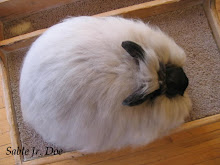
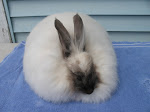
It has been extremely hot here this summer, and it has been one heck of a job trying to keep everybun cool while allowing show coats to grow in for fall at the same time. Attached below is a post from my old blog about keeping rabbits cool. Hope everyone is hanging in there and not suffering any major losses!
Summertime Angoras
Here are a few tips for keeping Angoras cool in summer:
1) Try not to time your breedings so that your bunnies are in extreme full coat during the heat of the summer. If you are a spinner and keep bunnies for wool this should be simple to do if you record the average holding time of your coats and breed your babies to molt before the warm weather comes. If you are a Show breeder you can do precisely the same thing if you live in an area where there are no shows at that time of year, otherwise you will have to investigate methods of keeping them cool or keep several indoor cages for buns in the heaviest coats.
2) Make sure there are fans in your rabbitry, and be sure that those fans are taken apart and cleaned before the start of the season, and periodically throughout the summertime to avoid fire hazards. Position fans on either end of the rabbitry between the aisles or suspend them from the ceiling in various positions so that the draft hits no one directly. A thermometer placed on the wall is also helpful, and the fans can be turned on whenever the temps. go above 80 or it is excessively humid.
3) Place ice bottles in your freezer weeks ahead of time to have on hand for the very hottest days. Buy or find 2 liter soda bottles and freeze them halfway to 3/4 full with water and place them into the cages when it gets very warm. Since soda bottles are large they will stay frozen for up to 2 hours on a hot day, and the rabbits cannot get a grip on the tubular shape to chew the plastic.
4) Keep cage pans and cages in general cleaner than usual in the summer. Urine and the ammonia it produces create heat, and if there are 50 rabbits in a building with full pans (assuming you use cages with pans), the temperature is naturally going to increase, sometimes dramatically. Also, cleaning cages more often keeps the flies down, which lessens the chance of flystrike.
5) Try to construct your rabbitry in a shady area, and if there is no shade plant some vines or fast growing shrubs or trees that will shield the structure and lower the temperature in the building somewhat. (Note: Be certain that nothing planted over the barn is poisonous!)
6) Refill water bottles with ice cold water once or twice a day and add Acid Pak on the very warmest days to keep electrolyte levels on an even keel. Also, scale down the amount of pellets you feed since rabbits do not need to create heat in the summer. In the Spring and Fall a mounded cup of Pellets for adults is appropriate for an FA, in summer it is a good idea to remove or minimize all top dressings and "hot" grains, and feed 1 level cup of pellets to each adult rabbit per day.
7) Another way to keep bunnies cool is to go into the building periodically with a wet cloth or spritz bottle to wet down the ears of your bunnies. Rabbits regulate heat through their ears, so cooling them down this way will enable them to find relief immediately. Be sure not to drip water into the ear canal, and if the rabbit in question is in coat be certain not to drip water onto the wool around the ears to avoid matting.
8) If you are breeding or have nursing does in the barn pay special attention to their comfort since they will suffer far more in the heat than bucks, young rabbits, and non-pregnant does. A late-term pregnant doe is in greater danger than a nursing doe, but both will feel the heat and have a much more difficult time than others in the barn. Also, bucks tend to be affected by heat more easily than does, (and can go sterile if the temps rise above 85 for 2-3 days in a row). The entire herd is much more susceptible to heatstroke during the first 1-2 heat waves of the year before slowly acclimating to the higher temperatures. All rabbits seem to tolerate the heat better late in the summer once they have become accustomed to it.
9) It is questionable whether it is a good idea to immerse an Angora in extreme heat stress in water. Breeders of short haired rabbits routinely use this technique, but an Angora coat complicates that approach, so unless the rabbit has been sheared down to the skin (in which case heat stroke would be unlikely), the wool will matt up to the point where it will be next to impossible to get it off, even with a scissor. It is also important to note that the skin of a matted rabbit cannot breathe and heatstroke may become imminent. Angoras should be well groomed or clipped altogether in the summer to assure proper air circulation. If a rabbit is in serious danger, bring it indoors to an air conditioned room OR to a basement or garage to lay out on the concrete floor. Soak the rabbit's ears down repeatedly with cool water, and keep it calm and quiet. Once it has recovered sufficiently, keep the animal indoors until evening with herbs such as Dandelion or Parsley, and make certain that Acid Pak has been added to cool water to give the bunny's system a boost and help it recover.
10) Another option is to hang bags of ice cubes over the fronts of your fans to blow cold air into your barn ( similar to a homemade air-conditioner). Just make sure that the bags do not leak and are not situated anywhere where they can be sucked into the fan blades.
These are a few warm weather tips, but generally speaking if angoras are sheared every summer and have adequate housing and ventilation, they are excellent at surviving and thriving. Keep a close eye on your rabbits at all times and know their habits so that stress can be identified quickly. As with everything, good management is the key to keeping Angoras healthy in summertime:).
Sunday, July 18, 2010

Sunday, July 4, 2010
To Breed or Not to Breed
--another post from the old blog
There is a wide assortment of criteria that people use to determine whether or not a rabbit should be added to their breeding herd. In some programs, several groups of rabbits are actually maintained for different purposes in categories that have separate and distinct requirements. For example, some Angoras make excellent woolers and are kept solely for that purpose, but they are poor prospects for breeding because they have mismatched toenails, skeletal problems, or some other characteristic that is highly heritable and could pose a problem for future generations. Alternatively, other rabbits may be excellent specimens on the showtable but poor candidates for the gene pool if they don't conceive well, are poor mothers, or have a less than adequate milk supply.
The question most breeders ask themselves repeatedly (and one that is by far the toughest to answer), is "Will this rabbit advance my breeding program or handicap it?" One of the most difficult things to learn when breeding livestock is where the line must be drawn in order to keep a bloodline moving forward and keep the herd as productive and vigorous as possible.
In rabbits (or any animal, for that matter), there are several categories that physical and genetic traits fall into. The first is composed of traits that should never be bred into a herd under any circumstance, the second contains those that could be incorporated under certain conditions, and the third lists qualities that are rarely serious enough to warrant culling or keeping an animal out of the gene pool, and which may even be desirable 99% of the time.
A list like this is something that would be different for every breeder. Respective categories would vary according to individual philosophies, personal goals, and personal preferences in the areas of color, wool, type, and production capability. A show person's threshold of tolerance for certain characteristics is invariably going to differ from the person who raises Angoras strictly for wool, and a Meat breeder's needs will invariably differ from those who show, breed wool, or raise rabbits as pets. An example of the traits in these categories for most breeders is as follows:
NEVER BREED
-malocclusion
-split penis
-pigeon breast
-cowhocks
-white or mismatched toenails
-white spots, blazes, snips (in solid colors)
-does who kill/ cannibalize their litters
-does with inadequate or no milk supply
-does who repeatedly scatter litters/ have no mothering instinct
-biters/ rabbits with nasty temperaments
-disease (esp. Pasteurella)
-thin/ poor bone quality
-underweight (not nutrition-related)
Be aware that this list does not encompass various color genes that can infiltrate a herd and cause serious damage if not handled properly. Traits like this may include the Vienna gene, Steel, Harli gene, or the Dutch spotting gene.
SOMETIMES BREED
-stray white hairs or tiny white spots/snips
-unrecognized colors
-'slightly' cowhocked
-low(er) shoulders
-overly hairy coat
-overly wooly coat
-cottony texture to coat
-more than 1/2 inch gap protrusion between guard hair and underwool
-pin bones
-medium density
-mediocre mothering skills/ milk supply/ litter sizes/ conception rates
-'moodiness' that does not result in biting (esp. in mature does)
BREED READILY
-correct color but with varying intensity
-good temperament/ inquisitive personality
-solid type/ solid bone
-aggressive sires/eager breeders/receptive does/ excellent mothers
-rapid weight gain (5 lbs. @ 12 weeks for commercial breeds, etc.)
-density, good texture, high yield, excellent overall balance (in wool)
-prepotent bucks/does (rabbits who readily pass on their best traits)
-supreme health and vigor
-ability to maintain condition and a long prime period
-6 months or more holding time between molts
-unfussy (appetite, behavior, and general disposition)
These are only a few examples of traits in each category and I know I've missed some, but it is important to realize that these groupings are not definitive, but rely in large part on the goals of the individual breeder, the breed being raised (since different breeds have different requirements), and the short and long term goals that you have set in your rabbitry.
In my own situation I fall into the stricter end of this breeding spectrum. I would never knowingly breed a rabbit with any of the characteristics listed in the first group, and at this point I wouldn't normally breed rabbits falling into the second group, either. That being said, there are times when I have deliberately neglected a certain trait in order to fall back and fix another one, and when first starting out as a breeder there is little choice but to work with what one has in order to progress to something better. Over the past few years I worked hard to improve wool balance and quality, but one day I realized that I had been sacrificing type (over the hind quarter especially) in order to achieve it, so I stopped, backed up, and thought about how to fix the problem. The majority of points in every angora breed are on the wool, but the FA in particular cannot compete on a National level without being strong in both categories, so this was something that had to be corrected. For the time being I have chosen to ignore the wool a bit in order to focus on better type (especially since type is hard to set but wool improves much more quickly), To this end I brought in the F2 NZ/FA Cross from Elaine who is extremely strong in the hindquarter, and that should help to correct the problem.
A last word about color, also. When I began breeding in the beginning I felt that color was extremely important, almost to the exclusion of everything else. A few more years down the road I learned more about genetics and began to see the rabbit as a total package rather than a sum of it's individual parts, and realized that color could be sacrificed at times in order to fix a more important wool or type trait. I still would not knowingly breed in a problematic color gene (such as the ones listed above), and I would never breed snips, spots, or white/mismatched toenails, but what I WOULD do if the more important goals of my breeding program called for it is breed incompatible or outright unrecognized colors if they had the type and wool that I was looking for. A rabbit with outstanding type who showed up in a color that was not recognized or registerable would be incorporated into the breeding program simply because that is an easy fix at this point, and the line would benefit immensely as a result. Once a herd evolves to the point where type and wool become set, then THAT is the time to nitpick and pay strict attention to details such as color, focusing strictly on like to like combinations that improve the overall quality and intensity. Maybe you could even say that it is important to focus on the inside of a rabbit first (bone, skeletal quality, type detail), and progress to the outside later with density of wool, texture, and finally color.
There is a wide assortment of criteria that people use to determine whether or not a rabbit should be added to their breeding herd. In some programs, several groups of rabbits are actually maintained for different purposes in categories that have separate and distinct requirements. For example, some Angoras make excellent woolers and are kept solely for that purpose, but they are poor prospects for breeding because they have mismatched toenails, skeletal problems, or some other characteristic that is highly heritable and could pose a problem for future generations. Alternatively, other rabbits may be excellent specimens on the showtable but poor candidates for the gene pool if they don't conceive well, are poor mothers, or have a less than adequate milk supply.
The question most breeders ask themselves repeatedly (and one that is by far the toughest to answer), is "Will this rabbit advance my breeding program or handicap it?" One of the most difficult things to learn when breeding livestock is where the line must be drawn in order to keep a bloodline moving forward and keep the herd as productive and vigorous as possible.
In rabbits (or any animal, for that matter), there are several categories that physical and genetic traits fall into. The first is composed of traits that should never be bred into a herd under any circumstance, the second contains those that could be incorporated under certain conditions, and the third lists qualities that are rarely serious enough to warrant culling or keeping an animal out of the gene pool, and which may even be desirable 99% of the time.
A list like this is something that would be different for every breeder. Respective categories would vary according to individual philosophies, personal goals, and personal preferences in the areas of color, wool, type, and production capability. A show person's threshold of tolerance for certain characteristics is invariably going to differ from the person who raises Angoras strictly for wool, and a Meat breeder's needs will invariably differ from those who show, breed wool, or raise rabbits as pets. An example of the traits in these categories for most breeders is as follows:
NEVER BREED
-malocclusion
-split penis
-pigeon breast
-cowhocks
-white or mismatched toenails
-white spots, blazes, snips (in solid colors)
-does who kill/ cannibalize their litters
-does with inadequate or no milk supply
-does who repeatedly scatter litters/ have no mothering instinct
-biters/ rabbits with nasty temperaments
-disease (esp. Pasteurella)
-thin/ poor bone quality
-underweight (not nutrition-related)
Be aware that this list does not encompass various color genes that can infiltrate a herd and cause serious damage if not handled properly. Traits like this may include the Vienna gene, Steel, Harli gene, or the Dutch spotting gene.
SOMETIMES BREED
-stray white hairs or tiny white spots/snips
-unrecognized colors
-'slightly' cowhocked
-low(er) shoulders
-overly hairy coat
-overly wooly coat
-cottony texture to coat
-more than 1/2 inch gap protrusion between guard hair and underwool
-pin bones
-medium density
-mediocre mothering skills/ milk supply/ litter sizes/ conception rates
-'moodiness' that does not result in biting (esp. in mature does)
BREED READILY
-correct color but with varying intensity
-good temperament/ inquisitive personality
-solid type/ solid bone
-aggressive sires/eager breeders/receptive does/ excellent mothers
-rapid weight gain (5 lbs. @ 12 weeks for commercial breeds, etc.)
-density, good texture, high yield, excellent overall balance (in wool)
-prepotent bucks/does (rabbits who readily pass on their best traits)
-supreme health and vigor
-ability to maintain condition and a long prime period
-6 months or more holding time between molts
-unfussy (appetite, behavior, and general disposition)
These are only a few examples of traits in each category and I know I've missed some, but it is important to realize that these groupings are not definitive, but rely in large part on the goals of the individual breeder, the breed being raised (since different breeds have different requirements), and the short and long term goals that you have set in your rabbitry.
In my own situation I fall into the stricter end of this breeding spectrum. I would never knowingly breed a rabbit with any of the characteristics listed in the first group, and at this point I wouldn't normally breed rabbits falling into the second group, either. That being said, there are times when I have deliberately neglected a certain trait in order to fall back and fix another one, and when first starting out as a breeder there is little choice but to work with what one has in order to progress to something better. Over the past few years I worked hard to improve wool balance and quality, but one day I realized that I had been sacrificing type (over the hind quarter especially) in order to achieve it, so I stopped, backed up, and thought about how to fix the problem. The majority of points in every angora breed are on the wool, but the FA in particular cannot compete on a National level without being strong in both categories, so this was something that had to be corrected. For the time being I have chosen to ignore the wool a bit in order to focus on better type (especially since type is hard to set but wool improves much more quickly), To this end I brought in the F2 NZ/FA Cross from Elaine who is extremely strong in the hindquarter, and that should help to correct the problem.
A last word about color, also. When I began breeding in the beginning I felt that color was extremely important, almost to the exclusion of everything else. A few more years down the road I learned more about genetics and began to see the rabbit as a total package rather than a sum of it's individual parts, and realized that color could be sacrificed at times in order to fix a more important wool or type trait. I still would not knowingly breed in a problematic color gene (such as the ones listed above), and I would never breed snips, spots, or white/mismatched toenails, but what I WOULD do if the more important goals of my breeding program called for it is breed incompatible or outright unrecognized colors if they had the type and wool that I was looking for. A rabbit with outstanding type who showed up in a color that was not recognized or registerable would be incorporated into the breeding program simply because that is an easy fix at this point, and the line would benefit immensely as a result. Once a herd evolves to the point where type and wool become set, then THAT is the time to nitpick and pay strict attention to details such as color, focusing strictly on like to like combinations that improve the overall quality and intensity. Maybe you could even say that it is important to focus on the inside of a rabbit first (bone, skeletal quality, type detail), and progress to the outside later with density of wool, texture, and finally color.
Monday, June 14, 2010
Feed and Other Stuff
It is continuing to be busy around here with new litters born and new breedings being planned and carried out. Last week Spang's Margaux gave birth to a litter of 8, and Juno (surprise, surprise!) gave birth to a litter of 6. Over the last several days I re-bred Etienne (this time to Diego), and Diana (to Beauregard), and also took 3 or 4 does to my black Giant buck Milo, so we will see how everything goes over the next couple of months as these babies are born and the existing ones get weaned:).
Out of the lack of anything better to say (I am totally strung out on kid activities this month and have little to no brain matter left:-)), I figured I would post a picture of my feed storage corner in the basement, since this type of thing always fascinates me in other peoples' rabbitries:).
Anyway, once every month or so a friend of mine from our local rabbit club coordinates a one ton order of Heinold feed for several breeders in the area. I drive out to the next town where it is stored in another guy's hardware store (a guy who is the president of the rabbit club, LOL), and I pick up enough to last me for 3-4 weeks.
In a corner of my basement where it is clean, cool, and dry, my dh put a wooden pallet next to the ramp we installed to make it easy to roll dollies loaded with feed in and out. I store my feed in two piles---one for the Wool formula (used for all adult rabbits including those over 14 weeks old), and one for the General formula, which is used for babies up to 14 weeks. Next to my feed piles I have three large rubbermaid tubs that hold 'Adult feed', 'Baby feed', and 'Grain mix', consecutively, and on top of those closed tubs are the buckets and containers I use to haul the feed and supplements in and out (luckily, my rabbitry is located right outside the basement door, LOL).

There are lots of efficient ways to store feed, but the main requirement is always that it is kept in a cool and stable environment in airtight containers to keep everything fresh and palatable to the bunnies.
More again next week when life calms down and there is more time to snap pics and do other interesting bunny work:). I hope everyone out there is enjoying a mild summer so far with tons of litters and LOTS of promising new herd dams/sires:).
Out of the lack of anything better to say (I am totally strung out on kid activities this month and have little to no brain matter left:-)), I figured I would post a picture of my feed storage corner in the basement, since this type of thing always fascinates me in other peoples' rabbitries:).
Anyway, once every month or so a friend of mine from our local rabbit club coordinates a one ton order of Heinold feed for several breeders in the area. I drive out to the next town where it is stored in another guy's hardware store (a guy who is the president of the rabbit club, LOL), and I pick up enough to last me for 3-4 weeks.
In a corner of my basement where it is clean, cool, and dry, my dh put a wooden pallet next to the ramp we installed to make it easy to roll dollies loaded with feed in and out. I store my feed in two piles---one for the Wool formula (used for all adult rabbits including those over 14 weeks old), and one for the General formula, which is used for babies up to 14 weeks. Next to my feed piles I have three large rubbermaid tubs that hold 'Adult feed', 'Baby feed', and 'Grain mix', consecutively, and on top of those closed tubs are the buckets and containers I use to haul the feed and supplements in and out (luckily, my rabbitry is located right outside the basement door, LOL).

There are lots of efficient ways to store feed, but the main requirement is always that it is kept in a cool and stable environment in airtight containers to keep everything fresh and palatable to the bunnies.
More again next week when life calms down and there is more time to snap pics and do other interesting bunny work:). I hope everyone out there is enjoying a mild summer so far with tons of litters and LOTS of promising new herd dams/sires:).
Monday, June 7, 2010
Bunny Bulletin Board:)
--another post from the old blog
At some point in the future I plan on setting up a nice bulletin board above my computer to put all of my bunny-related paperwork into one place:). I realize that many breeders keep all their bunny records on computer nowadays using the Evan's program or related software, but I have always been a person who needs things directly in front of me (being primarily "visual"), and have always had lists and pieces of paper all over the walls and doors of my house in order to keep our life and my bunnies' lives organized, LOL:).
Anyway, here are a few of the "bulletin board" records that I keep on hand for my herd:
1) Ivomec Schedule--This list has each bunny's name or ear # on it and a date posted as to when they were last ivomeced. Clearly this information is important in order to keep everyone on a regular schedule during show season, but it is also important to know who was dosed when to be sure that at least 3 weeks have elapsed before I do any breeding and risk a possible birth defect:(. I try to Ivomec all my showbunnies during the show season and summertime, and then give them a long break in the winter.
2) Clipping Schedule--Another list I keep has the names of each bunny alongside dates as to when each was clipped so I can keep track of how quickly the wool grows back and also get an idea of how long each bunny holds a coat. Information like this has been invaluable so far in determining the average hold time for each bunny as well as the average for my herd. I try to always clip during the slipping stage so as not to cut off the ingrowing tips of the next coat, so knowing when to expect this stage really helps me to time my coats. The next thing I hope to do in the future is get even more specific and have information next to each bunny stating how long each stage of wool growth lasts--for ex. New Growth/ Prime/Slipping/ Molt/, etc.
3) Breeding Schedule--I also have a chart hanging up that shows a list of my most important show dates and what month/week the does need to be bred in order to get Juniors and Seniors of the proper age for each one. Before breeding anyone I always try to refer to this list to find out when I OUGHT to be breeding according to a certain show date (such as Convention). However, there are times when I have to disregard this totally, like when I have a schedule change, or if a doe is older and needs to squeeze in a few extra litters before she 'retires'. Breeding really depends on the factor being considered at the moment, but I do always try to breed my best buns on the most 'important' show schedule dates.
4) Grain Mix Recipe and Schedule--I also have a list hanging up containing my exact grain mix recipe (since it has changed a few times and I don't really have it memorized:)), and also the measured amounts that my herd receives depending on the time of year or individual circumstances (ex. prego does get a specific amount until they kindle, after which they get no supplements at all until the babies come out of the nestbox and begin eating pellets with her out of the group feed dish).
These are just a few of the bunny records that I will be including when I get a bulletin board set up, but I'm sure I will be adding more info. such as tattoo numbers (where I left off after the last baby batch, etc.), calendars with breeding and kindling dates listed (instead of using my everyday family calendar:)), and a host of other tidbits that I could easily enter in my computer program but that I prefer to stare at instead:).
At some point in the future I plan on setting up a nice bulletin board above my computer to put all of my bunny-related paperwork into one place:). I realize that many breeders keep all their bunny records on computer nowadays using the Evan's program or related software, but I have always been a person who needs things directly in front of me (being primarily "visual"), and have always had lists and pieces of paper all over the walls and doors of my house in order to keep our life and my bunnies' lives organized, LOL:).
Anyway, here are a few of the "bulletin board" records that I keep on hand for my herd:
1) Ivomec Schedule--This list has each bunny's name or ear # on it and a date posted as to when they were last ivomeced. Clearly this information is important in order to keep everyone on a regular schedule during show season, but it is also important to know who was dosed when to be sure that at least 3 weeks have elapsed before I do any breeding and risk a possible birth defect:(. I try to Ivomec all my showbunnies during the show season and summertime, and then give them a long break in the winter.
2) Clipping Schedule--Another list I keep has the names of each bunny alongside dates as to when each was clipped so I can keep track of how quickly the wool grows back and also get an idea of how long each bunny holds a coat. Information like this has been invaluable so far in determining the average hold time for each bunny as well as the average for my herd. I try to always clip during the slipping stage so as not to cut off the ingrowing tips of the next coat, so knowing when to expect this stage really helps me to time my coats. The next thing I hope to do in the future is get even more specific and have information next to each bunny stating how long each stage of wool growth lasts--for ex. New Growth/ Prime/Slipping/ Molt/, etc.
3) Breeding Schedule--I also have a chart hanging up that shows a list of my most important show dates and what month/week the does need to be bred in order to get Juniors and Seniors of the proper age for each one. Before breeding anyone I always try to refer to this list to find out when I OUGHT to be breeding according to a certain show date (such as Convention). However, there are times when I have to disregard this totally, like when I have a schedule change, or if a doe is older and needs to squeeze in a few extra litters before she 'retires'. Breeding really depends on the factor being considered at the moment, but I do always try to breed my best buns on the most 'important' show schedule dates.
4) Grain Mix Recipe and Schedule--I also have a list hanging up containing my exact grain mix recipe (since it has changed a few times and I don't really have it memorized:)), and also the measured amounts that my herd receives depending on the time of year or individual circumstances (ex. prego does get a specific amount until they kindle, after which they get no supplements at all until the babies come out of the nestbox and begin eating pellets with her out of the group feed dish).
These are just a few of the bunny records that I will be including when I get a bulletin board set up, but I'm sure I will be adding more info. such as tattoo numbers (where I left off after the last baby batch, etc.), calendars with breeding and kindling dates listed (instead of using my everyday family calendar:)), and a host of other tidbits that I could easily enter in my computer program but that I prefer to stare at instead:).
Sunday, May 30, 2010
Current Events
Busy, busy, busy! Oh my gosh,the last few weeks have been insane with three kids playing baseball (on different teams!), my job, end of year school testing, garden chores, litters being born and weaned, and as usual, too many other things to count and keep track of:).
Yesterday and today two litters were born to Bijou and Carmen, and I am waiting for two more over the next day or two from Diana and Kimba. Bijou gave birth to 6 kits yesterday (1 Black and 5 REW), and Carmen had the same exact number with some Black in her litter also, combined with a bunch of regular Torts. I can't wait to see the quality of these babies since I used a REW buck for both that is probably one of the best typed buns I have ever bred out. Spang's Diego is a REW F4 cross with fabulous type and density, but I have not been able to get him to the show table as yet due to his unfortunate tendency to spray himself and all others, LOL. With an incoming coat he has been moved to 'solitary confinement' in a corner of the barn with no neighbors to the top, bottom, or sides of him. He seems to be neater as a result, but we'll see how far it gets and if the temptation to hose something winds up getting the better of him anyhow, haha:).
Aside from this there is not much else going on, except that we are having warmer days and summer is on it's way along with heat, fans, ice packs, and all the other things that make this time of year a living hell for rabbit breeders:(. I weaned all the first litters of the year now and they are doing well at 7-8 weeks. In a little while I will begin taking them out and seeing how everyone looks (who seems to have potential and who doesn't) and begin the sorting process that peaks at week 12 when I decide who will stay and who will be sold to new homes and new breeding programs.
And as if all this weren't enough, a friend who is a 4-H Poultry leader emailed me recently about some ducklings who had been hatched in a Manhattan classroom and needed new homes. Although I have never owned ducks before (and wouldn't have minded keeping it that way), my dh and kids thought differently and decided to build a new place here for them to stay:). Needless to say we now have 9 little ducklings in our yard (one of whom is pictured below). There were 2 Cayugas and 7 Welsh Harlequins in the bunch, so hopefully they will provide lots of eggs and entertainment:).

More again next time and have a great week!
Yesterday and today two litters were born to Bijou and Carmen, and I am waiting for two more over the next day or two from Diana and Kimba. Bijou gave birth to 6 kits yesterday (1 Black and 5 REW), and Carmen had the same exact number with some Black in her litter also, combined with a bunch of regular Torts. I can't wait to see the quality of these babies since I used a REW buck for both that is probably one of the best typed buns I have ever bred out. Spang's Diego is a REW F4 cross with fabulous type and density, but I have not been able to get him to the show table as yet due to his unfortunate tendency to spray himself and all others, LOL. With an incoming coat he has been moved to 'solitary confinement' in a corner of the barn with no neighbors to the top, bottom, or sides of him. He seems to be neater as a result, but we'll see how far it gets and if the temptation to hose something winds up getting the better of him anyhow, haha:).
Aside from this there is not much else going on, except that we are having warmer days and summer is on it's way along with heat, fans, ice packs, and all the other things that make this time of year a living hell for rabbit breeders:(. I weaned all the first litters of the year now and they are doing well at 7-8 weeks. In a little while I will begin taking them out and seeing how everyone looks (who seems to have potential and who doesn't) and begin the sorting process that peaks at week 12 when I decide who will stay and who will be sold to new homes and new breeding programs.
And as if all this weren't enough, a friend who is a 4-H Poultry leader emailed me recently about some ducklings who had been hatched in a Manhattan classroom and needed new homes. Although I have never owned ducks before (and wouldn't have minded keeping it that way), my dh and kids thought differently and decided to build a new place here for them to stay:). Needless to say we now have 9 little ducklings in our yard (one of whom is pictured below). There were 2 Cayugas and 7 Welsh Harlequins in the bunch, so hopefully they will provide lots of eggs and entertainment:).

More again next time and have a great week!
Sunday, May 23, 2010
Disease Factors in Rabbits
--another post from the old blog
I was browsing through the Rabbit Production book again today (which I have said time and time again is my favorite rabbit resource:)), and I found an excellent description of the three most important factors in preventing disease in a rabbit herd. As everyone knows, illnesses such as Pasteurella (aka Snuffles) are among the most feared health problems in rabbits, and since there are virtually no vaccines available for rabbits, it is imperative that our herds are genetically sound and that we pay continual attention to the three factors mentioned in RP's 'Rabbit Diseases and Health Problems' chapter.
According to the book on pages 198-199, the three most important factors involved in disease control are Ventilation, Sanitation, and Observation.
1) Ventilation is crucial to healthy rabbitries because "air dilution" serves to reduce the concentration of harmful bacteria, viruses, and protozoa. This in turn gives the rabbit's immune system a better chance of fighting off a germ that may otherwise have overwhelmed it if the ventilation was poor and the population of these organisms increased.
2) Sanitation is the "physical or chemical" removal of potential disease causing organisms by scrubbing or through the use of disinfectants such as Bleach, Vanodine, or Listerine (for ex). Cage pans and floors should be kept clean, and hair and wool that is stuck to the wire in various places should also be removed. According to RP, "a single rabbit hair can carry thousands of bacteria or viruses".
3) Observation is exactly what it appears to be----keeping a close eye on how your rabbits feel from day to day. The problem with maintaining large rabbit herds is that it is easier to miss potential health problems due to the lack of time devoted to each animal. Watch your herd carefully and be aware of those who suddenly look peaked, unthrifty, or ill, or who stop eating and display signs that they are stressed or under the weather. Remove sick rabbits from the main herd immediately and isolate them in quarantine until you determine the problem and prevent the spread of contagious bacteria or viruses throughout the herd. Do NOT be soft on sick animals when they appear-----ANY sign of disease, particularly Pasteurella, should be dealt with immediately and the animal should be humanely disposed of if the disease proves incurable and the rest of your herd is at risk. Pet owners who keep a few isolated rabbits for wool may elect to pursue medical options that are available to forestall the effect of these diseases, but a show or production breeder cannot risk the health of an entire herd by coddling the weak and permitting disease symptoms to go unchecked:(.
Many individuals specialize in trying to prevent disease with the use of regular doses of antibiotics, products that keep ammonia smells down in the rabbitry, and the liberal use of drugs and medications when their rabbits get sick. All of these measures are expensive and usually unnecessary, and unfortunately serve to mask the root of a problem. The simpler solution is to breed for strong immune systems, keep the rabbitry as clean as possible, and make sure that there is an excellent exchange of air at all times. The importance of good nutrition should not be ignored either, as a rabbit in good health will be much more able to fight off disease than one who is malnourished. These tips are simple but effective, and all that any rabbit breeder needs to know to produce a healthy herd:).
I was browsing through the Rabbit Production book again today (which I have said time and time again is my favorite rabbit resource:)), and I found an excellent description of the three most important factors in preventing disease in a rabbit herd. As everyone knows, illnesses such as Pasteurella (aka Snuffles) are among the most feared health problems in rabbits, and since there are virtually no vaccines available for rabbits, it is imperative that our herds are genetically sound and that we pay continual attention to the three factors mentioned in RP's 'Rabbit Diseases and Health Problems' chapter.
According to the book on pages 198-199, the three most important factors involved in disease control are Ventilation, Sanitation, and Observation.
1) Ventilation is crucial to healthy rabbitries because "air dilution" serves to reduce the concentration of harmful bacteria, viruses, and protozoa. This in turn gives the rabbit's immune system a better chance of fighting off a germ that may otherwise have overwhelmed it if the ventilation was poor and the population of these organisms increased.
2) Sanitation is the "physical or chemical" removal of potential disease causing organisms by scrubbing or through the use of disinfectants such as Bleach, Vanodine, or Listerine (for ex). Cage pans and floors should be kept clean, and hair and wool that is stuck to the wire in various places should also be removed. According to RP, "a single rabbit hair can carry thousands of bacteria or viruses".
3) Observation is exactly what it appears to be----keeping a close eye on how your rabbits feel from day to day. The problem with maintaining large rabbit herds is that it is easier to miss potential health problems due to the lack of time devoted to each animal. Watch your herd carefully and be aware of those who suddenly look peaked, unthrifty, or ill, or who stop eating and display signs that they are stressed or under the weather. Remove sick rabbits from the main herd immediately and isolate them in quarantine until you determine the problem and prevent the spread of contagious bacteria or viruses throughout the herd. Do NOT be soft on sick animals when they appear-----ANY sign of disease, particularly Pasteurella, should be dealt with immediately and the animal should be humanely disposed of if the disease proves incurable and the rest of your herd is at risk. Pet owners who keep a few isolated rabbits for wool may elect to pursue medical options that are available to forestall the effect of these diseases, but a show or production breeder cannot risk the health of an entire herd by coddling the weak and permitting disease symptoms to go unchecked:(.
Many individuals specialize in trying to prevent disease with the use of regular doses of antibiotics, products that keep ammonia smells down in the rabbitry, and the liberal use of drugs and medications when their rabbits get sick. All of these measures are expensive and usually unnecessary, and unfortunately serve to mask the root of a problem. The simpler solution is to breed for strong immune systems, keep the rabbitry as clean as possible, and make sure that there is an excellent exchange of air at all times. The importance of good nutrition should not be ignored either, as a rabbit in good health will be much more able to fight off disease than one who is malnourished. These tips are simple but effective, and all that any rabbit breeder needs to know to produce a healthy herd:).
Sunday, May 16, 2010
Rabbit Handling
I have been wanting to post an entry about rabbit handling after a discussion that took place on the FA list. A great point was made during this discussion that since handling (and rabbit holds) are such a difficult thing to explain in words it would be nice to have a film or pictures available to study and imitate as needed. I decided to take a bunny out and post a few pics for anyone who might be interested:).
I decided to use a recently clipped rabbit for this tutorial because my hand placement would be easier to see, as well as the location of both ends of the rabbit. LOL. This is Spang's Miriam, a young REW doe who has recently been clipped.
The first picture below shows the standard method breeders and show people use to transport their rabbits from place to place. You can see that the bunny's head is tucked beneath my elbow on one side and the entire rabbit is being supported in a 'football' hold to keep it calm and avoid unnecessary movement.

The first step in the process of flipping a rabbit over to check teeth, etc. is to place it down in front of you on all fours. Grasp the rear of the rabbit with one hand, and the BASE of the ears (and back of the head) with the other so that the head is firmly in place and cannot move from side to side.

Supporting the hindquarters strongly, lift the rabbit gently and turn it over deliberately, allowing for no twisting or struggling.

To check teeth, LIGHTLY balance the rabbit on it's back and use the hand that previously held the head to quickly lift the top lip of the rabbit. A quick look is all that's necessary to rule out malocclusion. Do not dawdle in this part of the bunny examination. Most rabbits absolutely hate having their teeth checked:(.

When you are finished checking teeth (or any other part of the underside that requires checking), gently grasp the rabbit in the same position as before (on the rump and head) and flip it back to it's original position on the table, facing you on all fours.


In order to flip an angora over for belly grooming, all you have to do is employ the above method over your lap instead of the grooming table. If you prefer to sit on the floor with your legs extended out in front of you that's fine, but you can also sit on a chair and rest the rabbit between your knees where it cannot escape or injure itself.

In this position (wedged between your knees with one hand supporting head and ears firmly again), it is extremely easy to groom or clip the underside of your rabbit, even on the chin or chest, which are difficult areas to reach. Again, once you are finished, simply flip the rabbit over right side up again using the method shown above.

Bunny handling takes some time to learn, but with practice it truly becomes second nature and the rabbit feels safe and secure. There are different ways of handling rabbits and everyone must find their own comfort level, but the method shown above is the same one judges employ at shows and it has been tried and true for decades.
Hopefully this 'tutorial' has been helpful:). I will see if I can find other step by step subjects to blog about, especially since my 12 year old son is getting to be such a good photographer that I don't have to take all the pictures myself anymore, LOL.
Have a great week and see you again next time:-)
I decided to use a recently clipped rabbit for this tutorial because my hand placement would be easier to see, as well as the location of both ends of the rabbit. LOL. This is Spang's Miriam, a young REW doe who has recently been clipped.
The first picture below shows the standard method breeders and show people use to transport their rabbits from place to place. You can see that the bunny's head is tucked beneath my elbow on one side and the entire rabbit is being supported in a 'football' hold to keep it calm and avoid unnecessary movement.

The first step in the process of flipping a rabbit over to check teeth, etc. is to place it down in front of you on all fours. Grasp the rear of the rabbit with one hand, and the BASE of the ears (and back of the head) with the other so that the head is firmly in place and cannot move from side to side.

Supporting the hindquarters strongly, lift the rabbit gently and turn it over deliberately, allowing for no twisting or struggling.

To check teeth, LIGHTLY balance the rabbit on it's back and use the hand that previously held the head to quickly lift the top lip of the rabbit. A quick look is all that's necessary to rule out malocclusion. Do not dawdle in this part of the bunny examination. Most rabbits absolutely hate having their teeth checked:(.

When you are finished checking teeth (or any other part of the underside that requires checking), gently grasp the rabbit in the same position as before (on the rump and head) and flip it back to it's original position on the table, facing you on all fours.


In order to flip an angora over for belly grooming, all you have to do is employ the above method over your lap instead of the grooming table. If you prefer to sit on the floor with your legs extended out in front of you that's fine, but you can also sit on a chair and rest the rabbit between your knees where it cannot escape or injure itself.

In this position (wedged between your knees with one hand supporting head and ears firmly again), it is extremely easy to groom or clip the underside of your rabbit, even on the chin or chest, which are difficult areas to reach. Again, once you are finished, simply flip the rabbit over right side up again using the method shown above.

Bunny handling takes some time to learn, but with practice it truly becomes second nature and the rabbit feels safe and secure. There are different ways of handling rabbits and everyone must find their own comfort level, but the method shown above is the same one judges employ at shows and it has been tried and true for decades.
Hopefully this 'tutorial' has been helpful:). I will see if I can find other step by step subjects to blog about, especially since my 12 year old son is getting to be such a good photographer that I don't have to take all the pictures myself anymore, LOL.
Have a great week and see you again next time:-)
Subscribe to:
Posts (Atom)