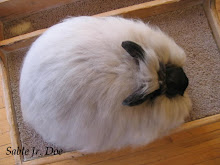
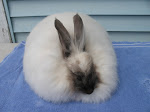
Over the summer I had several experiences with new owners who showed up to purchase one or more bunnies with no carriers to take them home in, and a few even had no cages set up at home to put them in when they got there:(. After the last instance, I decided to write up a 'Prep Sheet' for prospective new angora owners which I now keep as a file and send to every person who makes an appointment to come and buy a rabbit. I thought I would include it here for anyone who can make use of it.
Please feel free to copy or customize this list in any way, and make a point (even if it seems unnecessary!) of letting people know what equipment they will need before coming and what supplies will be needed at home in order to properly care for an angora. So far I have gotten excellent feedback on this list, and I'm sure I will be revising it over time and adding new information.
BEGINNER ANGORA SUPPLY LIST
This is a list of materials that are required for the health and maintenance of an angora rabbit. Before bringing your new bunny home, please have the following items on hand:
-Sheltered Wire Cage or Outdoor hutch. Housing should be well protected from drafts and sunlight. Cages should measure 30 X 30 X 18 inches or (preferably) 30 X 36 X 18.
-32 oz. Water bottle or 32 oz. Ceramic (or Plastic) Water Crock
-32 oz. Ceramic or Plastic feed dish
-Hay (preferably Timothy)
-Quality Pelleted Feed (16-17% protein)
Quality brands include:
Heinold Wool Formula
Manna Pro
Purina Show Formula
Blue Seal Show Hutch Deluxe
Blue Seal 16%
Nutrena
King Feeds
-Slicker brush
-Toenail clipper (either small dog or cat scissor)
THE CAR TRIP HOME
Please bring:
-Secure metal rabbit carrying cage (available from KW Cages at http://clover.forest.net/kwcages/index.html or Klubertanz Equipment at http://www.klubertanz.com/. ) If transporting more than one rabbit, you must either have separate compartments for each OR separate carriers. They cannot be transported together.
-If a metal cage is unavailable, one or more plastic cat carriers with latched doors may be substituted. If using a cat carrier, do NOT line the floor of the cage with wood shavings, towels, or newspaper. Pad carrier floors with hay only.
**DO NOT use cardboard boxes to transport rabbits OR expect to hold rabbits in lap during transport, as both could result in severe injury to the rabbit. If no adequate mode of transport is available upon arrival, the animal in question will not be permitted to leave and the non-refundable deposit will be absorbed.
-Feed and Water dishes will not be necessary during transport unless the trip extends overnight or lengthy stops are expected. Rabbits typically do not eat or drink in transport, so it is important to provide food and drink immediately upon arrival home.
The only time a list such as this would not be needed would be if you are selling to an experienced breeder/owner. Even if someone arranges pickup at a show or fiber event, it is simple to mail this list ahead of time so that the buyer knows what is expected.
Have a great week!:-)
Sunday, December 5, 2010

Saturday, November 27, 2010
Giant X notes
I finally got the chance to snap pictures of most of my Giant/cross keepers from this summer's breedings. These babies were all born in the middle of July and are now about 4 1/2 months old:).
This here is BOCA, an FA/GA cross. She weighs in at 7 lbs. so her bone/frame is good, but her wool is typical of what you might see in a crossbreed---lack of balance and a very high maintenance coat as a result. Surprisingly, the FA/GA crosses are proving far harder to keep matt-free than the NZ/FA/GA crosses. I will need to breed toward the easiest care coat possible that still maintains a correct ratio of GH to underwool/awn fluff.

This is DAFFODIL, the Chocolate littermate to Boca. I have said before that I am not wild about the color Chocolate because it has never been very dense in my experience, but since this girl has big bone and has already passed the 8 lb. mark, I am keeping her around. LOL.


These are the two boys out of Marin, DOMINO and OLIVER. They are not as large as the other rabbits, but their weights are still respectable and they have very good type.


And this is the best (cross) baby that was born this year. MARLEY is very large for her age (around 8 lbs.). She is typey and well balanced. Her wool is dense and easy to care for, and she feels like a lead weight when you pick her up *grin*. She is also out of an NZ/FA/GA breeding.


And this last picture is of Soraya, a black FA out of Etienne and Diego who is also 4 1/2 months old. This is a beautiful little girl who should do well on the show table next year:).

These buns only represent the first GA breedings I have done so there will be lots of work to do in the future. Since the real work in breeding is to isolate the best qualities of a herd and make them repeat themselves again and again, it will take many years and many generations to get the animal I want that can be produced the way I want it over and over the same way. Just as it is with French Angoras or any animal anywhere, each person's herd is like a signature that is refined and developed over time. Lots of work, lots of time, and lots of fried brain cells , LOL.
Have a great week:^)
This here is BOCA, an FA/GA cross. She weighs in at 7 lbs. so her bone/frame is good, but her wool is typical of what you might see in a crossbreed---lack of balance and a very high maintenance coat as a result. Surprisingly, the FA/GA crosses are proving far harder to keep matt-free than the NZ/FA/GA crosses. I will need to breed toward the easiest care coat possible that still maintains a correct ratio of GH to underwool/awn fluff.

This is DAFFODIL, the Chocolate littermate to Boca. I have said before that I am not wild about the color Chocolate because it has never been very dense in my experience, but since this girl has big bone and has already passed the 8 lb. mark, I am keeping her around. LOL.


These are the two boys out of Marin, DOMINO and OLIVER. They are not as large as the other rabbits, but their weights are still respectable and they have very good type.


And this is the best (cross) baby that was born this year. MARLEY is very large for her age (around 8 lbs.). She is typey and well balanced. Her wool is dense and easy to care for, and she feels like a lead weight when you pick her up *grin*. She is also out of an NZ/FA/GA breeding.


And this last picture is of Soraya, a black FA out of Etienne and Diego who is also 4 1/2 months old. This is a beautiful little girl who should do well on the show table next year:).

These buns only represent the first GA breedings I have done so there will be lots of work to do in the future. Since the real work in breeding is to isolate the best qualities of a herd and make them repeat themselves again and again, it will take many years and many generations to get the animal I want that can be produced the way I want it over and over the same way. Just as it is with French Angoras or any animal anywhere, each person's herd is like a signature that is refined and developed over time. Lots of work, lots of time, and lots of fried brain cells , LOL.
Have a great week:^)
Sunday, November 21, 2010
Spang's Evita--0SP57
Just a quick picture this week of my junior doe Evita, who is nearly 6 months old now and got her first haircut today. Evita was my best baby born this summer, and she is looking forward now to the 2011 show season:).
I've got loads more grooming to do tomorrow and this week. Keeping up with 2 breeds is a LOT of work, (LOL!) and I have recently come to the conclusion that I am not---just not---a Furnishings Person:(:(. I completely understand that there are people who are completely devoted to fluff on ears, cheeks, foreheads, and feet and I would never want to insult those fabulous people, but unfortunately I will never be one of them because I love the practicality of clean ears and faces too much, LOLOL!


Anyway, more again next time and have a WONDERFUL Thanksgiving!:-):-)
I've got loads more grooming to do tomorrow and this week. Keeping up with 2 breeds is a LOT of work, (LOL!) and I have recently come to the conclusion that I am not---just not---a Furnishings Person:(:(. I completely understand that there are people who are completely devoted to fluff on ears, cheeks, foreheads, and feet and I would never want to insult those fabulous people, but unfortunately I will never be one of them because I love the practicality of clean ears and faces too much, LOLOL!


Anyway, more again next time and have a WONDERFUL Thanksgiving!:-):-)
Sunday, November 14, 2010
Handling Rabbits--Do's and Don'ts


--This is another post from the old blog, but since I groomed a lot today I decided to also include pictures of Spang's Zsa Zsa, a REW doe whom I've been growing out to extremes to see if she can eat a full ration all the way to harvest. Since she has NZ in her (she's an F4 cross) I wanted to be sure that there were no issues with woolblock before breeding her. As of today, she is wearing a 6 1/2 month coat and I am thrilled to report that she is cleaning her dish everyday---YAY! More stuff again next time:-)
Handling Rabbits--Do's and Don'ts
Lots of people, particularly newer breeders, are often unsure of the best way to handle, pick up, and carry a rabbit. Different people have different methods that are used for pets, showbunnies, and angoras wearing showcoats, but here is a list of the typical do's and don'ts when it comes to running rabbits around in general:
DO's
-Keep bunny nails neatly trimmed to avoid getting them ripped out on the cage floor and to keep from being seriously scratched by your rabbit.
-Let the rabbit know that you are ready to pick them up by talking to them first and making them aware of your presence (no surprises, in other words!)
-Place one hand over the head and ears/neck of the rabbit before lifting it out of the cage, and slip the other hand under the belly so as NOT to be lifting the rabbit out by the head or scruff of the neck. Placing your hand over the head is only for restraint purposes, never for lifting.
-Use a stepladder to remove rabbits from top cages so that you are not forced to drag a rabbit forward in order to get it out.
-Always LIFT, and never PULL a rabbit out of a cage whether you are taking them out backwards or forwards.
-When removing a rabbit from the cage who is facing backward, place one hand over the head and the other one under the belly and lift the rabbit out backwards. If you cannot get one hand on the head then slip it under the belly/chest of the rabbit right up to the front legs, hold them firmly, then use the other hand to grab the rump of the rabbit and lift it safely out.
-When taking a rabbit out of a cage who is facing forwards, wrap one arm around the side and rear of the rabbit, and the other directly under the rib cage and lift up.
-Once you have a rabbit out of a cage tuck it into the crook of your arm like a football (facing backwards), and hold it against your body firmly.
-When placing the rabbit back into the cage try to do it backwards to avoid tripped/torn toenails. Reverse the hold you used to take the rabbit out of the cage facing frontwards and place one hand under the chest with the other hand grasping the rump. Lift the rabbit into the cage backwards and place it down on the cage floor.
DON'Ts
-Do not ever sneak up on a rabbit before picking it up or touching it. Always make sure he/she is 100% aware you are there to avoid sudden bolts and possible spinal injury.
-Never pick up a rabbit by the ears, head, or scruff of the neck. Repeated lifting of the skin over the neck can cause it to actually become permanently separated from the meat. The resulting flabbiness/fattiness will make it impossible to get the rabbit into show condition, and performance will suffer as a result.
-Never drag a rabbit out of it's cage. Instinct will cause it to dig it's nails into the cage floor and resist the motion, resulting in broken or ripped out toenails.
-Once a rabbit is out of it's cage, never carry it like a briefcase with the legs dangling. This is almost a sure-fire recipe for spinal injury, and one that should be avoided at all costs.
-Never hold a rabbit away from your body unless you have a very firm grip on the chest and rump of the rabbit. Any position of 'dangling' or flailing will greatly upset a rabbit of any breed, and if they must be held out they must be held firmly enough so that they feel secure and do not kick or panic.
-Never grip a rabbit's hind legs together to stop it from kicking. It is not natural for rear legs ever to be touching one another, and if a rabbit should panic or try to escape in this position both legs could break.
-Never move quickly around rabbits. Never grab them roughly, severely, or suddenly, and never surprise them from behind or above. Remember that calm bunnies are much less likely to injure themselves, and much more likely to let you handle them when they trust you to keep them safe:).
Monday, November 8, 2010
Misc. Stuff:)
It has been really, absurdly busy around here since I went back to work (for the most part) full time. There has been hardly any time to do dishes, feed children, take care of animals, or clean the house I live in much less blog and check email, LOL. It has been an embarrassing couple of weeks I tell you:).
There are a couple of days off coming in the district I work in, so I will begin to try catching up on normal life. Several new bunny litters arrived this week which I will be updating to my website. Juno had a litter of 3, Diana had 9, Bijou had 7, Etienne had 5, Elenita had 2, and Natalya and Marin are due with litters tomorrow. I have noticed lately that Fall litters often tend to be smaller than the Spring ones, and I am sure this year it is directly due to the horrible summer we had and the fact that my bucks (especially the older ones) went completely and totally infertile for a period of several weeks:(.
These new litters will be 12 weeks old by the PA Convention (which is exactly why I bred them at this time, LOL). There should be plenty of babies to bring for sale even if they are too young to place on the show table yet. I am looking forward to seeing how they turn out and also how the latest Giant litters turn out, of which two more are due to be born this week.
Speaking of Giants, I managed to acquire 3 more purebred bunnies from a very nice breeder in PA named Ashley Shaw. She sold me a beautiful little doe along with a nice buck and a purebred Black buck, and I am thrilled to death because now my GA base herd is complete and I can really get to work with a decent sized gene pool in place. The GA crosses I saved from my last breedings are really coming along now, and at the last weigh-in they either equaled or exceeded my French litters of the same age. Of course, much of this is due to hybrid vigor which can be expected to wear off in the next 2 generations, but it's a good start and the buns I am holding onto are strong, hardy representatives of the breeds that were used.
Aside from this there is really nothing going on besides the usual closing up of the rabbitry for winter and preparing to break out the water dishes for everyone. This week (as everyone knows!!) is ARBA Convention week up in Minneapolis, MN, and I think the judging should have finished up by now and we will soon be awaiting the results of the show. From what I understand there is actually a larger Satin Angora entry than FA this year which is utterly amazing. Years past have seen well over 100-150 French entered at that show, but apparently there are less than 40 entered this year:(. I have heard rumors that the Pennsylvania clubs are planning to put in a bid for the 2013 location, and if that is the case then I will certainly plan on driving down and adding my numbers to the bunch. There is nothing like an ARBA convention to look forward to--the biggest (rabbit) show on earth!:-)
Anyway, more again next time when I have time to snap and post pictures. Best of luck to those traveling to and showing in MN this week. Have a fun week and get home SAFE!
There are a couple of days off coming in the district I work in, so I will begin to try catching up on normal life. Several new bunny litters arrived this week which I will be updating to my website. Juno had a litter of 3, Diana had 9, Bijou had 7, Etienne had 5, Elenita had 2, and Natalya and Marin are due with litters tomorrow. I have noticed lately that Fall litters often tend to be smaller than the Spring ones, and I am sure this year it is directly due to the horrible summer we had and the fact that my bucks (especially the older ones) went completely and totally infertile for a period of several weeks:(.
These new litters will be 12 weeks old by the PA Convention (which is exactly why I bred them at this time, LOL). There should be plenty of babies to bring for sale even if they are too young to place on the show table yet. I am looking forward to seeing how they turn out and also how the latest Giant litters turn out, of which two more are due to be born this week.
Speaking of Giants, I managed to acquire 3 more purebred bunnies from a very nice breeder in PA named Ashley Shaw. She sold me a beautiful little doe along with a nice buck and a purebred Black buck, and I am thrilled to death because now my GA base herd is complete and I can really get to work with a decent sized gene pool in place. The GA crosses I saved from my last breedings are really coming along now, and at the last weigh-in they either equaled or exceeded my French litters of the same age. Of course, much of this is due to hybrid vigor which can be expected to wear off in the next 2 generations, but it's a good start and the buns I am holding onto are strong, hardy representatives of the breeds that were used.
Aside from this there is really nothing going on besides the usual closing up of the rabbitry for winter and preparing to break out the water dishes for everyone. This week (as everyone knows!!) is ARBA Convention week up in Minneapolis, MN, and I think the judging should have finished up by now and we will soon be awaiting the results of the show. From what I understand there is actually a larger Satin Angora entry than FA this year which is utterly amazing. Years past have seen well over 100-150 French entered at that show, but apparently there are less than 40 entered this year:(. I have heard rumors that the Pennsylvania clubs are planning to put in a bid for the 2013 location, and if that is the case then I will certainly plan on driving down and adding my numbers to the bunch. There is nothing like an ARBA convention to look forward to--the biggest (rabbit) show on earth!:-)
Anyway, more again next time when I have time to snap and post pictures. Best of luck to those traveling to and showing in MN this week. Have a fun week and get home SAFE!
Sunday, October 17, 2010
Rabbit Show 101
--another post from the old blog:
Visitors attending a rabbit show often come out of the experience with no idea of what actually happened, LOL. There is very little fanfare or discussion/direction going on on behalf of the judges or exhibitors at these events, so many people leave feeling confused as to what took place, what happened during the judging, and who exactly won in the end:).
This is the way a rabbit show works:
Early on the morning of a show the showroom opens early to allow breeders to enter, get themselves and their animals set up, and check in. Once the designated hour of the show comes around, the judges put on their showcoats and stand behind the row of cubbies that has been reserved for the breed/s that they will be working with that day. The exhibitors identify the table that they will be showing at, park themselves nearby with their animals, and the show begins.
While the judge stands behind the table to examine animals, a person called a "writer" sits next to him at a small table with control sheets and comment cards to write down the judge's comments for each animal and to record the winners of each class and BOB/BOS (BOB stands for "Best of Breed" and BOS stands for "Best Opposite Sex").
When the judge is ready, the writer calls for the first class to be brought up. In Angoras this is normally the "White Senior Buck" Class, so everyone who has entered WSBs brings their animals up and places them into the cubbies. Before placing the animals, the judge first checks all the entries for DQs. A DQ may include such problems as white or mismatched toenails, white spots or hairs in a colored coat, malocclusion, genital defects, signs of illness, or undesirable characteristics that are unique to each breed. Once the judge has finished the preliminary check, then he/she goes on to evaluate each animal in more detail, checking type quality, wool quality, overall balance, and so on. Once this is finished, the judge then places each animal in a cubby in the order of it's placement (This is not required but it is the method they often use to keep track of everything), and the last place animal is taken out first. The ear number of the animal is read off for the writer, the placement is given, and comments are recited as to what the strengths and weaknesses of the animal are. The animal is handed back to the owner, and the next-to-last-place animal is taken out. The routine is repeated, and the animal is handed back to its breeder again.
By the time the judge reaches the first place animal, he/she goes through the same routine again, reads off the ear number, gives comments, and then puts the class winner off to the side in a cage behind the table or in a cubby on the end if there is room. The next class is then called up, and the entire cycle repeats itself with the judge evaluating each new animal until another class winner is selected. The order of classes in the Angora breeds is usually judged as follows:
1-White Senior Buck (WSB)
2-White Senior Doe (WSD)
3-White Junior Buck (WJB)
4-White Junior Doe (WJD)
5-Colored Senior Buck (CSB)
6-Colored Senior Doe (CSD)
7-Colored Junior Buck (CJB)
8-Colored Junior Doe (CJD)
Once the White classes have been judged, the judge will then choose an animal for BOV (Best of Variety) and BOSV (Best Opposite Sex Variety). These two animals will remain on the table until the Colored classes are concluded so that a winner can be chosen between the White BOV/BOSV and the Colored BOV/BOSV. Once the Colored classes are finished and the Colored BOV, etc. have been chosen, then the judge will compare the 4 winning animals to determine which is the Best 'Overall', and that animal will be awarded BOB--the Best of Breed. The judge will then choose the best opposite sexed animal for BOS, and the judging is over. The BOB animal is entitled to advance to the BIS (Best in Show) table at the end of the day, but the show will be over for the rest of the animals that were entered.
In Angoras the winning rabbit is almost always a Senior Doe simply because does are larger and normally have superior coats and wool balance. The BOS often works out to be a Senior Buck, though it has certainly occurred that a buck has won BOB or a junior buck or doe has won BOB over a senior animal. Judges have individual opinions and preferences as to which animals are the best, of course, and one thing you can be positively certain of is that the results of one show will almost never be the same as the one that came before it. There are some judges out there who are extremely capable with Angoras and take the time to honestly evaluate them, while others have an active dislike or grave lack of knowledge with them (unfortunately).
People may ask, "Well, if you can never get the same result in each show then how will you ever learn what the quality of your animals is to begin with?" That is an excellent question and the answer is that you can't know after attending only one show with one judge. The proof in the pudding comes when one or more of your animals consistently does well, or consistently places in the top 10, 5, or 3, or gets similar comments day in and day out from different judges. The value of a show (and the reason they were invented to begin with), is to give breeders the chance to have their stock evaluated by a neutral and independent source that is a proven judge of rabbit quality. Everyone who raises livestock knows that 'barn blindness' is a standard problem among breeders, so it is critical to have animals seen and evaluated on a regular basis.
Visitors attending a rabbit show often come out of the experience with no idea of what actually happened, LOL. There is very little fanfare or discussion/direction going on on behalf of the judges or exhibitors at these events, so many people leave feeling confused as to what took place, what happened during the judging, and who exactly won in the end:).
This is the way a rabbit show works:
Early on the morning of a show the showroom opens early to allow breeders to enter, get themselves and their animals set up, and check in. Once the designated hour of the show comes around, the judges put on their showcoats and stand behind the row of cubbies that has been reserved for the breed/s that they will be working with that day. The exhibitors identify the table that they will be showing at, park themselves nearby with their animals, and the show begins.
While the judge stands behind the table to examine animals, a person called a "writer" sits next to him at a small table with control sheets and comment cards to write down the judge's comments for each animal and to record the winners of each class and BOB/BOS (BOB stands for "Best of Breed" and BOS stands for "Best Opposite Sex").
When the judge is ready, the writer calls for the first class to be brought up. In Angoras this is normally the "White Senior Buck" Class, so everyone who has entered WSBs brings their animals up and places them into the cubbies. Before placing the animals, the judge first checks all the entries for DQs. A DQ may include such problems as white or mismatched toenails, white spots or hairs in a colored coat, malocclusion, genital defects, signs of illness, or undesirable characteristics that are unique to each breed. Once the judge has finished the preliminary check, then he/she goes on to evaluate each animal in more detail, checking type quality, wool quality, overall balance, and so on. Once this is finished, the judge then places each animal in a cubby in the order of it's placement (This is not required but it is the method they often use to keep track of everything), and the last place animal is taken out first. The ear number of the animal is read off for the writer, the placement is given, and comments are recited as to what the strengths and weaknesses of the animal are. The animal is handed back to the owner, and the next-to-last-place animal is taken out. The routine is repeated, and the animal is handed back to its breeder again.
By the time the judge reaches the first place animal, he/she goes through the same routine again, reads off the ear number, gives comments, and then puts the class winner off to the side in a cage behind the table or in a cubby on the end if there is room. The next class is then called up, and the entire cycle repeats itself with the judge evaluating each new animal until another class winner is selected. The order of classes in the Angora breeds is usually judged as follows:
1-White Senior Buck (WSB)
2-White Senior Doe (WSD)
3-White Junior Buck (WJB)
4-White Junior Doe (WJD)
5-Colored Senior Buck (CSB)
6-Colored Senior Doe (CSD)
7-Colored Junior Buck (CJB)
8-Colored Junior Doe (CJD)
Once the White classes have been judged, the judge will then choose an animal for BOV (Best of Variety) and BOSV (Best Opposite Sex Variety). These two animals will remain on the table until the Colored classes are concluded so that a winner can be chosen between the White BOV/BOSV and the Colored BOV/BOSV. Once the Colored classes are finished and the Colored BOV, etc. have been chosen, then the judge will compare the 4 winning animals to determine which is the Best 'Overall', and that animal will be awarded BOB--the Best of Breed. The judge will then choose the best opposite sexed animal for BOS, and the judging is over. The BOB animal is entitled to advance to the BIS (Best in Show) table at the end of the day, but the show will be over for the rest of the animals that were entered.
In Angoras the winning rabbit is almost always a Senior Doe simply because does are larger and normally have superior coats and wool balance. The BOS often works out to be a Senior Buck, though it has certainly occurred that a buck has won BOB or a junior buck or doe has won BOB over a senior animal. Judges have individual opinions and preferences as to which animals are the best, of course, and one thing you can be positively certain of is that the results of one show will almost never be the same as the one that came before it. There are some judges out there who are extremely capable with Angoras and take the time to honestly evaluate them, while others have an active dislike or grave lack of knowledge with them (unfortunately).
People may ask, "Well, if you can never get the same result in each show then how will you ever learn what the quality of your animals is to begin with?" That is an excellent question and the answer is that you can't know after attending only one show with one judge. The proof in the pudding comes when one or more of your animals consistently does well, or consistently places in the top 10, 5, or 3, or gets similar comments day in and day out from different judges. The value of a show (and the reason they were invented to begin with), is to give breeders the chance to have their stock evaluated by a neutral and independent source that is a proven judge of rabbit quality. Everyone who raises livestock knows that 'barn blindness' is a standard problem among breeders, so it is critical to have animals seen and evaluated on a regular basis.
Sunday, October 10, 2010
Misc. Stuff
I spent most of this (beautiful) day doing barn work and moving bunnies around, and then we went ahead and processed 21 fryers so there aren't many brain cells left to think of something interesting to write tonight (grin:).
Due to this unfortunate case of brain-freeze, then, I have decided to re-post some interesting links that I found for the UARC list today in response to a discussion going on regarding the Chinese Angora. UARC members were discussing the difference in quality between Chinese wool found in the stores over here and that which is sold by individual breeders on a smaller level throughout the rest of the world. This first link below is really a history of the Angora rabbit in various regions (as told by one writer---there are really many different versions of this 'origin' story:)). The last two links are detailed accounts of the Chinese Angora itself, which is said to be a cross between the French Angora, German Angora, and New Zealand White meat rabbit.
http://www.raising-rabbits.com/angora-rabbit.html
http://www.medwelljournals.com/fulltext/?doi=javaa.2010.359.365
http://www.cuniculture.info/Docs/Magazine/Magazine2008/FiguresMag2008/Congres-20\
08-Verone/Papers/G-GuZilin.pdf
Anyway, hope you enjoy this, and I hope that the weather is cooling off in every area to get that wool growing out again!
Due to this unfortunate case of brain-freeze, then, I have decided to re-post some interesting links that I found for the UARC list today in response to a discussion going on regarding the Chinese Angora. UARC members were discussing the difference in quality between Chinese wool found in the stores over here and that which is sold by individual breeders on a smaller level throughout the rest of the world. This first link below is really a history of the Angora rabbit in various regions (as told by one writer---there are really many different versions of this 'origin' story:)). The last two links are detailed accounts of the Chinese Angora itself, which is said to be a cross between the French Angora, German Angora, and New Zealand White meat rabbit.
http://www.raising-rabbits.com/angora-rabbit.html
http://www.medwelljournals.com/fulltext/?doi=javaa.2010.359.365
http://www.cuniculture.info/Docs/Magazine/Magazine2008/FiguresMag2008/Congres-20\
08-Verone/Papers/G-GuZilin.pdf
Anyway, hope you enjoy this, and I hope that the weather is cooling off in every area to get that wool growing out again!
Subscribe to:
Posts (Atom)