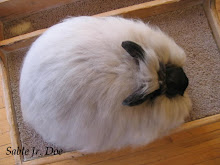
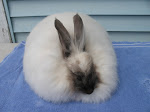
I always have the same exact mixed feelings at this time of year. On the one hand spring and summer are my favorite seasons because they give me the chance to add new prospects to the herd, and they are also great because I get to see how (or if:)) my line has improved on the whole from last year, reflecting the wisdom of culling decisions that were made the season before that. The bad part about it all, is that it is a heckuva lot of hard work:(.
My rabbits have always been my own project and something that I have always taken care of myself with the exception of help from my dh with culling and with the Big Time (1X/2X a year) Deep Cleaning Job that has to be done in the barn. The kids come out to help me sometimes, but as every breeder knows there are things that just cannot be passed off to other people everyday, and while the boys like bunnies and love to play with them, they have never been the crazed, pathological, rabbit fanatics that their mother so totally is, LOL:).
Anyway, during the year it is a simple question of grooming and dropping pans (for the most part), and it is not a big deal to maintain a herd of about 30-40. During breeding season, however, it becomes a whole other situation. Babies need to be supplied with more feed, hay, and oats. They have to be weaned in several stages into new cages that have to be cleaned and sterilized in between every batch, then separated still further into single cages as they grow older. There is sort of a 'musical cages' situation taking place at all times when 10-12 litters are growing out in the same barn at the same time, and a huge amount of time is spent juggling rabbits around and evaluating babies to see who goes out ASAP, who sticks around for further development, and who makes the cut off the bat (a very tiny and distinguished group). In the meantime, moms who are now baby-less must be dried up, cleaned up, groomed, and clipped if necessary, while other adults who have been growing coats must continue to be groomed and also harvested when it's time, after which there is a period of 3-4 few weeks where nothing much has to be done (at long last:-D).
Every breeder who manages a herd of any breed (particularly wool rabbits) knows very well what I mean by all this, and knows just how crazy it can get during the busy times:(. This year I did something I have almost never done in the past, which was to basically replace my entire show herd in a single season, LOL. Last fall I had a sudden epiphany while checking over rabbits---sort of like an 'aha' moment that kind of hits you all at once out of the clear blue---and suddenly I knew exactly what direction I wanted to move in with my herd. Alot of time in most barns is spent treading water and moving in opposite directions in a breeding program (which has happened here too:)), but suddenly I knew exactly what I needed to do and exactly how I needed to go about it. I removed any rabbit from the herd who was being held for any kind of 'sentimental' purpose but who did not directly contribute to the quality of the line, and I retained only those animals who displayed solid consistency in more than one area: type, wool quality, vigor, color, pre-potency, and breeding/mothering ability. Those were the rabbits who were then used to do all the breedings for the spring and summer of 2008.
Though this drastic move cut the legs out from under me for an entire show year (LOL!!), I am pretty sure now that it was worth it. The babies coming up (and older juniors/young seniors) have more consistency quality than litters of the past. While I may have been lucky to get 1-2 nice babies out of a litter before, I am now seeing 3, 4 or even 5 possible keepers in a single litter, which means that the gene pool is becoming more uniform. Color and wool quality have improved and best of all, the type has risen dramatically, which is where an angora herd needs help the most:). The NZ crosses that came in helped wonderfully in this area, and though they are still separate from the herd and not yet registerable (or sellable), they are wonderful, solid animals with better compatibility to the FA breed than I would ever have expected. The culling talents of the previous breeder in this case (Elaine Harvey) came through with some animals who threw their good qualities almost immediately, building yet another excellent case for linebreeding:).
Anyhow, so what I am meaning to say after this long-winded post is that I am busy as a bee right now raising all these rabbits and moving into the next stage of this herd's development. Things should calm down radically in the next few weeks and there will be time again to get back to the leisurely schedule of grooming and (hopefully, this year) showing. I will post pictures of some of the new buns over the coming weeks (once I pick up a camera:)), and the fall should be interesting and alot of fun.
Have a fabulous weekend!:-)
Friday, August 22, 2008

Wednesday, August 13, 2008
Bottle Cleaning
I was just going through the rabbitry switching out and cleaning water bottles today, and thought I'd write a little bit about that since it is a job everyone has to do from time to time, especially in the heat of summer with lots of litters and full cages to deal with. Even if you don't use water bottles and have a watering system instead, it is still necessary to flush it out from time to time to eliminate mold and other undesirable bacteria that build up in a wet environment continually.
My favorite bottles in the absolute whole world are Lixits:-). Not only do they have a really simple hanging wire that eliminates complex brackets, but the bottles themselves are wide mouthed and tilted on a 45 degree angle into the cage, making them easy to clean and position for perfect access.
One easy, no-scrub way to clean a water bottle is to put a few drops of bleach into it, fill it halfway up with water, put the cap on, and then leave it sitting on the counter on it's side until the mold and dirt 'melt' off. You will need to clean the outside of the bottle by hand after that, or simply pop the whole thing in the dishwasher to sterilize.
If you have a limited amount of bottles and need to wash them by hand fast in order to return them to the cage right away, just grab a sponge with a little dish liquid on it, wipe down and rinse the outside of it, and then take a bottle brush (the kind with a brush at either end---large and small sized), and scrub the inside thoroughly.
Sometimes the brush is not enough to get around the mouth of the bottle and the little nooks and crannies around it, so at that point I take a sponge on a stick (or just a really soft sponge that I can squeeze part-way into the bottle), and scrub it out again (with lots of rinsing). I then wash the cap by hand because it is tough to get that totally clean in the dishwasher, and I use the small end of the bottle brush to push in and out of the zip tube a few times, because lots of slime and grimy stuff can hide out in hard-to-reach places like that:(. After this (if there is time), I put all bottles in the dishwasher on the top rack, and all caps in the utensil basket to get everything sterilized and ready to use.
There is nothing wrong with skipping bottles completely in favor of water dishes, and lots of people prefer those year round because they are easier to clean and much less complicated to use. With wool breeds, however, I find that dishes tend to be unsanitary and a downright disaster for long coats, especially when someone somewhere decides to stand in the dish in order to cool off and cakes the wool on their chest and dewlap into a solid, unremovable matt:(.
Anyhow, so this is a little bit about how I keep water bottles clean, though people everywhere may have alternative methods. I have maxed out my supply of feed dishes and water bottles completely with all the babies that are growing around here, so I am now doing cleaning and maintenance 24/7, and can't wait til the weaning is finally done so I can get things down to a manageable level again, LOL:).
Have a wonderful week!
My favorite bottles in the absolute whole world are Lixits:-). Not only do they have a really simple hanging wire that eliminates complex brackets, but the bottles themselves are wide mouthed and tilted on a 45 degree angle into the cage, making them easy to clean and position for perfect access.
One easy, no-scrub way to clean a water bottle is to put a few drops of bleach into it, fill it halfway up with water, put the cap on, and then leave it sitting on the counter on it's side until the mold and dirt 'melt' off. You will need to clean the outside of the bottle by hand after that, or simply pop the whole thing in the dishwasher to sterilize.
If you have a limited amount of bottles and need to wash them by hand fast in order to return them to the cage right away, just grab a sponge with a little dish liquid on it, wipe down and rinse the outside of it, and then take a bottle brush (the kind with a brush at either end---large and small sized), and scrub the inside thoroughly.
Sometimes the brush is not enough to get around the mouth of the bottle and the little nooks and crannies around it, so at that point I take a sponge on a stick (or just a really soft sponge that I can squeeze part-way into the bottle), and scrub it out again (with lots of rinsing). I then wash the cap by hand because it is tough to get that totally clean in the dishwasher, and I use the small end of the bottle brush to push in and out of the zip tube a few times, because lots of slime and grimy stuff can hide out in hard-to-reach places like that:(. After this (if there is time), I put all bottles in the dishwasher on the top rack, and all caps in the utensil basket to get everything sterilized and ready to use.
There is nothing wrong with skipping bottles completely in favor of water dishes, and lots of people prefer those year round because they are easier to clean and much less complicated to use. With wool breeds, however, I find that dishes tend to be unsanitary and a downright disaster for long coats, especially when someone somewhere decides to stand in the dish in order to cool off and cakes the wool on their chest and dewlap into a solid, unremovable matt:(.
Anyhow, so this is a little bit about how I keep water bottles clean, though people everywhere may have alternative methods. I have maxed out my supply of feed dishes and water bottles completely with all the babies that are growing around here, so I am now doing cleaning and maintenance 24/7, and can't wait til the weaning is finally done so I can get things down to a manageable level again, LOL:).
Have a wonderful week!
Saturday, August 9, 2008
The Difference Between Bucks and Does

Bunny litters are born after a 31 day gestation period. At birth, the kits are approx. 2 inches long as well as naked and blind, but with daily feedings they begin to grow very quickly until their eyes open up around the 12th day, and they are climbing out of the nestbox by week 3:).
At about the same time as babies emerge from the box, they also begin to sample pellets and water, in addition to the hay and oats they have been munching in their nestboxes previously. Once they begin to eat solid food, it isn't long until they are eating alot of solid food, and in 2-3 weeks you are pouring pellets into food dishes around the clock, wondering how on earth so much food can disappear into so many little tummies, LOL. At this point, the kits are either weaning themselves or being weaned by mom (slowly), and by the 6-7th week they are ready to be separated from the doe entirely to begin an independent life.
When bunnies are initially weaned they are usually placed into a separate cage along with 1-2 other siblings of the same sex in order to minimize stress, and change is slowly introduced. At 9-10 weeks of age, angora babies are placed into their own cages to avoid ruining their growing coats, and they will live separately for the remainder of their lives with the exception of breeding and (in the case of does) raising litters.
At 12 weeks of age a growing rabbit begins to settle and hit adolescence. Weaned babies have established their own eating patterns and are beginning to fulfill their genetic potential, and this is also the time when differences in personality tend to emerge. Junior bucks are generally extremely "active" and somewhat on the hyper side (even more than somewhat in some cases, LOL), while does tend to be quieter at this age and much more relaxed.
At the 6 month mark, we find bunnies who have practically matured into adults, and a new set of behavior patterns surface. Physically, a 6 month old FA is nearly full grown (often weighing 8-9 lbs.), but many continue to hold onto their baby coats, though the first molt is probably right around the corner. At this point, the personalities of does and bucks tend to flip flop, and as the bucks quiet down and settle in, the does begin to get more and more antsy and temperamental. Hormonally, does are beginning to mature sexually which is something that has already occurred in the bucks (most bucks are ready to breed by 4 1/2 months), and along with the doe's development comes behavior such as cage territoriality, frequent digging and restlessness, and more of an "attitude" than you would encounter in a buck of the same age (so to speak:)). Not all does and bucks express these traits, but it is safe to say that most probably do. If the behaviors are indeed related to sexual maturity, then a breeder will find that they tend to slow down or be non-existent in off-times of the year such as winter, when breeding in the wild does not occur. Spring and Summer are prime breeding seasons with the most reproductive behavior taking place, while Fall and Winter show a marked decrease with considerably calmer and more tranquil bunnies:).
Later in life (2-3 years old or so), bucks often become extremely mellow, don't spray often (if they ever did to begin with), and are usually described as passive and calm. Does may continue to display breeding behaviors at certain times of the year, but they can mellow out quite a bit as well, in some cases becoming almost matronly:). Older does generally make wonderful mothers because of their experience and predictability at that age, and they are a pleasure to have around the rabbitry and on the showtable, where they have usually learned to sit very calmly in a picture perfect pose.
What most people normally think of as the ideal FA pet is a mellow older buck (older meaning anything over the age of 2). Does can make wonderful pets as well, but they tend to have different personalities due to their hormonal differences, and can be both terrible and entertaining depending on how you look at it:^). None of the personality traits listed above are carved in stone. There are certainly horrible bucks and fabulous does out there as most of us who breed can attest, but raising bunnies is also about genetics, and sometimes even the person who owns them and whether or not they "click" with the animal in question (we have all heard stories of bunnies who bit certain owners but loved other ones to death, LOL).
"Unpredictablility" is a term that will always apply to rabbits, no matter how we breed or raise them. One man's angel is another man's monster :^).
Hope you are enjoying the summer. I have been busy with birthdays, family reunions, and extra garden/bunny work, but it looks as though fall will soon arrive with angora-friendly weather (not that there's been anything to complain about the last few weeks in that department, however:)). Have a great weekend!
Wednesday, July 30, 2008
Babyfaces:)
I decided to snap a couple of baby pictures today just for fun. There are currently lots of litters in the barn ranging in age from 3-6 weeks. The youngest were moved in just last weekend, and the oldest are due to start weaning tomorrow (as I frantically clear cages to make room for them all, LOL).
This first bunch is Pascha's litter, with a few of Neva's babies fostered in (the REW and Sable are Pascha's, and the Fawn is Neva's). There are more babies in this litter hiding on the other side of the cage, but they did not see fit to squeeze into the picture:).

This is a close-up picture of one of the Fawns scratching itself:)


This is a (3 week old) Pearl from Juno's litter. Another very dark bunny. It will probably be very nicely shaded when the wool comes in.

This first bunch is Pascha's litter, with a few of Neva's babies fostered in (the REW and Sable are Pascha's, and the Fawn is Neva's). There are more babies in this litter hiding on the other side of the cage, but they did not see fit to squeeze into the picture:).

This is a close-up picture of one of the Fawns scratching itself:)

This is Evariste lounging with some of the babies from her litter. Shown here are 2 REWs, but there is also a Sable and Pearl in the bunch (sired by Pierre).

This is a (3 week old) Pearl from Juno's litter. Another very dark bunny. It will probably be very nicely shaded when the wool comes in.

And this is a close-up of 2 of the babies in Oomi's litter (with Oomi's nose stuck in on the left). A Pearl and a REW--again:).

And this is Echo's big litter, with 9 remaining from the original 13. Needless to say this cage is CRAMMED with that many babies and one doe in a 30 X36 inch space, but tomorrow is the 6 week birthday mark, so three of them will be removed first thing tomorrow morning. This is one of the Pearls in the batch. There are also 4 Sables, and a REW.

And this is a shot I tried to take of the Sable bunnies from the same litter, but Mom (who doesn't like me much even on her best day, LOL) has decided that there is NO way I will be taking any unauthorized photographs of her babies today or anyday, as long as she has even one thing to say about it. Look at that expression! This is Echo in a nutshell:).

And finally, here are 2 pics of Giacomo and Arcadia just before their haircuts last week. At only 5 months it was a little early to clip the babies out of Juno's litter, but given the weather lately and the fact that they were starting to look miserable, I decided not to wait. With a little luck all of the babies from this litter will be in coat and ready for the PA Convention.


More again next time, and have a great week!:-)

And this is Echo's big litter, with 9 remaining from the original 13. Needless to say this cage is CRAMMED with that many babies and one doe in a 30 X36 inch space, but tomorrow is the 6 week birthday mark, so three of them will be removed first thing tomorrow morning. This is one of the Pearls in the batch. There are also 4 Sables, and a REW.

And this is a shot I tried to take of the Sable bunnies from the same litter, but Mom (who doesn't like me much even on her best day, LOL) has decided that there is NO way I will be taking any unauthorized photographs of her babies today or anyday, as long as she has even one thing to say about it. Look at that expression! This is Echo in a nutshell:).

And finally, here are 2 pics of Giacomo and Arcadia just before their haircuts last week. At only 5 months it was a little early to clip the babies out of Juno's litter, but given the weather lately and the fact that they were starting to look miserable, I decided not to wait. With a little luck all of the babies from this litter will be in coat and ready for the PA Convention.


More again next time, and have a great week!:-)
Wednesday, July 23, 2008
The Color Black
Another old post revisited:)
In addition to my favorite FA color, REW, I am also in love with all the Self colors:). Since I am not a spinner and don't get to see the effect of each color in yarn (which might make me prefer different ones, LOL), I breed for the colors that I think will make the biggest impact on the showtable OR are easiest to breed for uniformity and intensity of color. REW is an obvious choice for showing simply because there are very few DQs that a white rabbit can have (aside from crooked tails, teeth and actual physical deformities). Also, a White rabbit of almost any breed will always have greater wool/fur quality, yield, and density (for reasons that are not entirely clear but that seem consistent).
Self colors (IMO) are wonderful simply because they are stunning when bred for good intensity and there is nothing that distracts your eye away from the whole rabbit when it is on the showtable. A rabbit with a Broken pattern can sometimes appear to be "broken up" or "unbalanced" when posed, and your eye is likely to be drawn away from the type and coat to focus more strongly on the pattern instead, which tends not to happen with solid colors (I am not criticizing the broken variety in any way, this is just a personal observation I have made:) ).
The most dramatic Self color of all tends to be Black, for obvious reasons:). I have bred huge numbers of this color over the last several years but have kept very few because while they are stunning to behold in full coat, they can also be a nightmare to breed in terms of scattered white hairs/silvering, and other problems that occur. It is not that these problems emerge with less frequency in every other Self color (or any other variety for that matter), it's just that the Black variety is the opposite of White in that EVERY, TINY, little imperfection, spot, hair, and inconsistency shows up dramatically, and you see judges scrutinize this variety to no end simply because everything there is so obvious :(.
According to Glenna Huffmon's book, "Rabbit Coat Color Genetics" intensity of Color primarily has to do with Plus and Minus modifiers. On pg. 99 she says,
"The plus modifiers will produce larger areas of color, while the minus modifiers will enlarge and extend the areas of white. It all depends on the balance between the two factors. On a self-colored animal, no white is usually the ideal coloration-that is no small white spots and no scattered white hairs in the coat. However, with the presence of too many of the minus modifiers, the solid colored animal may show some white hairs or small white spots in the normally colored coat."
"The self-colored animal with 80% plus modifiers and 20% minus modifiers should still have a solid colored coat. Even 50% of each will usually result in a colored coat with no white. However, when the percentage of minus modifiers outnumbers the plus modifiers, such as 20% plus modifiers and 80% minus modifiers, those annoying white spots and hairs can show up. These white spots usually appear on the head, belly, chest, toes, and feet."
To correct white spots and hairs, she says,
"Breeders of rabbits with lilac and/or blue varieties are no doubt already aware of the modifiers that can result in more intense and darker coloration as opposed to those that lighten the basic color to a lighter shade. It takes a great deal of careful selective breeding on the rabbit breeder's part to get and keep the desired shade. These color intensifiers are not the result of just one gene. There needs to be a large number of them accumulated for them to have the desired affect on the final coat color. They cannot change the blue to black, but they can control the darkness or lightness of the blue color. It all depends on the ratio of dark to light modifiers present."
So in other words, each color is subjected to the effect of modifiers (most notably the Self varieties), but certain Selfs will more clearly express differences in intensity because they are a lighter color in general (Lilacs and Blues for ex.). Blacks and Chocolates will not necessarily get darker in overall body color, but you will see less of the stray white hairs and spots that plague these varieties and stand out so clearly.
I spoke with a number of breeders and looked at info. from a variety of sources, and it appears that the best way to improve Self colors and eliminate white hairs and spots is simply to cull out the rabbits who express them and breed only the best colored offspring, breeding like color to like color for as long as it takes to increase plus modifiers to the point where any trace of white in a rabbit's coat is eliminated. What I have done lately is to keep the best Blacks in my breedings that express few if any white hairs, and this year I will begin breeding them to each other in order to produce better bunnies of this variety and repeat the same color combination for approx. 3 generations to see what I come up with.
* Quick note* A judge who didn't have much experience with Angoras recently told me that he thought most Angoras looked as though they had snips of white on their front feet. What I believe he was referring to was the fact that the footpads on a dark Angora variety like Black are light gray underneath and often 'push up between' the toes when the bunny is sitting, making it seem as though the feet have silver or white hairs on them. ALWAYS make certain that the color you are seeing is not really coming up from underneath a bunny's foot----remember that to qualify as a DQ, the snip/hairs/ spot must be on top of the feet and clearly be white. Check your little toes carefully:).
*Also--the same principle applies to 'silvering' that can appear right beneath the bunny's nose (silver color, not white). White on TOP or anywhere around the nose can be a DQ but a 'silvery' (kind of faded black color) is normal on the upper lip of some darker color varieties (I see it regularly in my Blacks and Sables but they are never penalized for it at shows).
Also, I just wanted to mention in closing that there are other factors that can cause white spots/hairs in rabbits, and one of these is the Steel gene. Since I have quite a bit of Steel floating around in my lines it is entirely possible that the snips/hairs on some of the rabbits I had in the past may be due in part to the presence of Steel, but for now I have chosen to treat this as a modifier problem and breed accordingly while I tackle the Steel gene using Torts and Pearls on the other end of my breeding program.
Anyhow, so this is a little bit about the color Black, one of my favorite colors aside from White, LOL. I may have missed info. here but will continue to do research as I go until I achieve the quality of color I am looking for:).
In addition to my favorite FA color, REW, I am also in love with all the Self colors:). Since I am not a spinner and don't get to see the effect of each color in yarn (which might make me prefer different ones, LOL), I breed for the colors that I think will make the biggest impact on the showtable OR are easiest to breed for uniformity and intensity of color. REW is an obvious choice for showing simply because there are very few DQs that a white rabbit can have (aside from crooked tails, teeth and actual physical deformities). Also, a White rabbit of almost any breed will always have greater wool/fur quality, yield, and density (for reasons that are not entirely clear but that seem consistent).
Self colors (IMO) are wonderful simply because they are stunning when bred for good intensity and there is nothing that distracts your eye away from the whole rabbit when it is on the showtable. A rabbit with a Broken pattern can sometimes appear to be "broken up" or "unbalanced" when posed, and your eye is likely to be drawn away from the type and coat to focus more strongly on the pattern instead, which tends not to happen with solid colors (I am not criticizing the broken variety in any way, this is just a personal observation I have made:) ).
The most dramatic Self color of all tends to be Black, for obvious reasons:). I have bred huge numbers of this color over the last several years but have kept very few because while they are stunning to behold in full coat, they can also be a nightmare to breed in terms of scattered white hairs/silvering, and other problems that occur. It is not that these problems emerge with less frequency in every other Self color (or any other variety for that matter), it's just that the Black variety is the opposite of White in that EVERY, TINY, little imperfection, spot, hair, and inconsistency shows up dramatically, and you see judges scrutinize this variety to no end simply because everything there is so obvious :(.
According to Glenna Huffmon's book, "Rabbit Coat Color Genetics" intensity of Color primarily has to do with Plus and Minus modifiers. On pg. 99 she says,
"The plus modifiers will produce larger areas of color, while the minus modifiers will enlarge and extend the areas of white. It all depends on the balance between the two factors. On a self-colored animal, no white is usually the ideal coloration-that is no small white spots and no scattered white hairs in the coat. However, with the presence of too many of the minus modifiers, the solid colored animal may show some white hairs or small white spots in the normally colored coat."
"The self-colored animal with 80% plus modifiers and 20% minus modifiers should still have a solid colored coat. Even 50% of each will usually result in a colored coat with no white. However, when the percentage of minus modifiers outnumbers the plus modifiers, such as 20% plus modifiers and 80% minus modifiers, those annoying white spots and hairs can show up. These white spots usually appear on the head, belly, chest, toes, and feet."
To correct white spots and hairs, she says,
"Breeders of rabbits with lilac and/or blue varieties are no doubt already aware of the modifiers that can result in more intense and darker coloration as opposed to those that lighten the basic color to a lighter shade. It takes a great deal of careful selective breeding on the rabbit breeder's part to get and keep the desired shade. These color intensifiers are not the result of just one gene. There needs to be a large number of them accumulated for them to have the desired affect on the final coat color. They cannot change the blue to black, but they can control the darkness or lightness of the blue color. It all depends on the ratio of dark to light modifiers present."
So in other words, each color is subjected to the effect of modifiers (most notably the Self varieties), but certain Selfs will more clearly express differences in intensity because they are a lighter color in general (Lilacs and Blues for ex.). Blacks and Chocolates will not necessarily get darker in overall body color, but you will see less of the stray white hairs and spots that plague these varieties and stand out so clearly.
I spoke with a number of breeders and looked at info. from a variety of sources, and it appears that the best way to improve Self colors and eliminate white hairs and spots is simply to cull out the rabbits who express them and breed only the best colored offspring, breeding like color to like color for as long as it takes to increase plus modifiers to the point where any trace of white in a rabbit's coat is eliminated. What I have done lately is to keep the best Blacks in my breedings that express few if any white hairs, and this year I will begin breeding them to each other in order to produce better bunnies of this variety and repeat the same color combination for approx. 3 generations to see what I come up with.
* Quick note* A judge who didn't have much experience with Angoras recently told me that he thought most Angoras looked as though they had snips of white on their front feet. What I believe he was referring to was the fact that the footpads on a dark Angora variety like Black are light gray underneath and often 'push up between' the toes when the bunny is sitting, making it seem as though the feet have silver or white hairs on them. ALWAYS make certain that the color you are seeing is not really coming up from underneath a bunny's foot----remember that to qualify as a DQ, the snip/hairs/ spot must be on top of the feet and clearly be white. Check your little toes carefully:).
*Also--the same principle applies to 'silvering' that can appear right beneath the bunny's nose (silver color, not white). White on TOP or anywhere around the nose can be a DQ but a 'silvery' (kind of faded black color) is normal on the upper lip of some darker color varieties (I see it regularly in my Blacks and Sables but they are never penalized for it at shows).
Also, I just wanted to mention in closing that there are other factors that can cause white spots/hairs in rabbits, and one of these is the Steel gene. Since I have quite a bit of Steel floating around in my lines it is entirely possible that the snips/hairs on some of the rabbits I had in the past may be due in part to the presence of Steel, but for now I have chosen to treat this as a modifier problem and breed accordingly while I tackle the Steel gene using Torts and Pearls on the other end of my breeding program.
Anyhow, so this is a little bit about the color Black, one of my favorite colors aside from White, LOL. I may have missed info. here but will continue to do research as I go until I achieve the quality of color I am looking for:).
Monday, July 21, 2008
The Miracle of Bunny Manure
As all bunny people know (but not necessarily the normal population:)), rabbit manure is just about the best thing you can put on a garden. We have been using it for many years at our house now (in addition to other stuff donated by the chickens), and the fertility has just increased every year. The very best thing about bunny pellets is that they can be applied to a garden perfectly fresh without any aging whatsoever, and those breeders who do not use hay, (especially), are literally able to scrape it out of the cage pans and onto the garden beds. We use quite a bit of hay here because of the breed I raise, but that works too as long as there is a compost pile somewhere that gets turned fairly regularly in order to kill the weed seeds before they get applied. Since we only compost the garden once or twice a year, we need to have a central location to store manure from all those bunnies, and so there are 3 homemade bins in the back that get rotated from year to year, generously filled with a wheelbarrow of manure everytime I dump my pans:).
Below today I have posted a few pictures of this year's garden (just to illustrate the potency of this wonderful stuff), and there are herbs and vegetables followed by perennial garden flowers, all of which have positively thrived on the magic of bunny poop. See?:)


More next time as I try to come up with something interesting to talk about (since the well occasionally runs dry, LOL:-)). The babies are eating and growing, and I will try to get some pics of some of the youngest up and coming litters next time.
Below today I have posted a few pictures of this year's garden (just to illustrate the potency of this wonderful stuff), and there are herbs and vegetables followed by perennial garden flowers, all of which have positively thrived on the magic of bunny poop. See?:)


More next time as I try to come up with something interesting to talk about (since the well occasionally runs dry, LOL:-)). The babies are eating and growing, and I will try to get some pics of some of the youngest up and coming litters next time.
Have a great week!
Wednesday, July 16, 2008
A Shameless Election Pitch:)
I just wanted to take a moment and post a copy of this message that appeared on the Angora Rabbit List this morning in regard to the election campaign of Cindy Wickizer.
As many in ARBA already know, Cindy was a past President and did a very good job. She took a proactive approach against legislation that threatened our hobby and the work of countless breeders, and she was readily available to the membership. She addressed concerns that directly affected rabbit people on a day-to-day basis, and was extremely effective.
Our current president, Chris Hayhow, has done little if anything to combat (or even address) anti-breeder legislation in his terms of office. He is employed by the pharmaceutical industry which benefitted from his recent support of the MUMs legislation, but the act has done little if anything for the breeders that comprise the ARBA, and issues that directly affect us continue to be ignored.
I support Cindy Wickizer in her campaign for ARBA President, and I also support Eric Stewart in his bid for Vice President. Eric is a caring, brilliant judge, breeder, and current officer of the BOD who will do an excellent job in the position of VP. His talents combined with Cindy's will make for a proactive and effective organization in which our officers work for us, not against us. VOTE CINDY AND ERIC FOR 2008!
PLEASE READ AND PASS ON TO YOUR FRIENDS
ARBA ELECTIONS, 2008
AN OPEN LETTER TO ALL ARBA MEMBERS
CINDY WICKIZER FOR ARBA PRESIDENT
On July 15th ARBA ballots will be mailed to each voting member for a very important election. When you review the past two years of ARBA leadership, have your concerns been addressed with campaign promises that have been met over that time? Have you been able to directly phone the ARBA President and discuss those issues? Are you noticing a decline in the number of ARBA clubs, membership and show entries in your area? Have your concerns about our ARBA youth contests been addressed? Has the ARBA leadership provided you with positive solutions which will help you? Are you concerned with training new registrars and judges to have the skills to judge your rabbits and cavies? Are you concerned with national, state and local regulations that hinder our industry? Are you concerned about being able to fly your animals to the national convention or your national shows? Are you concerned that options may exist to promote the growth of the rabbit and cavy industry? Are you concerned that an open line of communication must exist between all officers and directors and the membership? Are you concerned about the financial stability of the ARBA at the present time? Are you concerned that the ARBA Constitution and By-Laws are being followed?
If your answer to any of these questions is YES, then perhaps it is time that you consider a vote in a positive direction for our association where people work together for our common goals. Let’s make a change with the only person that is running for the position of ARBA President who has proven their record at a local, state and national level. Let’s make a change with a President who believes in finding positive solutions for the benefit of all of our members. Several years ago, she had a network in place with other small stock breeders who are faced with the same common cause that face us in these changing times.
The person we are speaking about is of course CINDY WICKIZER, Washington for your next ARBA President.
Cindy has been a proven leader in the ARBA for a number of years as the only woman president. Her track record certainly speaks for itself. Please refer to her two full page ads in the May-June, 2008 issue of Domestic Rabbits magazine. We encourage you to also re-read her candidate profile in the same issue.
Cindy Wickizer is a proven leader that is not afraid to explore and try a new idea to strengthen the ARBA in these difficult times.
Cindy has been a proven leader in the ARBA in a variety of positions over the years. She has served as ARBA President. For the past two years, Cindy has traveled gathering ideas which might help us as an association. She continues to raise rabbits. She is not afraid to try new ideas which will help strengthen the association. She knows that our association can make a difference in passing or defeating legislation. We all know that she does not have the power to reduce our fuel bills etc….
Please don’t set your ballot aside, spend that 42 cent stamp and make a change for the betterment of the American Rabbit Breeders Association.
CINDY WICKIZER FOR ARBA PRESIDENT
THANK YOU FOR YOUR VOTE
We also ask you to pass this message on to all your rabbit and cavy friends in your address book.
As many in ARBA already know, Cindy was a past President and did a very good job. She took a proactive approach against legislation that threatened our hobby and the work of countless breeders, and she was readily available to the membership. She addressed concerns that directly affected rabbit people on a day-to-day basis, and was extremely effective.
Our current president, Chris Hayhow, has done little if anything to combat (or even address) anti-breeder legislation in his terms of office. He is employed by the pharmaceutical industry which benefitted from his recent support of the MUMs legislation, but the act has done little if anything for the breeders that comprise the ARBA, and issues that directly affect us continue to be ignored.
I support Cindy Wickizer in her campaign for ARBA President, and I also support Eric Stewart in his bid for Vice President. Eric is a caring, brilliant judge, breeder, and current officer of the BOD who will do an excellent job in the position of VP. His talents combined with Cindy's will make for a proactive and effective organization in which our officers work for us, not against us. VOTE CINDY AND ERIC FOR 2008!
PLEASE READ AND PASS ON TO YOUR FRIENDS
ARBA ELECTIONS, 2008
AN OPEN LETTER TO ALL ARBA MEMBERS
CINDY WICKIZER FOR ARBA PRESIDENT
On July 15th ARBA ballots will be mailed to each voting member for a very important election. When you review the past two years of ARBA leadership, have your concerns been addressed with campaign promises that have been met over that time? Have you been able to directly phone the ARBA President and discuss those issues? Are you noticing a decline in the number of ARBA clubs, membership and show entries in your area? Have your concerns about our ARBA youth contests been addressed? Has the ARBA leadership provided you with positive solutions which will help you? Are you concerned with training new registrars and judges to have the skills to judge your rabbits and cavies? Are you concerned with national, state and local regulations that hinder our industry? Are you concerned about being able to fly your animals to the national convention or your national shows? Are you concerned that options may exist to promote the growth of the rabbit and cavy industry? Are you concerned that an open line of communication must exist between all officers and directors and the membership? Are you concerned about the financial stability of the ARBA at the present time? Are you concerned that the ARBA Constitution and By-Laws are being followed?
If your answer to any of these questions is YES, then perhaps it is time that you consider a vote in a positive direction for our association where people work together for our common goals. Let’s make a change with the only person that is running for the position of ARBA President who has proven their record at a local, state and national level. Let’s make a change with a President who believes in finding positive solutions for the benefit of all of our members. Several years ago, she had a network in place with other small stock breeders who are faced with the same common cause that face us in these changing times.
The person we are speaking about is of course CINDY WICKIZER, Washington for your next ARBA President.
Cindy has been a proven leader in the ARBA for a number of years as the only woman president. Her track record certainly speaks for itself. Please refer to her two full page ads in the May-June, 2008 issue of Domestic Rabbits magazine. We encourage you to also re-read her candidate profile in the same issue.
Cindy Wickizer is a proven leader that is not afraid to explore and try a new idea to strengthen the ARBA in these difficult times.
Cindy has been a proven leader in the ARBA in a variety of positions over the years. She has served as ARBA President. For the past two years, Cindy has traveled gathering ideas which might help us as an association. She continues to raise rabbits. She is not afraid to try new ideas which will help strengthen the association. She knows that our association can make a difference in passing or defeating legislation. We all know that she does not have the power to reduce our fuel bills etc….
Please don’t set your ballot aside, spend that 42 cent stamp and make a change for the betterment of the American Rabbit Breeders Association.
CINDY WICKIZER FOR ARBA PRESIDENT
THANK YOU FOR YOUR VOTE
We also ask you to pass this message on to all your rabbit and cavy friends in your address book.
Subscribe to:
Posts (Atom)