Wednesday, July 9, 2008

Separating Lines Within a Herd

One of the more frustrating things about rabbit raising is trying to find new stock to bring into your herd that is compatible with what you already have. Linebreeding (and inbreeding) is a very important practice in good breeding programs, but occasionally outside stock may need to be brought in for various reasons, and this prospect can be intimidating because you never know exactly what genes are being introduced and what the overall effects will be.

One way to prevent having to bring new animals into your herd too often is to take your own stock and separate it into more than one 'line'. Breeders of other breeds routinely separate their animals into pools according to color variety, and when fresh blood is needed they simply cross rabbits from the two lines they already have and get the necessary 'refreshment'. By using stock that exists in your barn already you do not experience the setbacks that typically occur when new animals are brought in, and the results in the nestbox are typically better since the parents involved are related, even if only distantly.

In my own barn I have had an ongoing plan to separate my herd into several groups consisting of 10-15 individuals each, based on color variety. I intend to focus on Sable/Sable Pearl, Tort, Black, REW, and possibly Fawn, so I will be separating my herd into various groups over the next year and then working within 'lines' to create a diverse breeding pool that should last quite a long time. Of course, 5 varieties is ambitious and friends of mine who raise other, short-furred breeds tell me it is way too much and I will sorely regret it (LOL), but we will see how it goes and I am sure that my plans will change and revise themselves as time goes by.

Even if you do not decide to divide your herd up according to color, it is still a good idea to choose some criteria/means of separation to keep alternate lines of rabbits breeding, showing, and producing at the same time. Everyone has different goals to pursue and it is important to know what those are before launching any breeding program, but maintaining a structured herd is an excellent way of keeping qualities you have worked hard to set for a longer period of time.

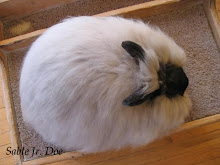
More again next time as we live through the end of this heat wave (I hope:)) and keep our bunnies as comfortable as possible. This week the last two litters of the summer here were born to Juno and Morwenna (both sired by Spang's Oberon). Juno gave birth to 6 kits---Pearls and Torts, and Morwenna had a litter of 5 REWs, Torts, and Fawns. This will be the end of the breeding season now until October and everyone will get a well-deserved break. Here is a picture of 4 of the nestboxes lined up in my living room (LOL). Pascha's, Neva's, and Echo's babies went outside to be with their moms permanently today, but Evariste's, Oomi's, Morwenna's, and Juno's litters will remain in the house a bit longer---for at least another 2 weeks:)


Have a great week!

Sunday, July 6, 2008

Bunny Type and Wool Test

Another repost from the old blog:-)

A judge recently offered a wonderful way of evaluating your own rabbits at home. He suggested using a Show Remark Card to "grade" each rabbit individually to get an idea of where each stands in comparison with the others, and then store that card in your rabbit's file either on computer or in some sort of binder. He suggested using this method mostly to gauge Type, but I quickly realized that this would be a fabulous way to assess the Wool on our animals as well!:)

Here are a few sample Type categories for use on a hypothetical "scoresheet". I took these characteristics from a variety of remark card styles/formats that I dug up out of my old show records:

TYPE
Head VG (very good) G (good) F (fair) P (poor)___________________________
Ears VG G F P_________________________________
Bone VG G F P_________________________________
Shoulders VG G F P_________________________________
Midsection VG G F P_________________________________
Hindquarters VG G F P_________________________________
Color VG G F P_________________________________
Meat condition VG G F P_________________________________
Depth VG G F P_________________________________
Overall Type VG G F P_________________________________


WOOL
Density VG G F P__________________________________
Texture VG G F P__________________________________
Length VG G F P__________________________________
Crimp VG G F P_________________________________
Overall Uniformity VG G F P_________________________
Uniformity of length VG G F P_________________________
Uniformity of density VG G F P_________________________
Uniformity of texture VG G F P_________________________
Coat Condition VG G F P_____________________
Ratio Guard Hair/Underwool VG G F P______________________


So what a breeder could do is print out several copies of these 'scorecards' for their rabbits, and then fill in the categories after a thorough evaluation of each animal. The lines at the end of each trait are for optional notes on each animal, and it would probably be a great idea to do evaluations at pre-determined ages for each rabbit in order to compare development of the animals in your line over time (for ex, do your rabbits tend to develop early or late, do they tend to lose "points" in certain categories at certain ages, do you notice trends of good or bad qualities emerging at certain stages of development, etc.). Be sure to place a date on each scorecard.

An evaluation system like this could really help to identify line characteristics that a breeder might never notice otherwise----and doing it ourselves at home gives us all the time in the world to inspect the minutest aspect of each bunny (unlike trying to get a rushed opinion from a judge at a show and hoping that the writer is able to get it all down on the remark card:)). On another note, something like this might be wonderful for Angora people to get together and do on a Saturday or Sunday at some central location or at someone's house----an informal "judging" of sorts of each other's animals with detailed remark cards that specifically pertain to the different breeds of Angora:). Something like this would be incredibly helpful to new breeders who are unsure of what qualities to look for but do not feel comfortable bringing their animals to shows, and it would give ALL breeders the second opinion that is so sorely needed to prevent unavoidable "barn blindness" on a regular basis, LOL.

Also, a personal rabbit "scoresheet" could be customized to fit specific problems in your barn that you are trying to fix. For ex, if you have trouble with fullness in the lower hindquarter in your herd, or density over the tops of your coats, you could certainly add categories that address and chart the progress of those particular traits.

There are books available that show diagrams illustrating good and bad type traits to help you determine the quality of your rabbits, and they are generally very helpful. The ARBA Standard of Perfection is one such resource available on the ARBA website for a reasonable price and it is invaluable as a resource for identifying type and color faults. It includes detailed descriptions of every recognized variety, and should be a part of every serious breeder's library.

Thursday, July 3, 2008

Just Pics Again

I am spending most of this week doing lots of grooming, now that the oldest jrs. are getting bigger and needier in terms of frequent 'haircare'. The oldest babies are hitting the 4 month mark now and approaching junior prime, while the younger buns are still able to roam freely without having to worry about attacks from me with the grooming tools just yet:).

There was another litter born this week to Evariste (sired by Pierre this time), and Oomi is pulling wool in the nest as we speak, so there should be news to report for her soon, too. Eva had a litter of just 4, and I am guessing that Oomi will have a small one as well given the fact that she is also a day past her due date. Pierre (who is an old man now at 4 years old) was the sire of both these litters, and I think that his sperm count was starting to wane at the time that the last 2 does were bred since the breedings were done in 85 degree temps. AFTER these breedings we were hit with a 90-95 degree heat wave for approx. one week, so needless to say this boy is now retired until the fall and the younger bucks will come in and gladly take his place:).

Below are just a few pics that I snapped of some of the other guys after grooming (even though I know I posted pictures of them already, LOL). The first here is D'Artagnan, the second two below that are of Giacomo, and the last two are Arcadia.


Below now are three of the younger litters that were born 2 weeks ago. I temporarily deposited them into a laundry basket while I cleaned and replaced nestbox bedding, and they had a fun time exploring before they collapsed into their boxes afterward and took a long, replenishing nap:).
The first two pictures are of Echo's litter. In the mix you can see four Sables, 4 Pearls, and 1 REW.


And here is a combination of two litters fostered to one doe. Neva's (bred to Dijon) babies are 3 of the REWs and 2 Fawns, while Pascha's two consist of 1 REW and 1 Sable (seen here with ALOT of frosting which will clear up later and turn brown).


Anyway, so that's about it for today. We are gearing up for the 4th of July holiday and getting lots of garden work done around here, too. The other day I picked a little 'snack' bowl of black raspberries, yellow alpine strawberries, mignionette strawberries, (with large size honeoye thrown in), and this week we will start up with the snap peas, white currants, and (many,many) more raspberries:).
Have a great week!

Saturday, June 28, 2008

Variation in Pearls

Pearl (or 'Point', as it is known in other breeds) is one of the most beautiful varieties of Angora, in my opinion. There have always been lots of Pearls around here because 1) I love them so much, LOL--and 2) they are steel-free, which has been a great help to me in my quest to strip that gene out of my herd. In this last round of breedings I have been using my oldest buck, Spang's Pierre, quite a bit. He is over 4 years old now and a nice Sable Pearl with some excellent traits that he seems to pass on very readily, so before it got too hot I decided to use him on every compatible doe I had, and I've gotten quite a few Pearls (mostly Sable) in the litters as a result.

Pearl is a color that can either be very dark, or so light that the coat is practically White for all intents and purposes. It is a clear DQ for a Pearl to have pure white body wool, but the standard otherwise describes this variety as having the "Light or dark marking color of Sable; Black, Blue, Chocolate, or Lilac, on-nose or mask, ears, feet, and tail, shading rapidly to a pearl or very light color. Undercolor to be white". According to the Rabbit Genetics list and other books I have read the 'ideal' Pearl is considered to be the very light but not-quite-white version. In my own barn, I have always favored the heavily shaded Pearls with lots of ticking and clear demarcations in the nestbox.

There have been both very lightly shaded Pearls and very dark bunnies born here this spring:). Today I made a project out of trying to photograph some, but as you can see most of the pictures did not come out clearly, though you can still see the markings I was referring to (I think my camera may be starting to bite the dust in today's entry, but it will have to survive a little longer, LOL).

These first two pictures are of some very well-marked Pearls in Echo and Pierre's litter. Even though the picture is blurry you can still see that there are lines of obvious shading on the side of each baby in addition to the normal mask and ear color (much like a good Tort, which is essentially a 'Reverse Pearl':)). The very lightly marked Pearls that are sometimes born do not have these demarcations, just the mask/ear color only. Without exception they all develop into adults that are showable under the standard, but who do not display the kind of shading and ticking that is evident on these babies below, who will grow up to be much darker and more heavily 'marked'.


This next picture below is of one of the babies out of Sadako and Pierre's last litter (age 6 weeks), who is NOT heavily shaded. Unfortunately the marks that are so easy to see in the nestbox tend to get more and more difficult to see once the wool begins to grow in. At this point even a good photograph would have difficulty exposing the difference, though it is still clear with the naked eye in good light during the day. This baby has shading only on the face and ears for the most part, but it is still perfectly showable. The baby BELOW it is a Pearl out of Neva and Dijon's litter who had very discernible shading from the beginning, and even today is basically 'frosted' with Sable tips from head to toe:


(Note: These babies are not posed on a grooming table, but given the temperatures today it wasn't a good idea to move anyone without a compelling reason, so all were snapped in-house instead:)).
In the previous entry where I posted pictures of my older Juniors there were also examples of 'light' and 'dark' Pearls. Spang's D'Artagnan was a very dark color as a baby and continues to have deep shading, while Spang's Savarna was very light, as is evidenced by her present wool color.
These are just a few observations about the color Pearl in Angoras. Once my Sable/Pearl line is established I will probably begin routinely selecting for dark shading in this color. While 'Pointed' could theoretically become too dark in a short haired rabbit, the fact that Angoras elongate their color can give us a great deal of leeway in determining how deep it could actually go in a long-haired rabbit (IMO). Although I do not spin, I imagine that the richest yarn would also result from the darkest rabbit, so it seems like a desirable trait to breed for.
More again next time as we wait for the temps and humidity to go down (soon, I hope) and two more litters to pop up out of Oomi and Evariste, due July 1 & 2.
Have a great weekend!:-)


Thursday, June 26, 2008

Herbs for Prego Moms


In keeping with the kindling/litter/pregnancy/breeding season subjects of the past week, I thought I would post another entry on the care of pregnant does. This one has to do with herbs that are beneficial during pregnancy, post-birth, and weaning, and since many of us have 'bunny borders' in our gardens at this time of year, it seems like a good topic to address.

Spring is the optimal time for getting does bred and kindling successful litters, and most everyone in the barn is ready for babies and doing what comes naturally as a result.
Since we have such a huge garden and a large variety of herbs at our fingertips, I have been using them more and more heavily during the breeding season, particularly for pregnant and nursing does.

There are lots of plants and herbs out there that benefit rabbits, but some are especially excellent for pregnant and lactating does. There are a few vitamins/minerals that are important for does and developing litters DURING pregnancy, some that are helpful AFTER kindling, and some that work to dry up a doe once the litter is weaned.

Before pregnancy, always make sure that the doe is in good condition. She cannot be woolblocked, experiencing health problems, or physically compromised in any way. She should not be fat or routinely overfed either, because overweight does build fat deposits around the reproductive organs that can hinder conception and litter growth. A vitamin that is critical at this time is Vitamin A, particularly since levels of this nutrient tend to fall off during the winter in pelleted feed and leave a doe deficient when it comes time for spring breeding. The PRIME source of Vitamin A in herbs/plants is unquestionably Dandelions, which contain 14,000IU of the vitamin in every 100 grams. Another good source is Comfrey.

Dandelions are easy to find and EXTREMELY palatable to most bunnies. I usually give 4-5 leaves to pregnant does every other day during gestation, and 2-4 leaves to every other rabbit at the same time (just for the other benefits it provides). Comfrey should be given more sparingly since studies have indicated the presence of carcinogenic properties in the leaves when they make up 33% of the diet, but it is still a beneficial plant as long as you feed it less often (about 1X a week) and rip it up finely so that it doesn't stick to the rabbits' wool.

The second most excellent herb to give pregnant does is probably Parsley. The wonderful thing about Parsley is that it is an appetite stimulant, it is good for woolblock, AND it is an excellent source of calcium which pregnant and nursing does need and can experience severe to fatal health problems without. I give 2-4 sprigs of Parsley to my does every other day as well:).

Another supplement to mention which is NOT an herb but is nonetheless helpful to gestating moms is an Electrolyte solution. AcidPak is an excellent product for this purpose (available at Klubertanz and other cage or livestock companies), and can be added to the water to keep systems balanced under the strain of kindling and nursing. I give 1/4 tsp. per gallon to does for 3-4 days before kindling and 3-4 days after. I continue to supply it every other day afterward, particularly in hot weather.

Directly after kindling the regimen changes and every doe who has just had a litter is given 4-5 leaves of raspberry, blackberry, or strawberry as a tonic for the reproductive tract and to soothe inflammation. Dandelions are eliminated from the diet entirely at this point because they boost milk supply and feed/supplements must be restricted the first few days to prevent too much milk from being forced in too early. Since dandelion stimulates milk production it may be helpful to does who are NOT good nursers and need extra help 3-4 days after kindling, but a good milker will need all stimulants eliminated completely until at least the 10th day when kits are beyond the danger of being overfed and the supply begins to dramatically increase. If a litter is large (7 or more kits) I begin adding it again around the 2nd week and certainly during the 3rd week when milk production is at it's highest and the doe needs all the help she can get in the heat of summer:).

Other herbs that stimulate milk production are Borage (both the leaves and flowers) and Fennel.

Once a litter is weaned it is time to dry up the doe and get her system back to normal. Some does wean babies naturally around the 5th or 6th week, but to be honest (more often than not), I have seen litters still nursing at 7-8 weeks, so do not assume that a doe is dried up and needs no special care because the babies are older.

Mint and Sage are excellent herbs for slowing down milk production, and can be given every day as soon as the last 2 babies are weaned. In addition to these, I take pellets away completely for 2 days and feed water and hay only, then slowly build the ration back up to pre-pregnancy levels. It is important to check the bellies of lactating does frequently to make sure that the milk is indeed drying up. If the stomach/chest is flat then the doe is fine and ready to go back to a normal feed ration. If you still feel puffiness/ lumpiness underneath keep the pellet level low and continue to feed herbs. Sometimes a doe who is a heavy milker will take longer than average to dry up----a doe I owned named Chartres routinely took 7 days to go all the way back to normal after weaning 8 week old litters, so be sure to check undersides every day:).

Well, that's it for today. We are winding down here after a hectic week with lots of active children running around (8 of whom are boys, LOL!), and now I will be looking forward to getting life back to normal and kicking off a fun and productive summer vacation. More again next time!:^)

Monday, June 23, 2008

Just a Quick Post----

I just wanted to post something quickly regarding the discussion on the Angora Rabbit List regarding BEW genes and a particular breeder's line. An entry was posted regarding a quote by a particular breeder that I misread and responded to this morning, and I would like to ask anyone from that list who reads this blog to disregard the posts I wrote and accept my apologies for jumping the gun and misunderstanding what the poster was originally trying to say. I posted this apology to the list but the thread was terminated before it turned up so I figured I would post it here instead. There are 9 children currently running through the house on vacation here this week making my faculties decidedly less sharp than usual (LOL), and I have not been reading mail as carefully as I usually do.

Other than this, that is about all:). More stuff on Wednesday regarding bunnies and other things, and have a wonderful but cool week.

Amy:^)
Sunday, June 22, 2008

Kit Stuff

Another previously published post:


I have 3 new litters this week----2 all REW litters out of Chartres and Calista sired by Marcel, and 1 litter of 2 (originally 3) out of Edelweiss, who had 1 REW and 2 Chestnuts by Emil. Anja, my Black doe, lost a litter of 9 the other day when she kindled overnight and failed to pull any wool (this was her first litter and by the time she pulled a pile the next day it was much too late:( ). I've already repeated her breeding and also gone ahead and fostered Edelweiss' babies over to Chartres since Chartres had only 4 this time and needs litters of 6-8 considering the amount of milk she produces. When I pulled the box out this morning all 6 of her babies were filled to bursting, so I may foster a few more over from Calista if it seems like she could use the break over the next couple of days, LOL.


There are several kit behaviors I have noticed over the years that make it easy to tell whether a litter has been fed well or not. I am normally one of those breeders who takes all nestboxes indoors and only brings them out for a feeding until the babies are 3 weeks old, but there are times when I have a doe who does not jump into the box right away and takes her time getting around to feeding. In those situations I need to leave it out longer and check babies periodically to tell whether they have been fed and the box can be brought back in:).


The reason I bring my boxes back and forth is two (or three) fold. First of all, I like to be present when feedings are taking place to avoid kits dying of exposure after being dragged out of the nest. With some does this hardly ever happens but with others I am almost guaranteed to find one or two on the wire after every feeding, so I always hang around to put everyone back in. Second, since we live near the woods in a very rural setting, the chance of predators invading the barn at night to snatch babies is a very real possibility, so I avoid that by having everyone safe in the house after dark. Thirdly, I don't like to take chances that baby feet will get caught in the floor wire, so lately I have kept litters in the house in hay padded carrying cages or rubbermaid tubs until 3 weeks of age, when their feet are usually big enough to be safe and they are ready to eat solid food and live with Mom in the cages full time. Keeping litters indoors also allows me to keep closer tabs on the babies, and they are handled more often by people as a result.


Babies who have just been fed will typically be very fat, and they are often wet with urine (which usually happens right after feeding). Right after they have eaten and the doe leaves the nest they begin digging away at the nesting material in an effort to fluff up the wool and dry the nest. This is when you hear frantic scratching noises (from older babies, especially), after which the entire litter settles into a pile and goes to sleep. Well fed babies are dopey and sluggish in much the way human babies (newborns) are right after they have nursed or finished a bottle.


Babies who have NOT been fed have thin and wrinkled stomachs, and when you stick your hand into the nest they immediately begin squirming, squealing, and "popping" up in an effort to find food (remember that newborn kits are blind and locate food by warmth and smell). If I have not looked at anyone's stomachs but the babies are jumping left and right when I stick my hand in, it is a pretty fair guess that they have not been fed.


Sometimes you will have a litter that has not been fed very much, (or enough to fill their bellies completely), and they will still be active after a feeding. Situations like this typically resolve themselves about 2-3 days after birth when the doe's real milk comes in and a regular nursing pattern gets established, but if you find that the litter is not quite full you can bring the box back to the doe again later in the day. Sometimes this works and sometimes it doesn't, but either way the baby/s should catch up quickly over the next day or two.


Occasionally you WILL get a doe who never gets milk due to genetics, sickness, or poor mothering ability (which is usually genetic as well). In a case like this you have no choice but to foster the litter to another doe who has been bred to kindle at the same time. If the doe in question is a first timer you may want to breed her again to see if the problem reasserts itself, but if you have tried 3 or more times with the same result, cull her out and think twice about keeping any of the babies she produced. It is a good idea ALWAYS to breed 3-4 does at a time because you will need extra mothers to foster babies to in the event of an emergency, and if you only breed 2 there is the chance that one of them won't take. Fostering is a very simple procedure that requires no paraphenalia----just take the babies out of one nest and place them into the pile of babies in the other nest several hours before bringing them to the doe. By feeding time they will all smell exactly the same and she will never know the difference. It is the simplest solution for orphaned babies:). If you need to foster babies of the same color together (REW, for example), take a black Sharpie and mark the inside of one or both ears for identification, redrawing them every day or two to keep things clear and legible until weaning.


Once the first 5-6 days after birth have passed, everything seems to fall into line and nursing becomes a regular task that the moms take care of casually and expertly. At the age of 3 weeks babies are out of the nest, beginning to eat, and displaying signs of normal rabbit behavior. Mom lays off to the side and patiently allows the little ones to climb and sleep all over her, nursing as needed until they are ready to wean.


Back to the here and now, there were three new litters born last week out of Pascha/Pierre (1 REW and 1 Sable), Neva/Dijon (2 Torts, 3 REWs), and Echo/Pierre (4 Sables, 4 Pearls, 5 REWs). All are doing very well except for two or three in Echo's litter, who I wouldn't be surprised to lose considering the size of the overall bunch. Work is over for the summer so I will be getting back to a normal blog schedule now starting Wednesday. It should be a productive summer what with the breedings going on and working to renovate my website (long, long past due, LOL). It will all be lots of fun and hopefully result in lots of fabulous babies, which is always a good thing:).

Best of luck getting those girls bred, and have a wonderful week!:^)